
Sourcing bulk matcha powder in 2026 means navigating a market shaped by Japan’s worst supply shortage in a decade, wholesale prices that have nearly doubled since 2023, and an explosion of global demand from RTD beverage makers, supplement brands, and foodservice chains. This guide covers everything a B2B buyer needs — from grade selection and Japan vs. China sourcing trade-offs to quality testing protocols, certification requirements, MOQ benchmarks, and a supplier vetting checklist. Whether you’re a café chain sourcing 200 kg/month or a supplement brand evaluating OEM partners, this is the reference you’ll keep coming back to.
Why Sourcing Matcha in 2026 Is Harder Than Ever
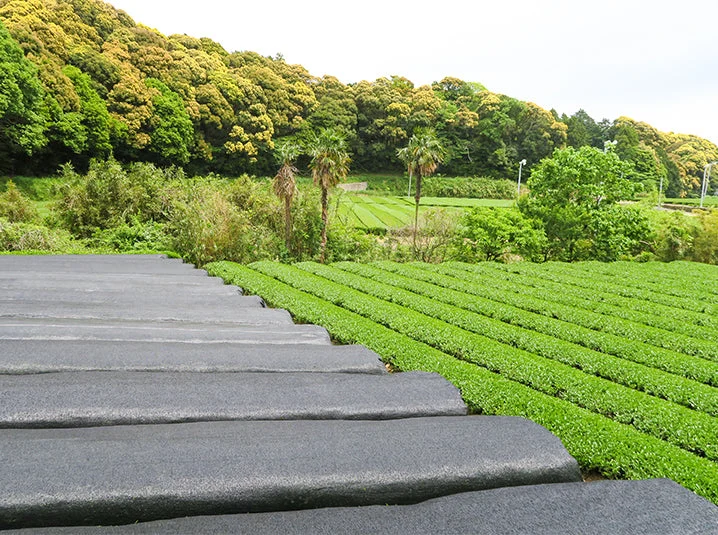
The global matcha market hit roughly $4.2 billion in 2025 and is growing at 7–12% annually depending on the analyst. But the headline number that matters for buyers is this: Kyoto’s Uji tencha auction price jumped 116% year-over-year in 2025 (rising from ¥20,024/kg to ¥43,330/kg), and Japan’s hand-picked tencha volume from Uji fell 40% in a single harvest season.
Three forces are colliding at once:
- Supply contraction. Record heat stress in Kyoto during 2024, a structural decline in tea cultivators (down from 54,000+ in 2000 to roughly 12,000 nationally by 2025), and rising domestic consumption in Japan are all squeezing export volumes.
- Demand expansion. RTD matcha beverages, supplement formulations, and foodservice adoption continue to grow, with consumer interest in matcha rising approximately 19% year-over-year in North America (Tastewise, 2025).
- Quality inflation. More brands are claiming “ceremonial grade” without standardized definitions, making independent quality assessment critical for B2B buyers.
The bottom line: If you’re sourcing matcha at scale, the playbook from two years ago — find a Japanese supplier, compare two quotes, pick the cheaper one — no longer works. You need a structured approach.
How to Choose a Matcha Supplier: 12-Point Evaluation Framework
After analyzing dozens of supplier relationships across the B2B matcha space, we’ve identified the criteria that actually predict whether a supplier will deliver consistent quality at a fair price. Here’s the framework we use:
Tier 1 — Non-Negotiables (must pass all four)
- Certificate of Analysis (COA) with every batch. Not a one-time lab report from 2023 — batch-specific COA covering L-theanine content, heavy metals (lead, cadmium, arsenic), pesticide residues, and microbial testing (TPC, coliform, Salmonella). If a supplier can’t provide this, walk away.
- Traceability to farm or cooperative. Can the supplier tell you exactly which farm grew the tencha? “Sourced from Japan” is not traceability. “Sourced from Uji cooperative X, harvest date Y” is.
- Steam sterilization capability. For US and EU markets, steam sterilization is non-negotiable for import compliance. It adds roughly ¥500–1,000/kg to costs but is required for food safety clearance. Ask about this early.
- Verified certifications. USDA Organic, EU Organic, JAS, HACCP, FSSC 22000, Kosher, Halal — whichever apply to your market. Request copies of current certificates, not expired ones.
Tier 2 — Quality Indicators
- Sample before you commit. Request samples from at least 3 suppliers for the same grade, then run them through a side-by-side evaluation (see our testing protocol in the Quality section below).
- Shade-growing documentation. Premium matcha comes from shade-grown tencha for 20–30+ days before harvest. Suppliers who can document this are more likely to deliver consistent quality.
- Particle size specification. Standard stone-milled matcha targets 5–10 microns. Air-jet milled can be finer but produces different mouthfeel. Ask for particle size distribution data.
- Freshness dating. Matcha degrades faster than most buyers realize. Ask for harvest date AND milling date, not just packaging date.
Tier 3 — Business Reliability
- MOQ flexibility. A good supplier offers tiered MOQs (100 kg for samples/trials, 500 kg for standard orders, 5,000+ kg for volume pricing).
- Lead time transparency. Post-shortage, Japanese ceremonial grades can take 8–16 weeks. Suppliers who give honest lead times are more trustworthy than those who promise “2 weeks.”
- Storage and logistics capability. Tencha should be refrigerated at 0–10°C pre-milling (long-term stock may be frozen at -20°C). Matcha powder needs light-proof, oxygen-barrier packaging. Does the supplier have cold chain capability?
- Communication responsiveness. Test this during the quoting phase. If they take a week to respond to a sample request, expect worse during production.
Matcha Grades: What B2B Buyers Actually Need to Know
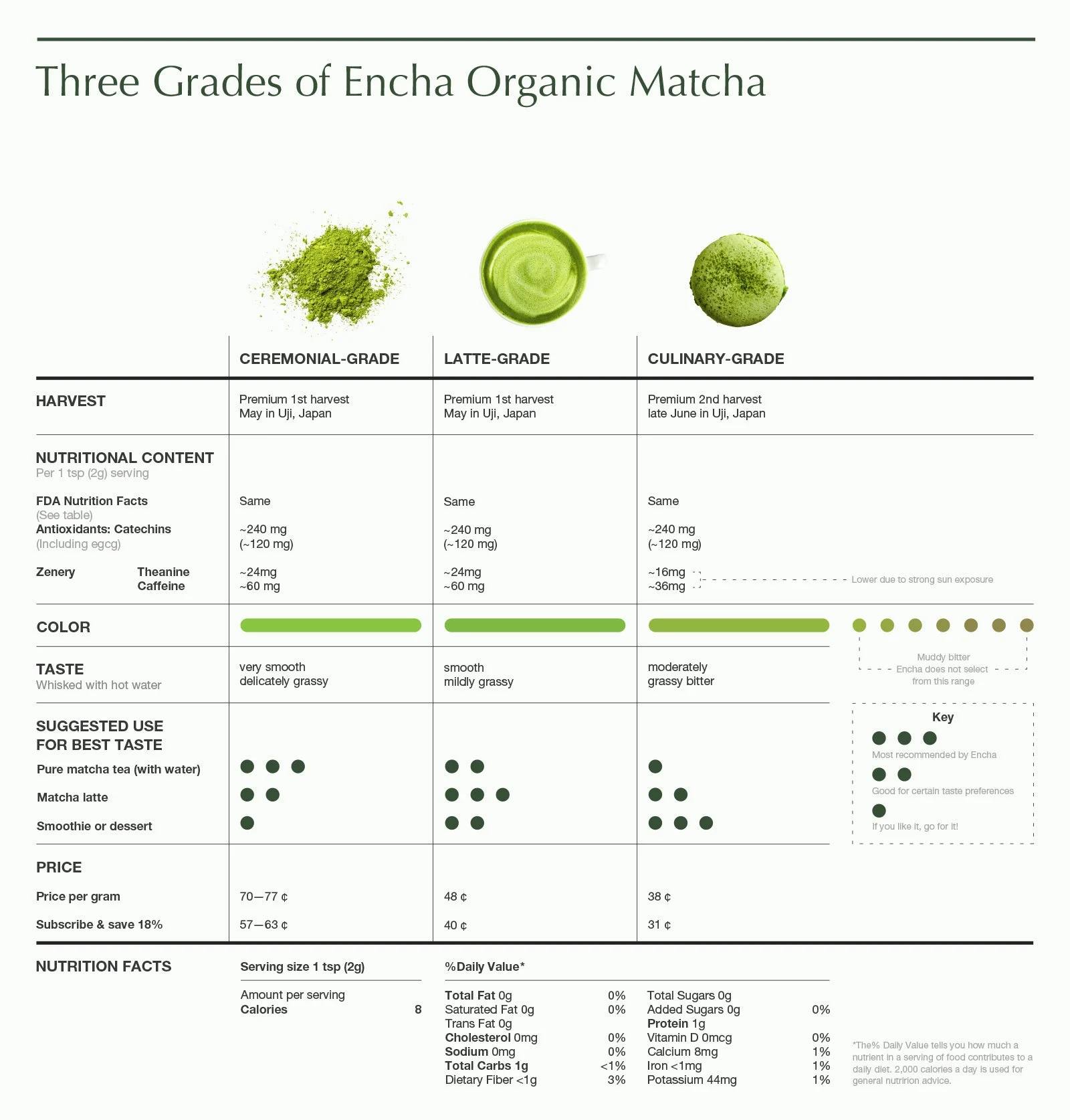
There is no universal standard for matcha grading. This is the single biggest source of confusion in B2B sourcing. One supplier’s “ceremonial grade” might be another’s “premium latte grade.” Here’s how to cut through the marketing:
The Four Practical B2B Grades
| Grade | What It Is | Typical Use | Japan Price (FOB, $/kg) | China Price (FOB, $/kg) |
|---|---|---|---|---|
| Ceremonial | First-flush, stone-milled, shade-grown 30+ days, vibrant green, umami-rich | Premium retail, matcha bars, high-end foodservice | $100–$300 (standard); $300–$600+ (heritage) | $30–$80 |
| Premium/Latte | Blended first-flush, good color and flavor, slightly less umami | Café lattes, premium RTD, ice cream, desserts | $40–$120 | $15–$40 |
| Culinary | Second-flush or blend, stronger bitter notes, good color | Baking, confectionery, blended beverages, cooking | $25–$70 | $5–$20 |
| Industrial | Lower grade, may include stem/leaf, focus on function over flavor | Supplements (capsules, powders), large-scale food manufacturing | $20–$40 | $3–$10 |
Critical caveat: These price ranges reflect 2026 market conditions after significant inflation. In 2023, standard Japanese ceremonial grades were roughly $80–$120/kg. The supply shortage has driven prices up substantially, with heritage and competition-grade matcha now exceeding $600/kg.
Objective Quality Metrics (Beyond Marketing Claims)
When a supplier says “ceremonial grade,” verify with these measurable indicators:
- Color: Premium matcha measures L* (lightness) of 40–55 and a* (green-red axis) of -8 to -14 on a colorimeter. Brownish or yellowish tones indicate older tea or poor storage.
- L-Theanine content: Matcha generally contains 1–2% L-theanine by dry weight, with ceremonial grades at the higher end of this range. Request lab results — this is one of the most reliable indicators of shade-growing quality.
- Particle size: Stone-milled matcha: 5–10 microns. Air-jet milled: 3–8 microns. Coarser particles (>15 microns) indicate lower-grade processing.
- Catechin/EGCG content: Higher grades have more balanced catechin profiles. Excessively high EGCG with low L-theanine suggests non-shade-grown material.
Our recommendation: Don’t rely on grade labels alone. Request the actual lab data and evaluate against these benchmarks.
Japan vs. China Matcha: An Honest Comparison
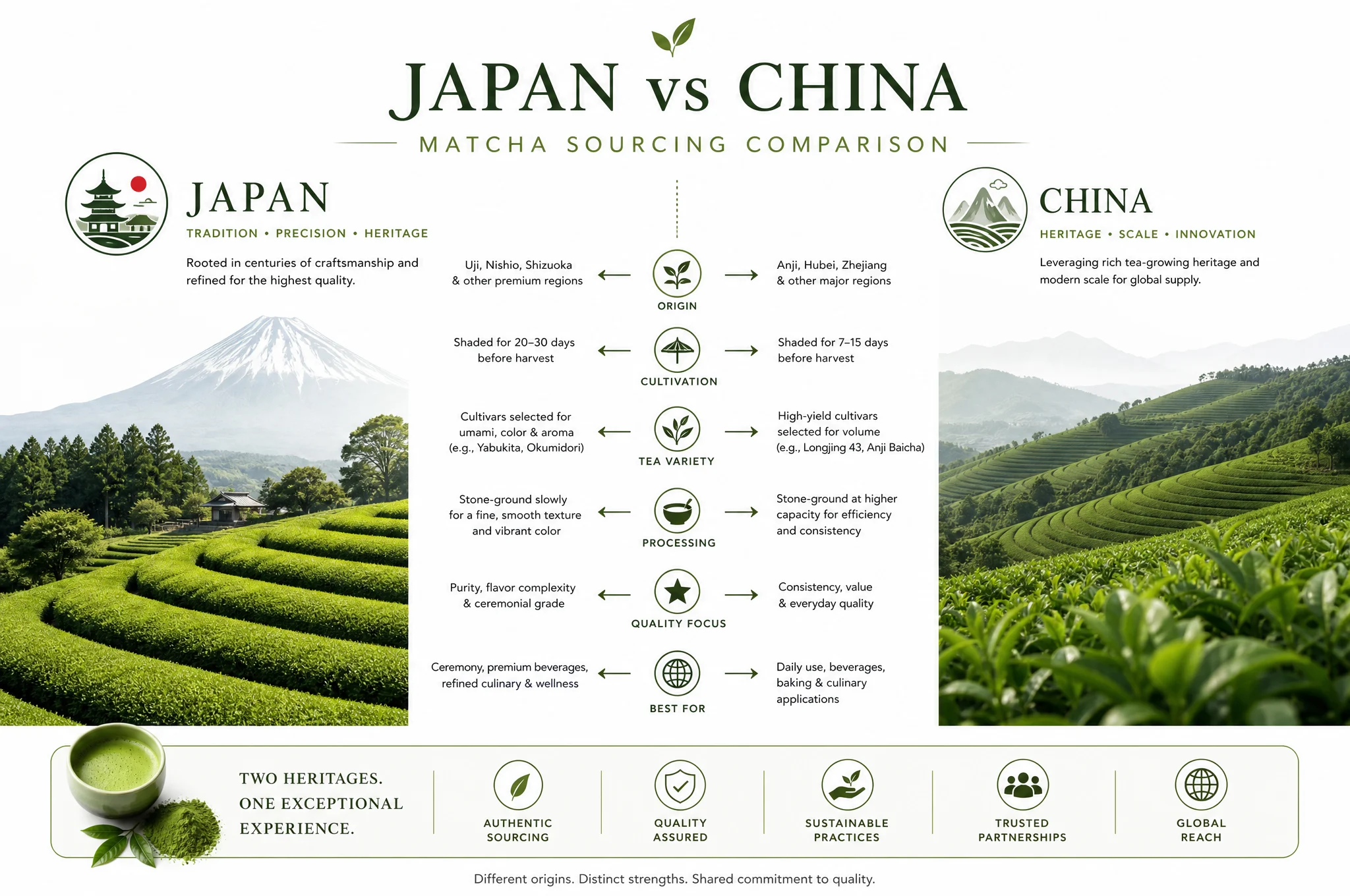
This is the question we get most from buyers, and the answer is more nuanced than “Japan is better.”
Quality Comparison
| Factor | Japan | China |
|---|---|---|
| Flavor profile | Rich umami, smooth, less bitter | More vegetal, sometimes astringent |
| Color | Vibrant emerald green | Green but often lighter/duller |
| Shade growing | Standard practice (20-30+ days) | Increasingly adopted, but not universal |
| Stone milling | Traditional and common | Less common; more air-jet |
| Organic certification | JAS (strict, limited farms) | China Organic (growing, less stringent) |
| Traceability | Farm-level common | Cooperative-level at best |
| Price | Premium | 70–80% cheaper |
When China Makes Sense
- Industrial/supplement applications where flavor is masked and cost per unit matters most
- Large-volume culinary for food manufacturing where budget constraints are tight
- New product testing where you need to validate market demand before committing to premium pricing
- Price-sensitive markets in Southeast Asia, Latin America, or emerging regions
When Japan Is Worth the Premium
- Ceremonial/premium retail where taste and brand story are selling points
- Café latte programs where matcha flavor is front-and-center
- Supplement brands marketing “Japanese origin” as a quality differentiator
- Export to EU/US where supply chain traceability expectations are higher
The hybrid approach: Many sophisticated buyers source Japanese matcha for their premium line and Chinese matcha for their value/culinary line, maintaining separate quality protocols for each.
Matcha Pricing Deep Dive: What You’ll Actually Pay
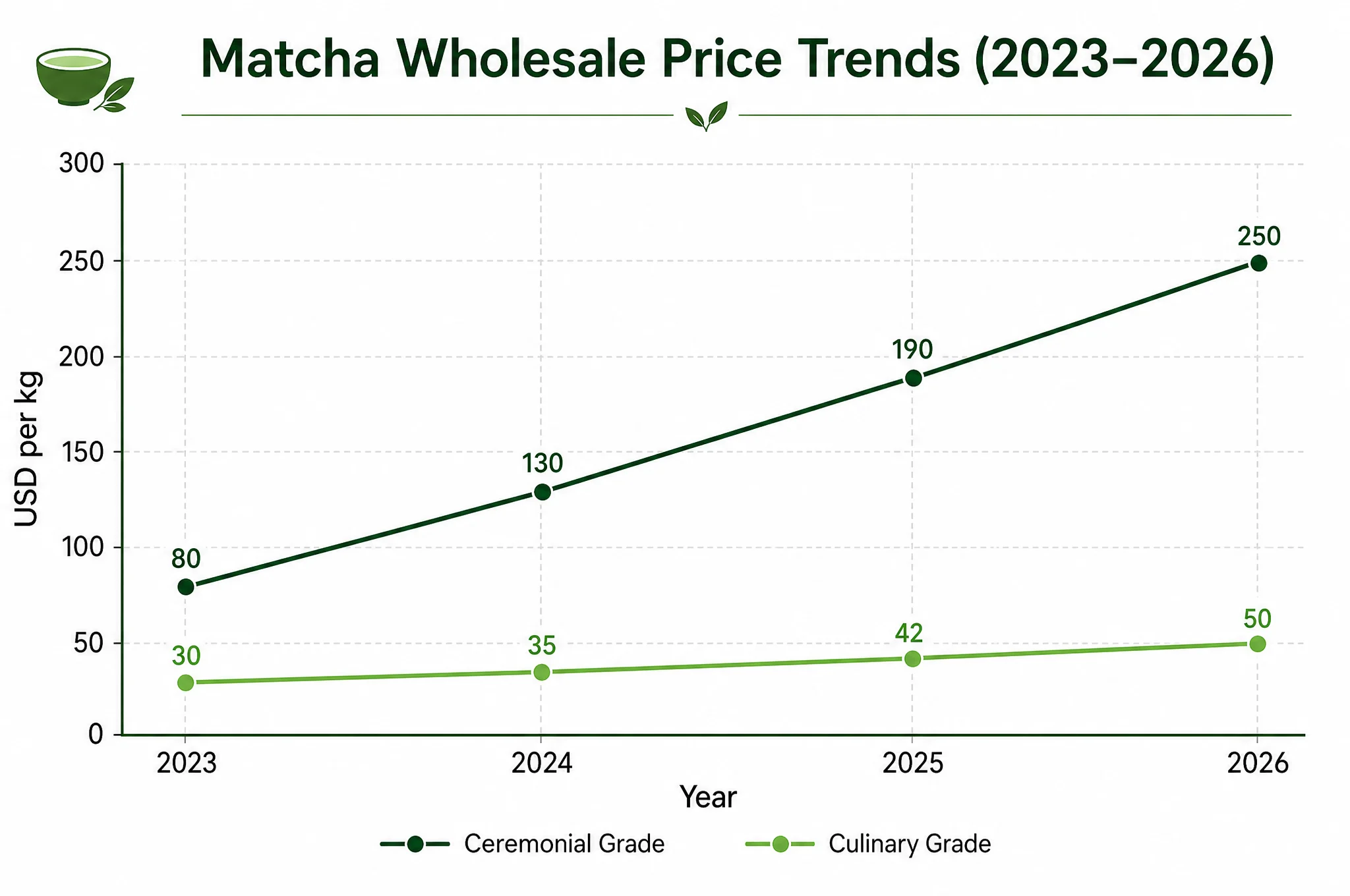
Pricing in the matcha market is opaque by design. Here’s the most transparent breakdown we can offer based on 2026 market data:
Japan Sourcing — Total Landed Cost (to US)
| Cost Component | Ceremonial ($/kg) | Culinary ($/kg) |
|---|---|---|
| FOB Japan | $130–$280 | $30–$65 |
| Steam sterilization | $0.40–$0.80 | $0.40–$0.80 |
| Air freight (Japan → US) | $5–$10 | $5–$10 |
| Sea freight (alternative) | $1–$2 | $1–$2 |
| US customs + FDA | $0.50–$1.50 | $0.50–$1.50 |
| Cold storage (US) | $0.30–$0.80/month | $0.30–$0.80/month |
| Estimated landed cost | $137–$295 | $37–$80 |
China Sourcing — Total Landed Cost (to US)
| Cost Component | Ceremonial ($/kg) | Culinary ($/kg) |
|---|---|---|
| FOB China | $30–$80 | $5–$20 |
| Steam sterilization | $0.30–$0.60 | $0.30–$0.60 |
| Sea freight (China → US) | $0.50–$1.50 | $0.50–$1.50 |
| US customs + FDA | $0.50–$1.50 | $0.50–$1.50 |
| Estimated landed cost | $31–$84 | $7–$24 |
Price Red Flags
- Ceremonial grade below $100/kg (Japan): Almost certainly not true ceremonial grade. Likely machine-picked, lower shade period, or blended.
- Culinary grade below $25/kg (Japan): May indicate old stock, poor storage, or adulteration.
- “Ceremonial grade” from China at $10–$15/kg: Marketing term only. Real quality differences exist at this price point.
- No price increase since 2023: Either the supplier locked in old contracts (good) or they’re not buying at current market prices (suspicious).
Quality Testing Protocol: How to Evaluate Matcha Before You Commit
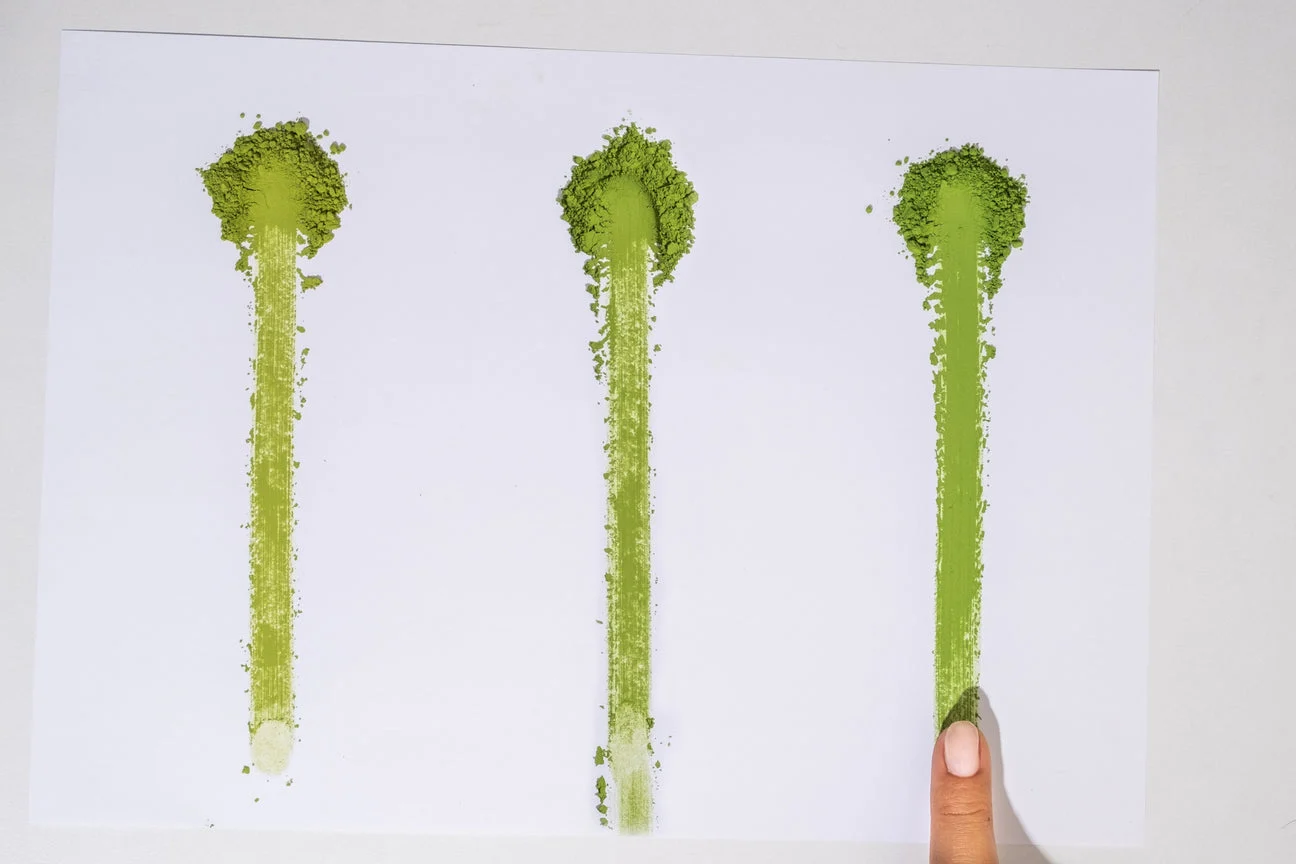
Don’t trust labels. Here’s a practical 3-step testing protocol we recommend for any serious B2B buyer:
Step 1: Sensory Evaluation (In-House, Day 1)
Perform this with your team using a standardized approach:
- Visual inspection: Color should be vibrant green. Brown/yellow = old or poor quality.
- Aroma test: Premium matcha smells like fresh-cut grass with sweet, marine notes. Musty or hay-like = storage issues.
- Taste evaluation: Prepare 2g matcha in 70ml water at 80°C. Score on umami (1-5), sweetness (1-5), bitterness (1-5), and overall smoothness (1-5).
- Color in liquid: Dissolved matcha should be opaque, deep green. Transparent or brownish = low quality.
Step 2: Lab Testing (Third-Party, Week 2-4)
Send samples to an accredited lab for:
- Heavy metals: Lead (<0.5 mg/kg), cadmium (<0.3 mg/kg), arsenic (<0.3 mg/kg)
- Pesticide residues: Full panel per your destination market (FDA, EU MRLs, or JAS)
- Microbiology: TPC, coliform, E. coli, Salmonella
- Nutritional verification: L-theanine %, catechin profile, caffeine content
- Moisture content: Should be <6% for shelf stability
Step 3: Compliance Verification (Week 4-6)
- Verify all certifications are current and valid
- Confirm steam sterilization has been performed (critical for US/EU import)
- Review allergen statements and dietary compliance (gluten-free, vegan, etc.)
- Request references from existing B2B clients in your industry
Estimated cost for full testing: $200–$500 per sample from an accredited lab. This is a negligible investment compared to a $10,000+ order of substandard product.
MOQ and Order Size: What Suppliers Actually Require
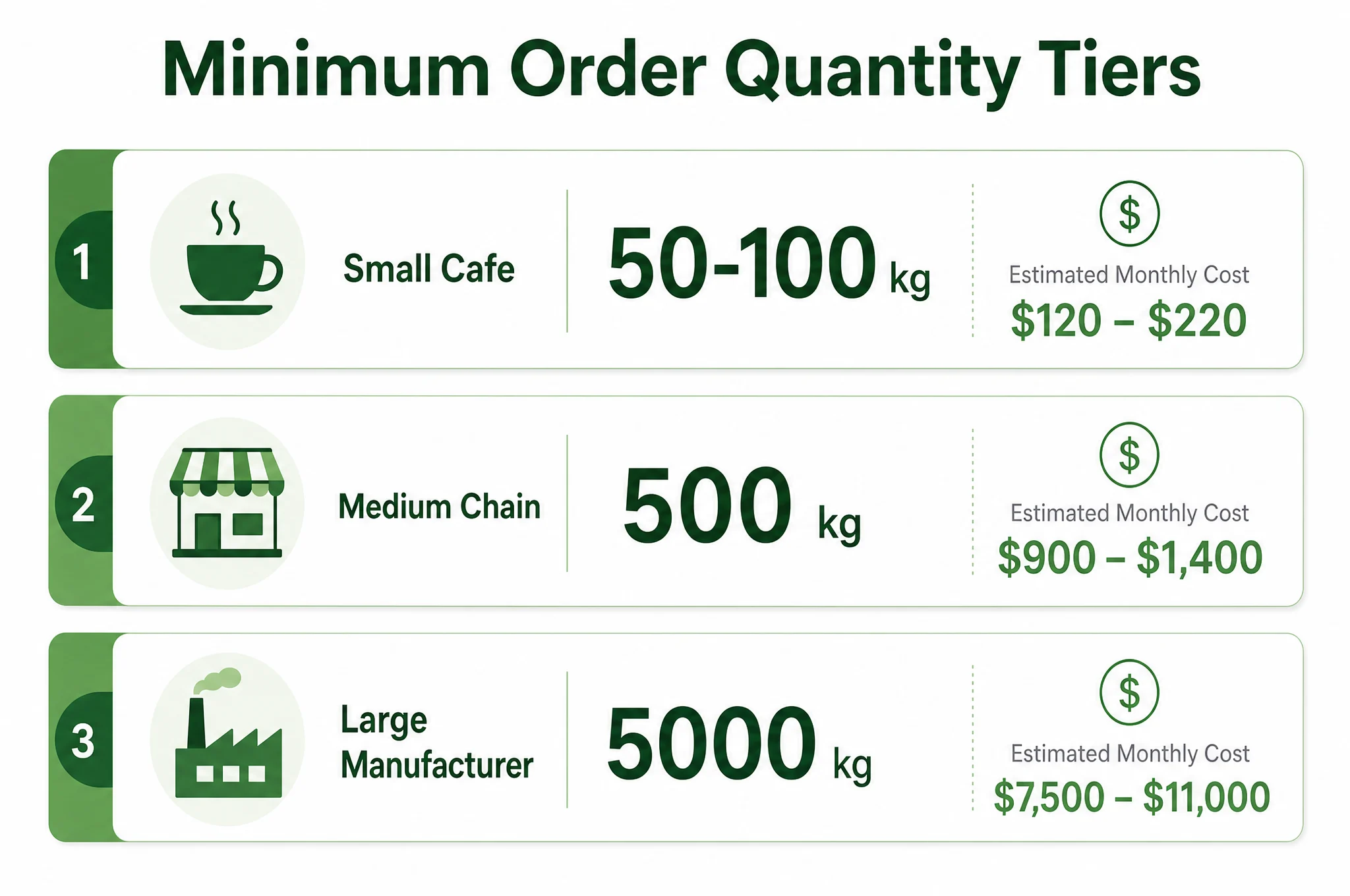
| Business Type | Typical Monthly Need | Recommended MOQ Tier | Estimated Monthly Cost |
|---|---|---|---|
| Single café / small foodservice | 5–20 kg | 50–100 kg trial order | $200–$2,000 |
| Café chain (5-20 locations) | 50–200 kg | 100–500 kg standard | $5,000–$25,000 |
| RTD beverage manufacturer | 500–5,000 kg | 500–2,000 kg contract | $25,000–$150,000 |
| Private label brand | 100–1,000 kg | 100–500 kg initial, scaling | $5,000–$50,000 |
| Supplement manufacturer | 1,000–10,000 kg | 1,000–5,000 kg contract | $30,000–$200,000 |
Negotiation tips:
- Start with a trial order (50–100 kg) to validate quality before committing to volume
- Many suppliers offer 5–15% volume discounts at 1,000+ kg
- Annual contracts can lock in pricing and guarantee supply — particularly valuable in the current shortage
- Ask about payment terms: 30% deposit + 70% before shipping is standard; Net 30/60 terms are available for established relationships
Matcha Import Regulations: US and EU Basics
Non-compliance at customs can mean destroyed product, fines, and months of delay. Here’s what you need to know:
United States
- FDA registration required for food facility importing into the US
- Prior Notice must be filed before shipment arrival
- FSVP (Foreign Supplier Verification Program) applies to all food imports
- Heavy metal testing — no specific limit under 21 CFR for tea, but FDA can act against adulterated products; industry benchmark: California Prop 65 Maximum Allowable Dose Level (MADL) for lead of 0.5 micrograms/day exposure
- Organic claim requires USDA NOP certification
European Union
- EU Food Import Regulation requires documentation of food safety compliance
- Pesticide MRLs are stricter than US/Japan; default limit of 0.01 mg/kg for unlisted substances
- EU Organic (Regulation 2018/848) required for organic labeling claims
- Allergen labeling under EU Regulation 1169/2011
Japan (for re-export)
- JAS certification for organic claims
- Positive List System for pesticide residues under the Food Sanitation Act
- Steam sterilization is expected for export-grade matcha
Storage and Logistics: Protecting Your Investment
Matcha is one of the most delicate powders in the food industry. Poor storage can destroy a $50/kg product in weeks.
Pre-Milling (Tencha)
- Temperature: 0°C to 10°C (refrigerated); -20°C for long-term storage
- Humidity: <60% RH
- Light: Complete darkness
Post-Milling (Matcha Powder)
- Temperature: Refrigerated (2–8°C) or frozen (-18°C for long-term)
- Packaging: Nitrogen-flushed, light-proof, oxygen-barrier pouches
- Shelf life: 6–12 months frozen; 4–6 weeks once opened at room temperature
- Light exposure: UV and visible light degrade chlorophyll and L-theanine rapidly
Shipping Recommendations
- Air freight (3–7 days, $5–$10/kg): Best for premium/ceremonial grades where freshness matters
- Sea freight, reefer container (30–60 days, $1–$2/kg): Acceptable for culinary/industrial grades if temperature-controlled
- Sea freight, dry container (30–60 days, $0.50–$1/kg): High risk — only for non-temperature-sensitive industrial applications
Red Flags: When to Walk Away from a Matcha Supplier
Based on patterns we’ve seen across failed supplier relationships:
- No batch-level COA available. “We can provide one if you ask” is not the same as “we include one with every shipment.”
- Price significantly below market. If Japanese ceremonial is offered at $60/kg when the market starts at $100+, something is wrong.
- No traceability beyond “Japan.” Legitimate suppliers can name the region, cooperative, and ideally the farm.
- Pressure to commit to large orders immediately. Good suppliers encourage trial orders first.
- Expired certifications. Check dates on all organic, HACCP, and FSSC certificates.
- Unwilling to provide references. Established B2B suppliers have happy clients they can connect you with.
- Vague answers about shade-growing period. “We do shade growing” without specifics (days, method) is a red flag.
- No food safety system. HACCP or FSSC 22000 certification is table stakes for serious B2B supply.
Frequently Asked Questions
How much does bulk matcha cost per kg in 2026?
Japanese ceremonial grade: $100–$300/kg FOB (standard), up to $600+ for heritage grades. Japanese culinary grade: $25–$70/kg FOB. Chinese ceremonial equivalent: $30–$80/kg. Chinese culinary: $5–$20/kg. These prices reflect the significant supply-driven increases since 2023; always confirm current pricing directly with suppliers.
What is the minimum order quantity for wholesale matcha?
Most B2B suppliers offer tiered MOQs: 50–100 kg for trial/sample orders, 100–500 kg for standard orders, and 1,000–5,000+ kg for volume pricing. Some suppliers offer as low as 10–20 kg for initial quality validation.
Where do cafes buy their matcha in bulk?
Cafes typically source from specialized B2B matcha wholesalers (not retail brands), foodservice distributors, or directly from Japanese/Chinese producers through import agents. The most common approach for mid-size cafes is 100–500 kg orders from a wholesale supplier with cold-chain logistics.
How do I know if matcha is truly ceremonial grade?
Request lab results for L-theanine content (generally 1–2% of dry weight, highest in ceremonial grades), verify shade-growing period (30+ days), check particle size (5–10 microns for stone-milled), and perform sensory evaluation. Grade labels alone are unreliable — always verify with data.
What certifications do I need to import matcha into the US?
FDA facility registration, Prior Notice filing, FSVP compliance, and state-specific requirements. For organic claims, USDA NOP certification is required. HACCP or FSSC 22000 is expected by major retailers and foodservice chains.
Is Japanese or Chinese matcha better for my business?
It depends on your application and budget. Japanese matcha excels in premium retail, café lattes, and products where “Japanese origin” is a selling point. Chinese matcha offers 70–80% cost savings and works well for industrial applications, supplements, and budget-conscious food manufacturing. Many successful brands use both.
How long does bulk matcha last?
Frozen storage: 12–18 months from milling date. Refrigerated: 6–12 months. At room temperature: 4–6 weeks after opening. Always ask for milling date, not just packaging date. Matcha degrades through oxidation — light, heat, and air are the enemies.
What is the difference between stone-milled and air-jet milled matcha?
Stone milling produces 5–10 micron particles with a traditional, smoother mouthfeel. Air-jet milling can achieve finer particles (3–8 microns) at higher throughput but can generate heat that affects flavor. For premium products, stone-milled is preferred. For industrial applications, air-jet is more cost-effective.
Summary
Sourcing bulk matcha in 2026 requires more diligence than ever. The supply shortage has created both risk (rising prices, potential quality compromises) and opportunity (suppliers who maintain quality will stand out). The buyers who succeed will be those who verify quality with data, not labels; negotiate with market knowledge, not guesswork; and build supplier relationships based on transparency and mutual accountability.
The framework in this guide — from the 12-point supplier evaluation to the 3-step testing protocol — is designed to give you exactly the kind of leverage you need. Start with a trial order, validate quality in-house and through third-party labs, and scale only when the data supports it. The matcha market is growing fast enough that the right supplier relationship can power your business for years.