
Wholesale matcha MOQ ranges from zero (some US-warehoused suppliers require no minimum) to 25 kg+ for farm-direct Japanese sources. For small cafés and brands, the practical range is 50 g to 1 kg — accessible through importers and distributors who break bulk. This guide covers the MOQ landscape by grade and supplier type, real landed-cost math, a supplier vetting checklist, and which certifications actually matter before you commit to a larger order.
What “MOQ” Actually Means in the Matcha Supply Chain
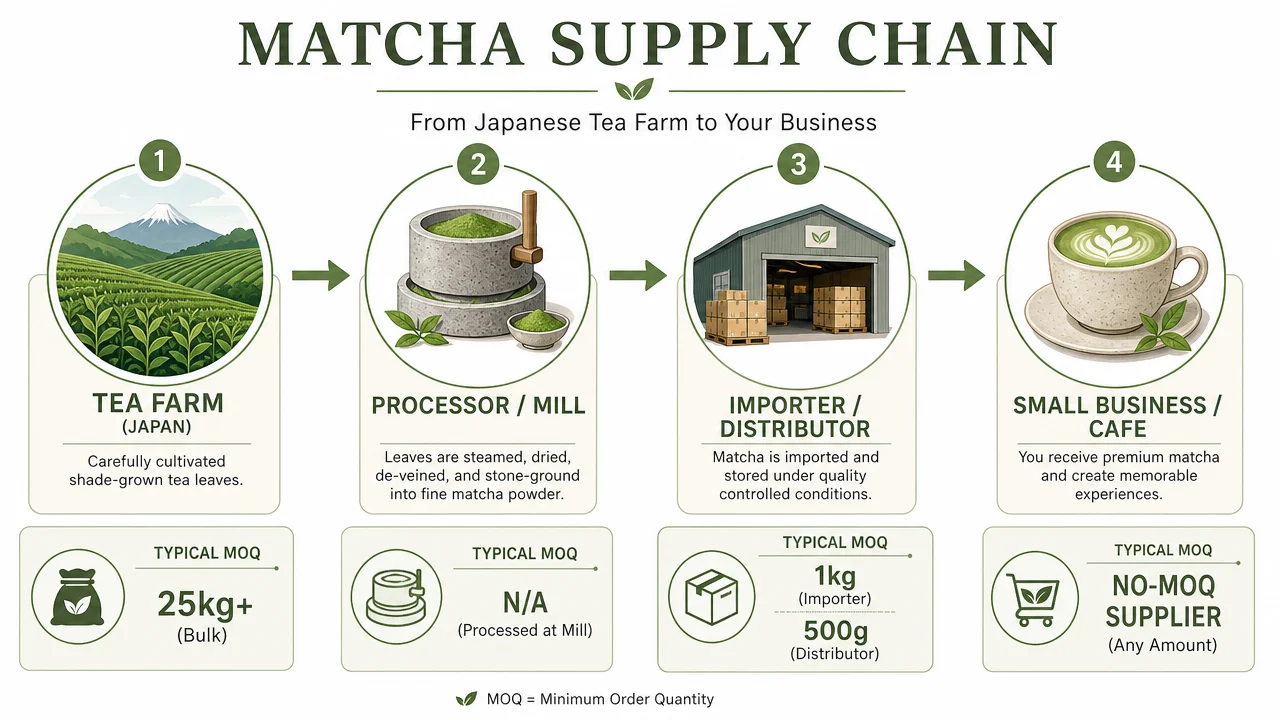
MOQ — minimum order quantity — is the smallest amount a supplier will sell in a single transaction. In the matcha world, it’s almost always quoted in grams or kilograms, and it varies enormously depending on the supplier’s position in the supply chain.
A tea farm in Uji, Japan, selling direct might require 25 kg as their floor because that’s one processing batch. An importer-distributor in the US or EU might accept 1 kg because they’re already breaking bulk. A broker running a sample program might ship you 100 g for testing purposes.
The MOQ you negotiate reflects where the supplier sits in the chain — not just their willingness to work with small buyers.
Understanding this prevents a common mistake: contacting a Japanese farm directly and expecting café-friendly quantities. Their economics don’t work that way. You need the right tier of supplier for your volume.
Matcha Grade × MOQ: The Matrix That Actually Matters
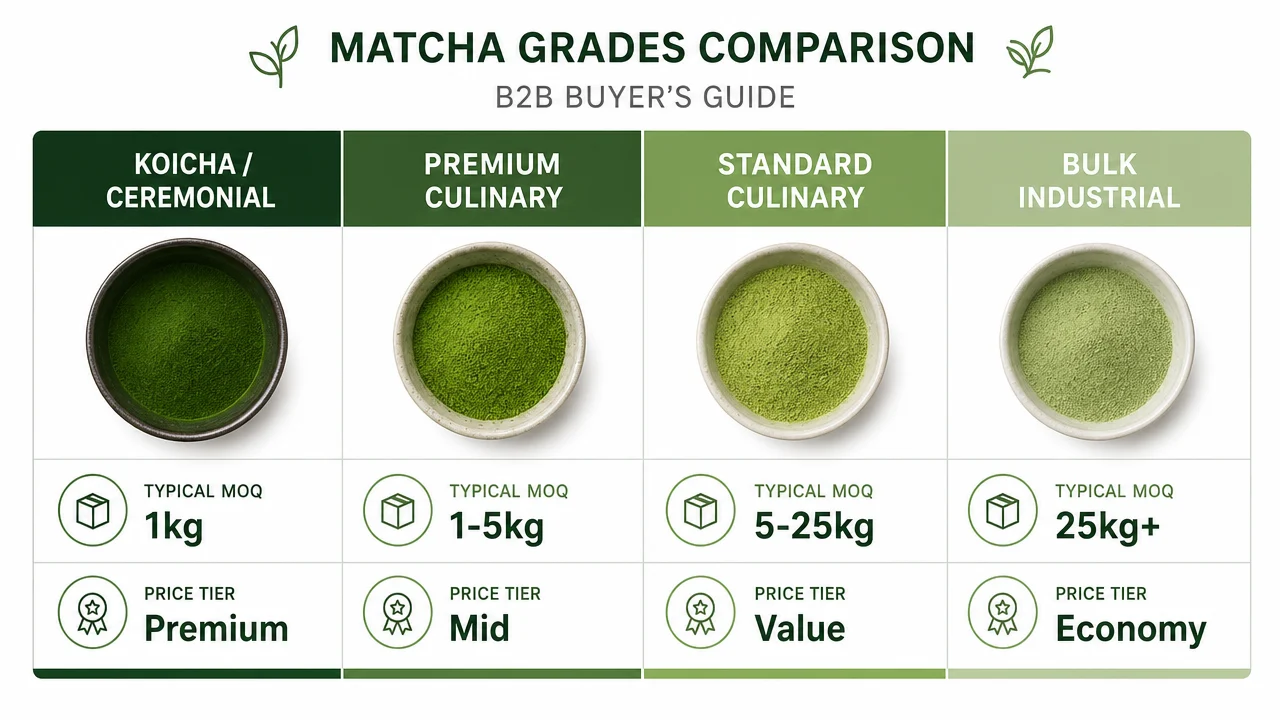
Not all matcha grades have the same MOQ dynamics. Here’s the practical breakdown:
| Grade | Typical Use | Common MOQ Range | Price Range (per kg) |
|---|---|---|---|
| Ceremonial (single-origin, shade-grown 20–30 days) | Whisked matcha, tea ceremonies | 100 g – 1 kg | $80–$200/kg wholesale |
| Premium culinary (café-grade) | Lattes, bakery, food service | 500 g – 5 kg | $40–$100/kg |
| Standard culinary | Baking, ice cream, mass food production | 1 kg – 25 kg | $15–$45/kg |
| Bulk/industrial | Food manufacturing, supplements | 25 kg+ | $8–$20/kg |
A few things stand out from this:
Ceremonial grade has the lowest MOQ options because it’s the most expensive. Suppliers can afford to ship 100 g samples at $12–$40 because the per-unit value is high. Culinary grade suppliers need you to order more volume to make shipping economics work.
If you’re a café making matcha lattes, you don’t need ceremonial grade — and ordering it at 100 g MOQ for daily service use will eat your margins. Premium culinary at 1–2 kg MOQ is almost always the right call.
Where to Actually Find Low-MOQ Matcha Suppliers
There are four reliable channels, each with different MOQ floors:
1. Japan-Based Importers with US/EU Presence
These companies source directly from Japanese farms and often maintain a US or international base, so they can fulfill smaller orders with reasonable lead times. Transparency markers to look for: named sourcing region (Uji, Yame, Nishio, Iga), named cultivar, and a stated harvest or production date.
MOQ range: 1 kg (some offer 20 g samples per SKU before committing)
Sample programs: Typically 20–50 g per product at low cost
One concrete example: UnD (based in Japan and New York) offers 1 kg MOQ across their full range — from ceremonial koicha grades to premium culinary — with 20 g samples available per product. Their matcha is produced after order placement and packed in Japan, which keeps it fresh. Aiya (Nishio origin) similarly serves cafés and food-service buyers with culinary-focused wholesale programs.
2. White-Label / Private Label Matcha Suppliers
These suppliers sell unbranded matcha that you can repack under your own brand. They’re built for small business buyers and typically have the most flexible MOQ structures.
MOQ range: 1 kg – 5 kg (some as low as 500 g for established clients)
Lead time: 2–4 weeks for custom packaging
The tradeoff: You get lower MOQ and branding flexibility, but you’re often buying from a blender, not a single farm. Batch-to-batch consistency depends heavily on the supplier’s quality control.
3. Alibaba / Global Sources (Chinese Suppliers)
Chinese matcha — primarily from Zhejiang province — is significantly cheaper per kilogram and often has very low MOQs (100 g+). The concern is quality and safety: lead content in Chinese matcha can be higher than Japanese matcha due to soil composition and farming practices.
MOQ range: 100 g – 1 kg (extremely flexible)
Price: $5–$25/kg
My honest take on Chinese matcha: If you’re using it in a recipe where it’s a minor ingredient (say, matcha cookies where the flavor is subtle), well-tested Chinese culinary grade can work. If you’re serving it as whisked ceremonial matcha or as the hero flavor in a latte, the color, flavor, and customer perception gap versus Japanese matcha is real. Always request a Certificate of Analysis (CoA) showing heavy metal testing before ordering.
4. US-Warehoused Suppliers (Zero or Near-Zero MOQ)
A smaller category, but worth knowing about: some suppliers maintain US warehouse stock and have no formal MOQ requirement. bulk.matcha.com is one example — they ship directly from a US location with no minimum order, which removes the import/shipping math entirely for domestic buyers.
The tradeoff: selection is usually narrower, origin transparency is sometimes limited, and pricing per kilogram may not be as competitive as direct-import options once you scale above 5 kg/month.
MOQ range: No minimum — order exactly what you need
Best for: Cafés in early testing phase, event buyers, small retail shops
5. Specialty Tea Distributors
Regional distributors often carry 3–8 matcha SKUs and accept orders as low as 500 g per item. They’re not the cheapest option per kilogram, but they offer consolidated shipping if you’re sourcing multiple teas, and their reliability is typically higher than direct-from-China options.
MOQ range: 500 g – 2 kg per SKU
The Sample-First Strategy: How to Vet Quality Before You Commit
The single biggest mistake small buyers make is skipping the sample stage. A 500 g order of bad matcha is annoying. A 5 kg order is expensive. A 25 kg order is a crisis.
Here’s a practical vetting process:
Step 1: Request a sample (not just a taste)
Ask for 30–100 g of the specific lot you’d be ordering from. Specify grade and intended use. A good supplier will send it; a supplier who resists should be a red flag.
Step 2: Check color first
High-quality matcha should be vivid, bright green — almost neon. Dull, yellowish, or brownish matcha indicates old stock, poor shading, or low-grade leaf. This is the fastest quality filter.
Step 3: Taste it neat
Whisk 1 g in 70–80°C water (not boiling — boiling water destroys delicate flavor compounds). High-quality matcha has umami depth and mild sweetness. Bitterness alone, without sweetness or umami, suggests low-grade or stale product.
Step 4: Ask for documentation
Request the Certificate of Analysis (CoA) for the batch. It should include:
- Pesticide residue levels (below EU/USDA limits)
- Heavy metals (lead, cadmium, arsenic)
- Microbial testing
- Moisture content
Any supplier unwilling to share a CoA on request is not a supplier you want.
Step 5: Check the harvest date, not just “best by”
Fresh matcha has a harvest date (typically spring — April/May first flush, or summer second flush). Best-by dates tell you shelf life from a given point; harvest dates tell you how fresh it actually is. For ceremonial grade, aim for matcha harvested within 12 months.
Certifications That Actually Matter (and One That Doesn’t)
Matcha buyers often get confused by the certification landscape. Here’s what to actually pay attention to:
JAS Organic (Japan Agricultural Standard) — the most relevant certification for Japanese matcha. If a supplier claims their matcha is Japanese and organic, JAS certification is what you want to see. USDA Organic or EU Organic can be additional layered certifications on top.
USDA Organic / EU Organic — required if you’re selling in the US or EU market and want to make organic claims on packaging. Note: a matcha can be JAS Organic in Japan but not USDA Organic unless separately certified.
ISO 22000 / FSSC 22000 — food safety management certifications for the processing/packaging facility. More relevant for food manufacturers than café buyers, but it’s a signal of operational maturity.
“Natural” or “Pure” claims — these are marketing terms with no regulatory teeth. Ignore them without documentation backing.
Real Cost Breakdown: What Small-Batch Orders Actually Cost
Let me be specific, because vague ranges don’t help buyers make decisions.
For a café ordering 2 kg of premium culinary matcha per month:
| Cost element | Estimate |
|---|---|
| Product cost (premium culinary, Japan-origin) | $60–$90/kg → $120–$180 |
| International shipping (Japan to US, 2 kg) | $25–$45 |
| Import duty (US: 6.4% on tea from Japan) | $8–$12 |
| Total landed cost | $153–$237 for 2 kg |
| Per-serving cost (3 g per latte) | ~$0.23–$0.36 per serving |
If you’re charging $6–$8 for a matcha latte, this cost structure works comfortably. If you move to 5 kg/month, economies of scale start improving your per-kg cost by 15–25% through lower per-unit shipping and volume pricing.
The math for scaling: Most suppliers offer meaningful price breaks at 5 kg, 10 kg, and 25 kg. If your monthly volume is approaching 3–4 kg consistently, it’s worth negotiating a 5 kg standing order to lock in the next price tier.
7 Questions to Ask Before Placing Any Wholesale Matcha Order
Before you commit to a supplier, get answers to these:
1. What is the harvest date of the current lot?
You want spring harvest (April–May), ideally within the past 12 months for ceremonial grade.
2. Can you provide a Certificate of Analysis (CoA) for this batch?
Non-negotiable. If they hesitate, walk away.
3. What is your MOQ for repeat orders vs. first orders?
Some suppliers have lower MOQs for first orders to earn your business, then require higher minimums on subsequent orders.
4. How is the matcha packaged and shipped for freshness?
Nitrogen-flushed, vacuum-sealed packaging in opaque foil bags is the gold standard. Matcha oxidizes quickly when exposed to oxygen and light.
5. What is your lead time from order to delivery?
Critical for café inventory planning. Japan to US typically takes 1–3 weeks depending on shipping method.
6. Do you offer custom packaging or private label?
If you’re building a brand, ask this upfront — not all wholesalers do it.
7. What is your quality consistency policy?
Ask specifically: “What happens if I receive a batch that’s noticeably different in color or flavor from the previous one?” Good suppliers have a documented process; suppliers without one are a risk.
Common Mistakes Small Buyers Make (And How to Avoid Them)
Ordering more than 3 months of supply at once. Matcha shelf life after opening is 4–8 weeks for peak quality (sealed: up to 12 months). Small buyers who buy large for price breaks often end up serving stale product by month 3.
Choosing ceremonial grade for lattes. Ceremonial grade is designed for whisking in water and drinking neat. The subtle flavor notes are mostly lost in milk. Premium culinary grade is better-suited and 2–4× cheaper.
Ignoring storage. Matcha must be stored in an airtight container, away from light, heat, and odors. In a café environment, this means a sealed container inside a refrigerator — not on an open shelf near the espresso machine.
Chasing the lowest MOQ without vetting the supplier. A 100 g MOQ from an unvetted source is a false economy if the product is inconsistent or fails safety standards.
FAQ
What is the typical MOQ for matcha wholesale?
It varies significantly by supplier type. Japanese farm-direct suppliers often require 25 kg+. Importers and distributors typically accept 500 g to 2 kg. White-label/private-label suppliers usually start at 1–5 kg. Sample programs can be as low as 30–100 g.
Can I order matcha wholesale in small quantities as a first-time buyer?
Yes. Many importers and distributors have new-buyer programs with lower first-order MOQs (500 g–1 kg) to let you test before committing. Always ask specifically about new customer terms.
What’s the difference between ceremonial and culinary grade matcha for wholesale buyers?
Ceremonial grade uses the youngest, most shaded leaves and is meant to be drunk neat, whisked in water. Culinary grade uses slightly older leaves and is designed for cooking, baking, and mixing into lattes. For most café and food-service applications, premium culinary grade is the better value.
How do I verify matcha quality before placing a bulk order?
Request a sample of the specific lot, check for vivid green color, taste it whisked in 75°C water, and always request a Certificate of Analysis (CoA) showing pesticide, heavy metal, and microbial test results.
Is Japanese matcha always better than Chinese matcha for wholesale?
Japanese matcha (especially from Uji and Nishio) is generally superior in flavor, color, and safety testing standards. Chinese matcha can be suitable for baking applications where quality differences are less perceptible, but always verify with independent lab testing due to potentially higher lead levels.
Summary
Sourcing matcha at low MOQ is completely achievable if you know where to look and what to ask. The key moves: match your grade selection to your actual use case (culinary for lattes and baking, ceremonial for tea programs), source from importers or distributors rather than direct farms when your monthly volume is under 10 kg, always run a sample before committing to bulk, and never skip the Certificate of Analysis. The suppliers worth working with long-term are the ones who share documentation without hesitation and can explain their supply chain clearly.