
A matcha Certificate of Analysis (COA) is a lab-generated document that verifies a product’s safety, purity, and quality parameters before it ships. For B2B buyers — importers, private label brands, and retailers — knowing how to read one is non-negotiable. This guide walks through every section of a matcha COA: heavy metals, pesticide residues, microbiological data, physical specs, and bioactive content (L-theanine, EGCG, caffeine). You’ll learn which numbers matter, what red flags to watch for, and how to verify that the certificate you’re holding is actually trustworthy.
What Is a Matcha COA and Why B2B Buyers Can’t Skip It
A Certificate of Analysis is a document — typically 2–6 pages — that records the results of laboratory testing on a specific batch of matcha. It tells you, in measurable terms, what is actually in the product.
Every serious matcha supplier will provide one. The question is whether theirs is worth the paper it’s printed on.
Here’s the practical problem I’ve seen repeatedly: a supplier emails over a COA, the buyer glances at it, sees “Pass” in multiple rows, and moves on. Three months later, the product fails EU customs testing for a pesticide not on the original panel, or triggers a California Prop 65 lead warning. The COA existed — it just didn’t cover what mattered.
A COA is only as useful as your ability to read it critically. This guide exists to give B2B buyers that ability.
COA vs. Quality Certificate: Not the Same Thing
Before going further, one clarification that trips up a lot of first-time importers:
- COA (Certificate of Analysis): A batch-specific lab report showing test results for a specific production lot. Numbers change lot to lot.
- Quality Certificate / Organic Certificate: A certification of process — JAS, EU Organic, USDA NOP — proving the supplier follows specific growing or processing standards. These are annual and attached to the producer, not the batch.
You need both. A COA tells you this batch is safe. An organic certificate tells you the farming system is verified. One without the other leaves a gap.
The 6 Core Panels on a Matcha COA
1. Heavy Metals Panel
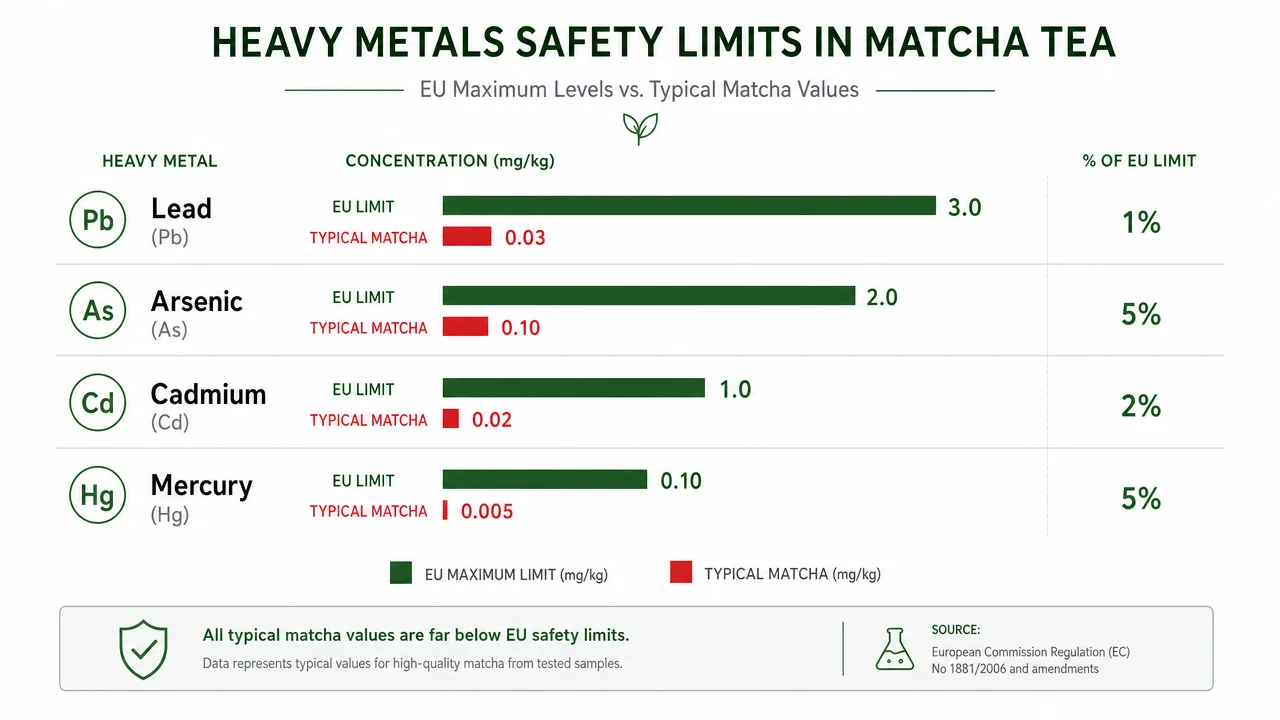
This is the highest-stakes section of any matcha COA, and the one most commonly misread.
Matcha is made from whole ground tea leaves. Unlike steeped green tea where you discard the leaves, you consume the entire leaf in powder form. That means any heavy metals absorbed by the plant during growth go directly into your product.
The four metals to check:
| Metal | EU Limit (dried tea) | Japan Limit | What to Watch |
|---|---|---|---|
| Lead (Pb) | Check EU Reg. 2023/915 annex for current tea category limit | No specific limit for tea | Most controversial for matcha |
| Arsenic (As) | No specific EU tea limit (general 0.5 mg/kg for food) | — | Inorganic arsenic is the concern |
| Cadmium (Cd) | 0.1 mg/kg (for tea-based products, per EU Reg. 2023/915) | — | Soil contamination indicator |
| Mercury (Hg) | 0.1 mg/kg | — | Less common in tea |
Lead deserves special attention. If you sell in California, your COA needs to show lead levels that translate to a daily exposure below 0.5 μg/day (the MADL under Prop 65). At a typical serving of 2g matcha, that means lead concentration needs to be well under 0.25 mg/kg to be safe without a Prop 65 warning. Many ceremonial grade matchas from Japan come in under 0.1 mg/kg. Culinary grade and Chinese-origin matcha can vary widely.
Red flag: A COA that reports heavy metals as “<5 mg/kg” or “<10 mg/kg” with no specific numerical result. That range is too wide to be meaningful for Prop 65 or EU compliance.
2. Pesticide Residue Report
The pesticide section is where COA quality gaps are most obvious — and most consequential for EU importers.
The EU operates on a “default MRL” principle: any pesticide without a specific limit defaults to 0.01 mg/kg (10 ppb). This is essentially a zero-tolerance standard. Japan’s domestic MRLs are often higher than EU limits, which means matcha grown legally in Japan can still fail EU testing.
The panel coverage problem: Many supplier COAs test 20–50 pesticide compounds. The EU pesticide database covers over 400 compounds for tea. If your COA only covers 50, you have no data on the remaining 350+.
Ask your supplier specifically:
- Which laboratory performed the pesticide analysis?
- How many compounds were tested?
- Was the method LC-MS/MS or GC-MS/MS? (Both are needed for full coverage)
Reputable European importers typically require multi-residue testing covering 400+ compounds via an ISO 17025-accredited laboratory.
Common compounds to check specifically:
- Clothianidin, Imidacloprid (neonicotinoids) — EU is sensitive
- Cypermethrin, Cyfluthrin — common in lower-grade tea
- Glyphosate — not universally banned but scrutinized
3. Microbiological Testing
Matcha is a ready-to-eat powder. Microbiological contamination is a food safety issue, not just a quality one.
Standard parameters and acceptable ranges:
| Parameter | Typical Acceptable Limit | Notes |
|---|---|---|
| Total Aerobic Count (TAC) | ≤100,000 CFU/g (10⁵) | Indicates overall hygiene |
| Yeast & Mold | ≤1,000 CFU/g (10³) | Key for powders with moisture |
| E. coli | <10 CFU/g or Absent | Fecal contamination indicator |
| Salmonella | Absent in 25g | Zero tolerance — mandatory |
| Staphylococcus aureus | Absent or <100 CFU/g |
Most Japanese matcha from certified facilities passes comfortably. The risk is higher with bulk culinary grade sourced through intermediaries with unclear cold chain handling.
4. Physical and Chemical Parameters
These numbers tell you about product stability and storage viability:
- Moisture content: Should be ≤5%. Above 5% accelerates oxidation, clumping, and mold risk. High-grade ceremonial matcha is typically 3–4%.
- Ash content: Reflects mineral content. For matcha, typically 5–7% on dry weight basis. Very high ash can indicate adulteration or low-grade filler.
- Particle size (mesh): Stone-ground matcha is typically 5–20 microns; jet-milled or cyclone-milled premium grades can reach 2–5 microns. Some COAs report mesh number — 6,000 mesh matcha is ultra-fine, appropriate for premium applications. Coarser particle size means lower grade.
- Water activity (Aw): Critical for shelf stability. Should be <0.6 to prevent microbial growth. Not all COAs include this, but it’s worth requesting.
5. Bioactive Profile: L-Theanine, EGCG, and Caffeine
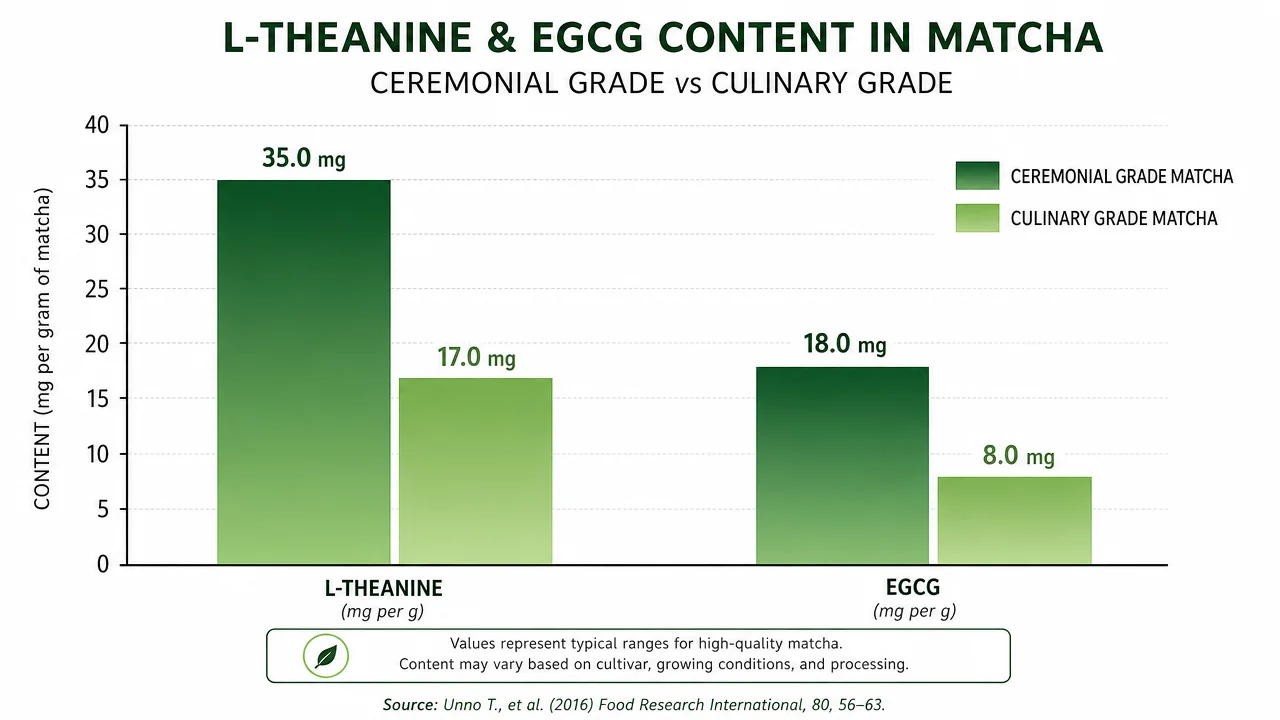
This section separates quality verification from safety verification. Not every COA includes it — and that omission is itself a red flag when a supplier is charging premium prices.
| Compound | Ceremonial Grade Range | Culinary Grade Range | What It Signals |
|---|---|---|---|
| L-Theanine | 15–25 mg/g | 6–15 mg/g | Umami, shaded growing, stress reduction |
| EGCG (total catechins) | 50–65 mg/g | 25–55 mg/g | Antioxidant potency |
| Caffeine | 25–40 mg/g | 18–30 mg/g | Energy effect, shading response |
Why L-theanine matters for B2B positioning: L-theanine is produced in response to UV stress reduction during the shading period before harvest. Higher L-theanine = longer, proper shading. A ceremonial grade matcha without verified L-theanine content above 15 mg/g is a positioning claim without evidence.
What to request: Ask for catechin profiling via HPLC (High Performance Liquid Chromatography). A real HPLC report breaks down EGCG, EGC, ECG, EC individually — not just “total polyphenols.”
6. Color and Sensory Parameters
Less critical for compliance but important for product consistency and brand positioning:
- CIE L*a*b* values: Objective color measurement. A high-quality ceremonial matcha should have high L* (brightness), negative a* (green bias), and specific b* values. These vary by origin and harvest.
- Chlorophyll content: Some premium suppliers include this. Higher chlorophyll = more vivid green, consistent with proper shading.
If your product is sold on visual appearance (e.g., in latte mixes, wellness shots), request color data and establish a specification sheet with acceptable L*a*b* ranges before signing a supply agreement.
How to Verify a Matcha COA Is Trustworthy
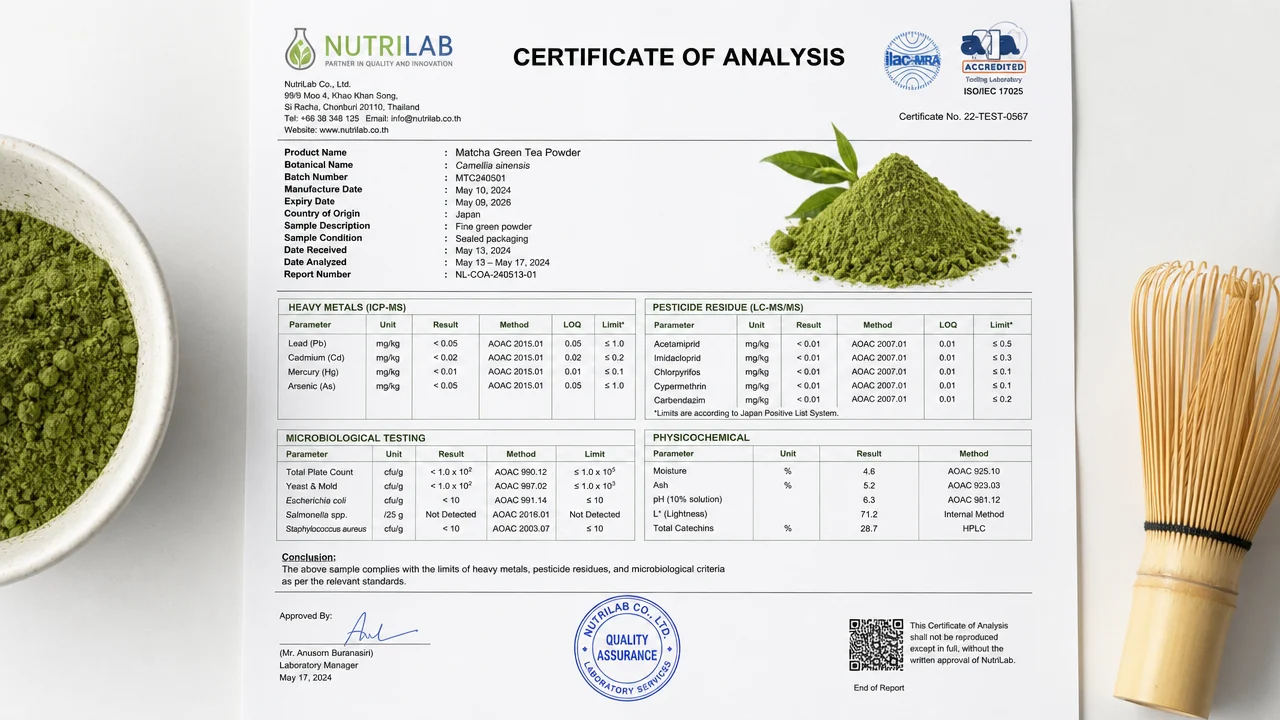
Receiving a COA is not the same as having verified data. Here’s how to validate what you’re looking at:
1. Check the laboratory accreditation. Every credible COA lists the testing lab. Search for their ISO 17025 accreditation. In the US, labs accredited by A2LA or NVLAP are reliable. In Europe, UKAS or DAkkS accreditation. A supplier running tests through their own in-house lab is not an independent third-party result.
2. Verify the batch number matches your PO. A COA for lot #2024-03 means nothing for lot #2025-07. Always request a COA that corresponds to the specific production lot you’re purchasing.
3. Check the test date. Most B2B contracts specify that a COA should be no older than 12 months. Reputable suppliers test each production run. A COA from 3 years ago should trigger a re-test request before purchase.
4. Cross-reference the pesticide compound list. Ask your supplier to provide the full tested compound list, not just the summary pass/fail. Compare it against EU Annex III pesticides relevant to tea.
5. Send a sample to your own lab. For first orders or new suppliers, commission an independent verification test. The cost ($300–800 for a comprehensive panel) is trivial against a $20,000+ shipment. I treat this as a standard line item in new supplier onboarding.
Matcha Quality Certificates: JAS, EU Organic, and FSSC 22000
A COA tells you what’s in a batch. Quality certificates tell you how the product is made.
JAS (Japanese Agricultural Standard) — Organic
JAS is Japan’s national organic certification, administered by the Ministry of Agriculture, Forestry and Fisheries (MAFF). JAS organic matcha prohibits synthetic pesticides and chemical fertilizers for a 3-year transition period before certification. It’s the most commonly cited organic standard for Japanese matcha in B2B contexts, but JAS organic alone does not satisfy EU Organic requirements for products sold in Europe. You need EU-recognized certification (JAS is recognized under the EU-Japan equivalency agreement as of 2021 for most categories — verify current status with your importer of record).
EU Organic (EC No 834/2007 / Reg 2018/848)
Required for labeling products as “organic” in EU markets. Look for a certifying body like Kiwa BCS, CERES, or Control Union on the certificate. The EU logo (green leaf) can only be used with this certification.
FSSC 22000 (Food Safety System Certification)
FSSC 22000 is built on ISO 22000 (food safety management systems) plus sector-specific prerequisites. It’s recognized by the Global Food Safety Initiative (GFSI) and is required or strongly preferred by most major European and North American food retailers. A matcha supplier with FSSC 22000 certification has demonstrated:
- HACCP-based hazard analysis
- Documented traceability systems
- Regular third-party audits
ISO 22000 alone is not GFSI-recognized. If a retailer or distributor requires GFSI certification, FSSC 22000 or SQF are the relevant standards — not ISO 22000 alone.
Halal / Kosher
Required for specific market channels. Matcha is inherently plant-based, so certification is usually straightforward but necessary if your downstream customer requires it for their product formulation or market.
A Practical Checklist: What to Request Before You Buy
When qualifying a new matcha supplier, this is the documentation package you should request — not just the COA:
- COA for the specific lot you are purchasing (not a generic sample COA)
- Full pesticide compound list tested, not just pass/fail summary
- Third-party lab name and ISO 17025 accreditation number
- Heavy metals results with numerical values (not just “pass”)
- Bioactive profile (L-theanine, EGCG/catechins, caffeine) via HPLC
- Organic certificate (JAS + EU/USDA as applicable)
- FSSC 22000 or equivalent GFSI certificate (if selling to retailers)
- COA age — test date within 12 months, matching your lot
- Prop 65 compliance letter (if selling to US/California market)
Frequently Asked Questions
What is the difference between a matcha COA and an organic certificate?
A COA (Certificate of Analysis) is a batch-specific lab report showing test results — heavy metals, pesticides, microbiology — for one production lot. An organic certificate covers the farming and processing practices of a supplier across all their production, renewed annually. Both serve different purposes and both are required for serious B2B sourcing.
How often should a matcha COA be updated?
At minimum, once per production year. Best practice for active trading relationships is per production lot (every batch shipped). If your supplier can’t provide a lot-specific COA, that’s a meaningful red flag.
What lead level is acceptable in matcha for the US market?
For California compliance, you need lead levels that result in daily exposure below 0.5 μg/day (Prop 65 MADL). At a standard 2g serving, that means lead concentration should be below 0.25 mg/kg to avoid a warning label. Premium Japanese ceremonial matcha typically tests at 0.02–0.10 mg/kg. Culinary and blended grades vary considerably.
Can I trust a COA from the supplier’s own lab?
Only partially. An in-house COA shows the supplier is testing, which is better than nothing, but it lacks independence. For regulatory compliance and commercial credibility, require testing from an ISO 17025-accredited third-party lab.
What does “multi-residue testing” mean on a pesticide COA?
Multi-residue testing (MRT) uses analytical methods — typically LC-MS/MS and GC-MS/MS — to screen for hundreds of pesticide compounds simultaneously from a single sample. A comprehensive MRT covering 400+ compounds is the industry standard for EU-bound matcha. Anything covering fewer than 200 compounds should prompt a conversation with your supplier.
What certifications does a matcha supplier need to sell to major US retailers?
Most major US natural retailers (Whole Foods, Target, Sprouts) require: FSSC 22000 or SQF certification, USDA Organic (if marketed as organic), and a current COA per lot. Some retailers also require additional documentation for heavy metals under their own supplier standards.
Summary
Reading a matcha COA is a concrete skill, not just due diligence theater. The six sections that matter — heavy metals, pesticide residues, microbiology, physical/chemical specs, bioactive profile, and color/sensory data — each tell you something specific about safety, quality, and regulatory risk.
The most common sourcing mistakes I see: accepting COAs without verifying the lab’s accreditation, not checking whether the pesticide panel covers EU-relevant compounds, and skipping the bioactive profile entirely when paying for premium ceremonial grade. Each of these is fixable with a few targeted questions before a purchase order is signed.
For ongoing supplier relationships, build COA review into your standard receiving process: verify lot match, check test date, confirm lab credentials, and flag anything outside your specification sheet. It takes 10 minutes per shipment and has saved significantly more than that in avoided customs holds and retailer delistings.