
Choosing a matcha supplier for B2B procurement requires more than tasting a good sample. The key evaluation criteria are: verified origin traceability, market-appropriate certifications (JAS / USDA / EU Organic + HACCP or FSSC 22000), a batch-level Certificate of Analysis covering heavy metals and pesticide residues, application-specific product specifications, transparent pricing within 2026 market benchmarks, and export documentation support for your target market. The global matcha market reached $5.1 billion in 2025 and is projected to grow to $8.9 billion by 2033 (Grand View Research) — and that growth has attracted a wave of new suppliers with widely varying quality and compliance standards. This guide gives you a repeatable framework for cutting through that noise.
Supplier Evaluation Quick Reference
Before going deep, here’s the full checklist in one table — use this as your intake screen for any new supplier:
| Evaluation Area | What to Check | Red Flag |
|---|---|---|
| Origin traceability | Prefecture + farm or cooperative name | “Made in Japan” with no region |
| Certifications | JAS, USDA/EU Organic, HACCP/FSSC | Logos on website, no certificates |
| Documentation | Batch-specific COA, pesticide panel | Generic or undated COA |
| Product specs | Particle size (D50), Lab* color values | Price list only, no spec sheet |
| Pricing | Within 2026 market benchmarks | Significantly below market floor |
| Export support | FDA registration, Prior Notice, customs docs | “You handle customs” response |
| Sample program | Multiple grades, real-application testing | One sample, no grade comparison |
| Communication | Response time, English capability, flexibility | Slow replies, no proactive updates |
Why Grade Labels Will Mislead You Every Time
“Ceremonial grade” and “culinary grade” are marketing categories, not standardized technical specifications — and sourcing decisions based on these labels alone are the most common B2B procurement mistake I see.
There is no universal standard governing what “ceremonial grade” means. One supplier’s ceremonial is another supplier’s premium latte powder. When I evaluated batches labeled “ceremonial” from three different suppliers in the same quarter, the Lab* color values ranged by more than 7 points in L* (brightness) — a visible difference in the finished cup. The grade label told me nothing useful.
For B2B buyers, the correct question is: what specific properties does my application require?
| Application | Critical Attribute | Specification Target |
|---|---|---|
| Specialty café lattes | Particle size (D50) | ≤ 10 microns for smooth texture without grit |
| Baking & desserts | Color stability under heat | High chlorophyll retention; test at ≥ 160°C |
| RTD beverages | Suspension + microbial count | Fine particle + TPC ≤ 1,000 CFU/g |
| Chocolate & confections | Bitterness / L-theanine balance | Request amino acid profile, not just grade name |
| Ceremonial / specialty drinking | Full sensory profile | Umami, sweetness, vibrant green, D50 5–10 microns |
Ask your supplier for a specification sheet — not a grade name. The spec sheet should list D50 particle size, CIE Lab* color values, moisture content, caffeine and L-theanine levels, and microbial limits. If a supplier can only send you a price list, that tells you something important about their quality management systems.
A note on particle size: industry specifications commonly target particle sizes under 10 microns for premium stone-milled matcha — fine enough to dissolve smoothly and feel silky between the fingers. Machine-milled or ball-milled matcha often runs 15–25 microns by D50 measurement. That range affects mouthfeel in beverages significantly — anything above 20 microns will be perceptibly gritty in a milk-based latte.
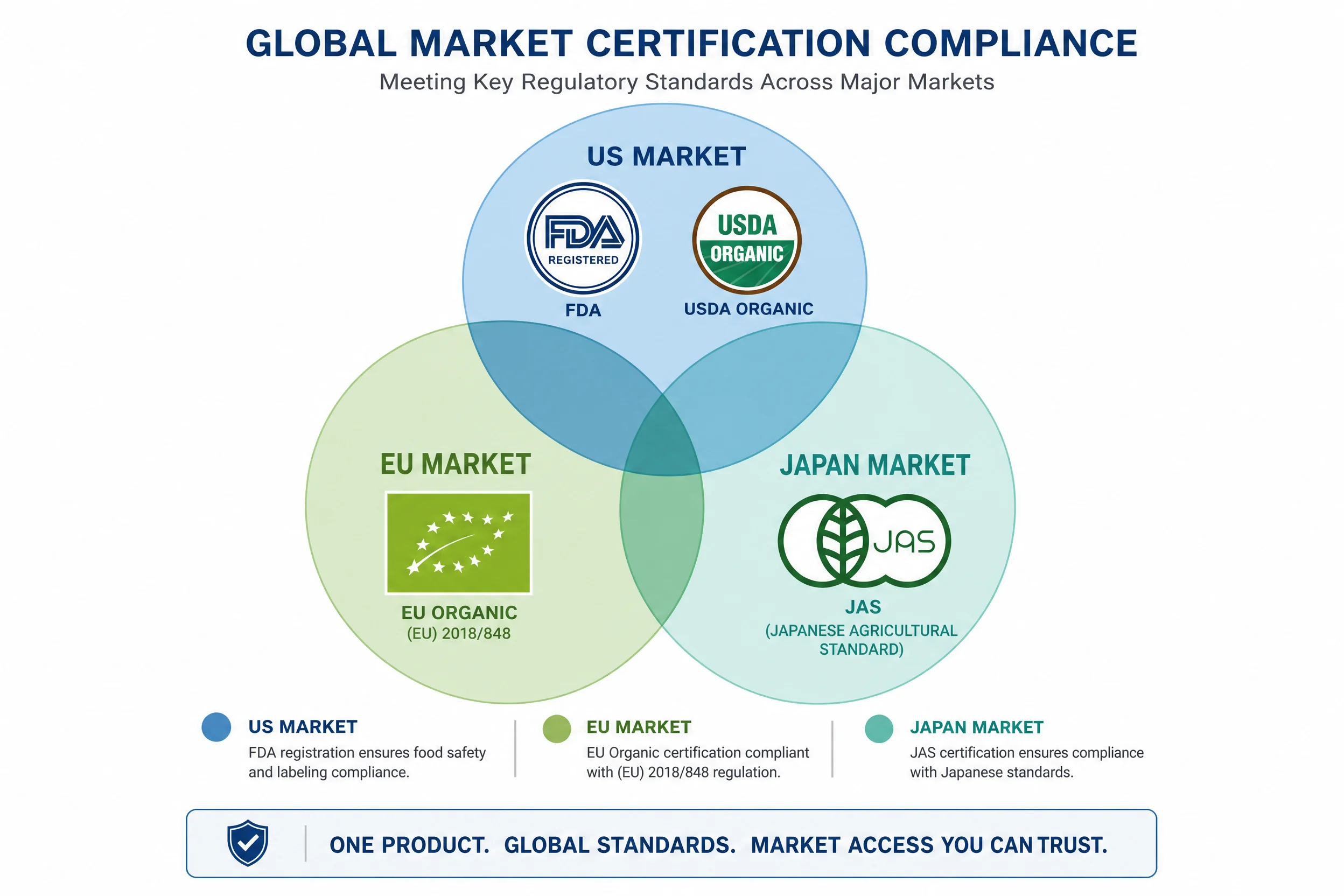
The Certifications That Actually Gate Your Market Access
Certifications divide into two types: market-access requirements (without them your product cannot legally enter certain markets) and operational quality signals (they indicate the supplier’s production standards). Confusing the two costs buyers time and money.
Many buyers collect certification logos like quality points without understanding which certificates they actually need for their specific distribution channel. Here’s the distinction that matters:
Market-access certifications by target market:
| Target Market | Required Certification | Practical Notes |
|---|---|---|
| United States | FDA Food Facility Registration + FSMA compliance | Prior Notice must be filed electronically before each shipment arrives |
| United States (organic claim) | USDA NOP Organic or JAS with equivalency transaction certificate | Confirm exporter handles NOP paperwork, not just the base JAS cert |
| European Union | EU Organic + Certificate of Inspection (COI) per shipment | EU applies the world’s strictest pesticide MRLs — often at the detection limit of 0.01 mg/kg |
| Japan domestic (organic) | JAS Organic | Japan’s Ministry of Agriculture, Forestry and Fisheries (MAFF) registers certifying bodies |
| Major global retail (Whole Foods, Costco) | FSSC 22000 or BRC Food | Both are GFSI-recognized; required by procurement teams at large retailers |
| Kosher / specific Halal markets | OU Kosher / relevant Halal body | Required for certain US and Middle East distribution channels |
Operational quality signals (always valuable regardless of market):
- HACCP: The baseline. A documented Hazard Analysis and Critical Control Points plan shows the supplier has systematically mapped contamination risks. Without it, you’re trusting their word on food safety.
- ISO 22000 / FSSC 22000: A step above HACCP. ISO 22000 is the internationally recognized food safety management system standard; FSSC 22000 builds on it with additional requirements accepted by major global retailers.
- GMP (Good Manufacturing Practice): Baseline hygiene and process control at the facility level — a floor, not a ceiling.
How to verify certifications without taking a supplier’s word for it:
- Request the certificate document itself — not a screenshot or website logo.
- Check the validity date. Certificates older than 12 months may have lapsed.
- Confirm the scope: the certified operator name, product scope, and facility address must match what you’re buying.
- For JAS: cross-reference the certifying body with Japan’s MAFF registered certifying agency list.
- For USDA Organic: verify the operation in the USDA NOP database at ams.usda.gov.
- For EU Organic: each shipment should have a Certificate of Inspection — the organic certificate alone isn’t sufficient for import.
I’ve seen suppliers present a valid JAS certificate for a different product scope — “processed green tea” rather than “matcha powder” — as if it covered their bulk matcha product. It didn’t. The scope field on the certificate matters.
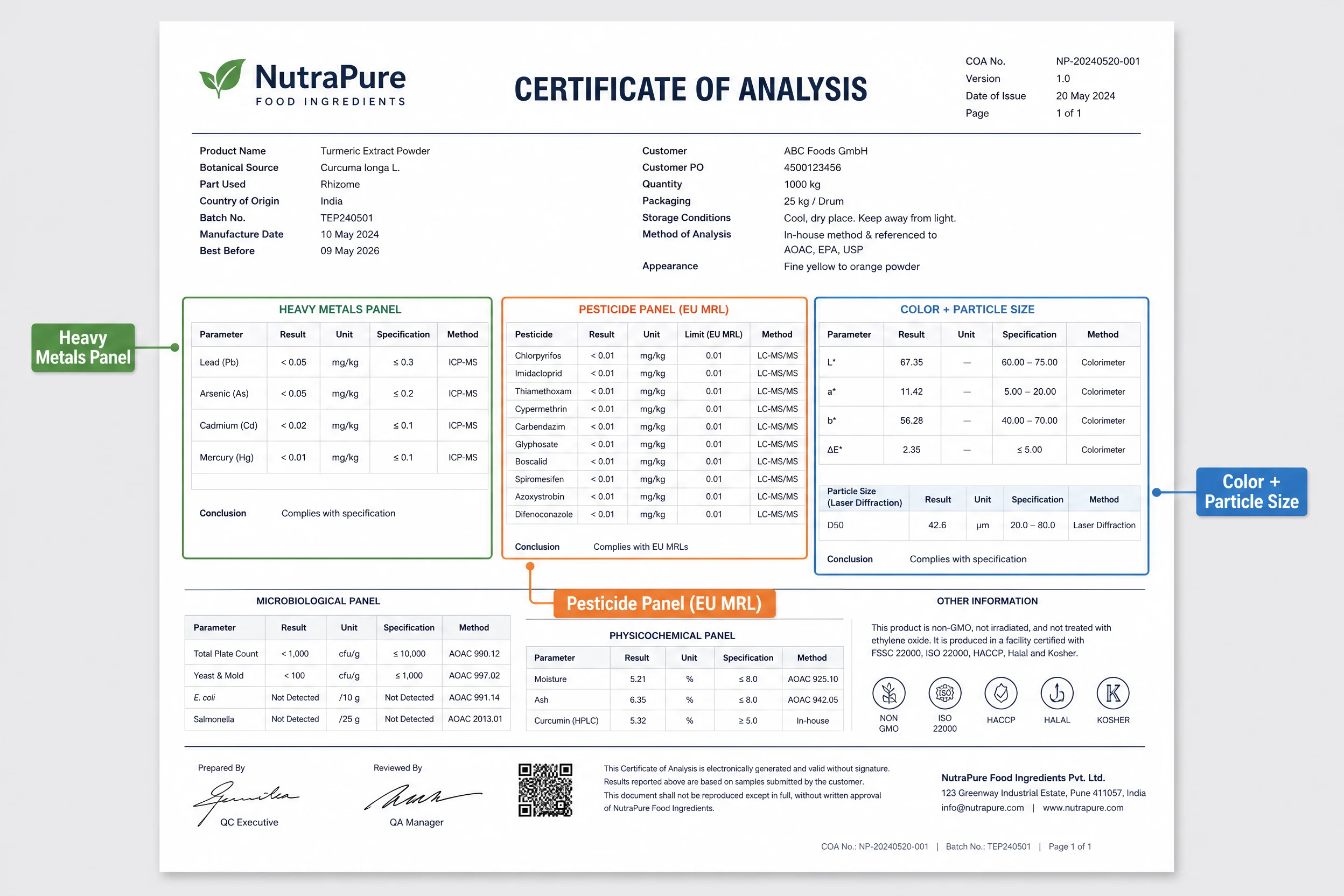
How to Read a COA: The 3 Fields That Matter Most
A Certificate of Analysis is the single most important document you’ll request from any matcha supplier — and most B2B buyers don’t know what to look for beyond a pass/fail stamp.
The COA is a batch-specific laboratory report. Every shipment should come with one, and the lot number on the COA must match the lot number on your shipment documentation. A generic COA without a batch or lot number is worthless for traceability — it proves nothing about the specific product you received.
Three fields to scrutinize first:
1. Heavy metals panel
Look for four metals: lead (Pb), arsenic (As), cadmium (Cd), and mercury (Hg). Matcha is a whole-leaf powder, which means it concentrates whatever was present in the soil. Lead is the primary concern. The FDA’s 2025 final guidance under the Closer to Zero initiative sets action levels for lead in processed food for babies and young children as low as 10 ppb (0.01 mg/kg) for fruits, vegetables, and most mixed food categories. For general adult food products, EU Regulation (EC) No 1881/2006 as amended sets maximum lead levels at 0.1 mg/kg for many categories including fruits and vegetables — a useful benchmark for premium food ingredients. Confirm the testing laboratory is accredited to ISO/IEC 17025 — a lab without this accreditation can issue a COA but the results carry no third-party credibility.
2. Pesticide residue panel
This is where EU-market buyers need particular attention. The EU applies Maximum Residue Limits (MRLs) for pesticides in tea that are often set at the detection limit of 0.01 mg/kg — significantly stricter than Japan’s domestic MRL standards. A pesticide that is legal in Japanese tea farming may fail EU customs inspection. The critical question to ask every supplier: “Is this pesticide panel tested against EU MRL limits or Japan MRL limits?” That single question tells you how export-ready they actually are. A supplier tested only against Japanese domestic standards is not necessarily a bad supplier — but they are not EU-ready.
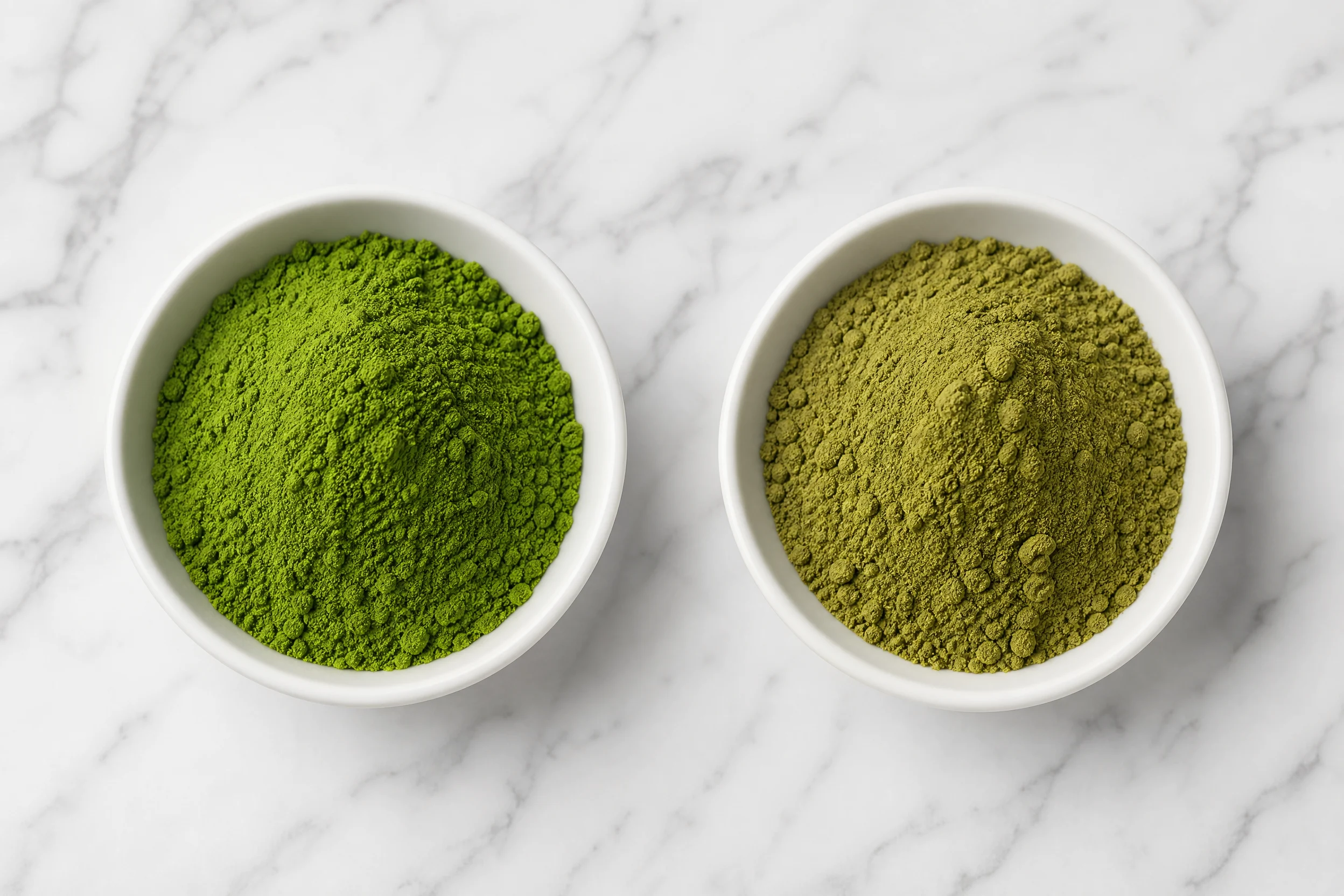
3. Color values (Lab) and particle size (D50)*
These are your batch consistency checkpoints. The CIE Lab* color model gives objective, measurable color coordinates: L* = lightness (0–100), a* = red-green axis, b* = yellow-blue axis. A first shipment with L* = 68.2 that is followed by a shipment at L* = 61.0 will look noticeably different to your customers. Get the Lab* values on every COA and track them across orders.
D50 particle size (the median particle diameter) should be ≤ 10 microns for premium stone-milled matcha. Anything above 20 microns is perceptibly gritty in milk-based beverages.
| COA Field | What to Look For | Red Flag |
|---|---|---|
| Lead (Pb) | ≤ 0.1 mg/kg for adult food applications | No result, or result without accredited lab ID |
| Pesticide panel | Scope: specify EU or JP MRL compliance | Panel only specifies Japan MRL — ask about EU MRL separately |
| L* (lightness) value | Consistent with previous orders (track variation) | No color data at all, or values outside agreed spec range |
| D50 particle size | ≤ 10 microns (stone-milled premium); ≤ 20 microns minimum for lattes | Not specified in COA or spec sheet |
| Lab accreditation | ISO/IEC 17025 certified testing laboratory | In-house lab only, no third-party accreditation |
| Lot number | Matches shipping documents exactly | Generic/undated COA not tied to a specific batch |
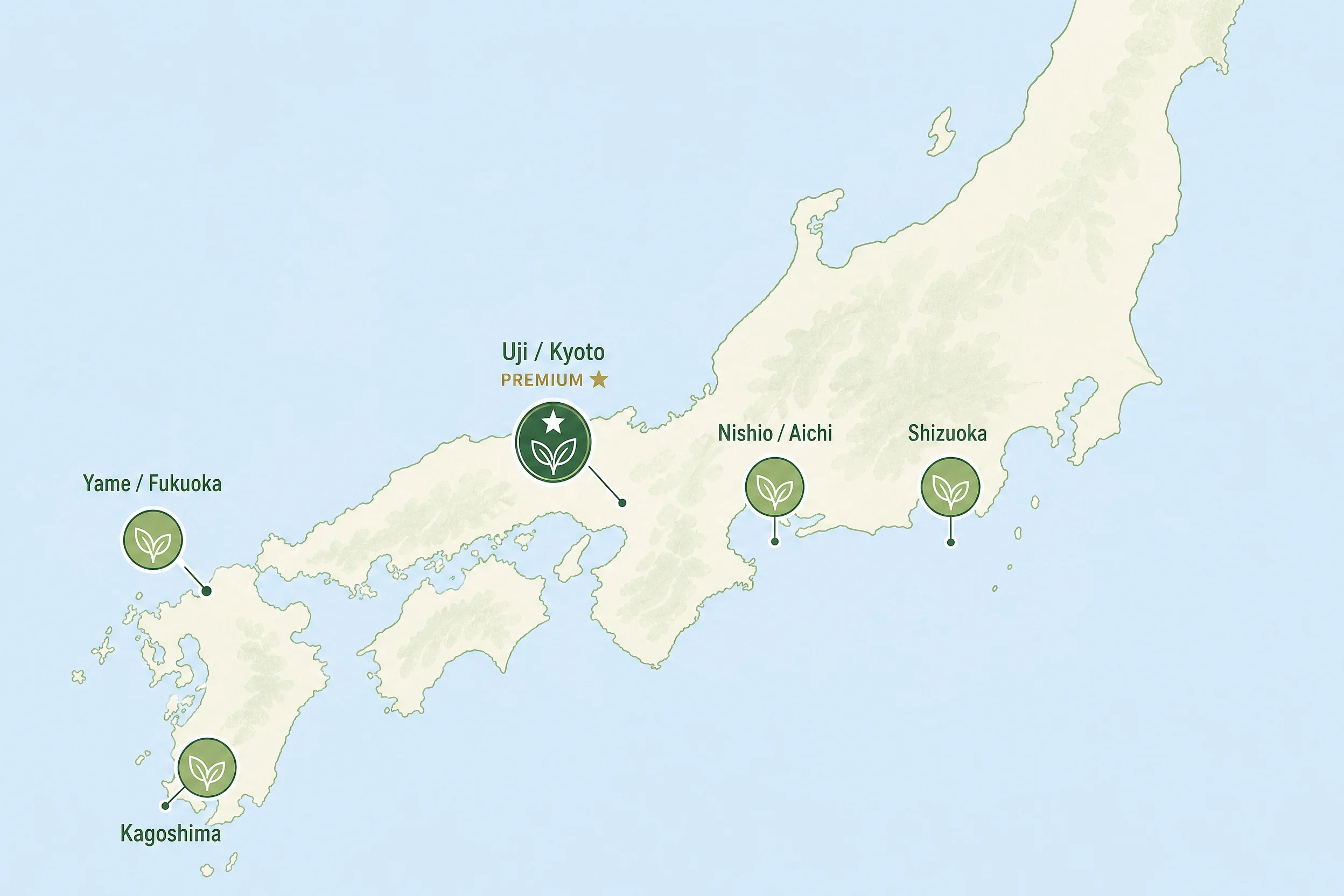
Origin Traceability: “Made in Japan” Is Not Enough
The surge in global matcha demand has created a parallel surge in mislabeling — tea products of mixed or non-Japanese origin being marketed as authentic Japanese matcha. A supplier who only states “Made in Japan” without specifying production region is providing the minimum legal declaration, not meaningful traceability.
Japan’s matcha production is concentrated in six prefectures. Each has documented agronomic characteristics:
| Region | Prefecture | Flavor / Color Profile | Best Fit for B2B Use |
|---|---|---|---|
| Uji | Kyoto | Rich umami, complex aroma, deep emerald green | Premium products, ceremonial grade, brand positioning |
| Nishio | Aichi | Vibrant color, large-scale, consistent harvest | Beverage chains, food manufacturing needing supply stability |
| Kagoshima | Kagoshima | Strong color, high organic farming output | Organic product lines, cost-effective latte grade |
| Shizuoka | Shizuoka | Japan’s largest tea region, clean and fresh | Everyday culinary, general food service applications |
| Yame | Fukuoka | Rare, high quality, limited volume | Specialty retail, small-volume premium positioning |
| Wazuka | Kyoto | Adjacent to Uji, similar quality profile | Premium, sometimes blended with Uji |
A credible supplier can tell you: the prefecture, the farm or cooperative name (or code), the harvest season (first flush = spring = highest quality for premium grades), and the processing facility. If they can’t, you should treat the origin claim as unverified.
Documents that verify Japanese origin:
- Prefecture of production certificate or farm registration documentation
- Export inspection certificate from Japan’s Plant Protection Station or food safety authority
- Radiation test results — many importing countries required radiation certificates for Japanese tea after Fukushima in 2011; the EU, US, and UK have since removed those measures for matcha-producing regions distant from Fukushima, but some destination markets still require certificates and exporters often test voluntarily. Confirm what your specific destination market requires.
- JAS certificate naming the certified farm or operation
An honest word on Chinese-origin matcha
Most supplier guides are written by Japanese matcha businesses, so they don’t say this: Chinese-origin matcha has meaningfully improved in quality over the past decade, and dismissing it entirely is a mistake for certain B2B applications.
For high-volume culinary use — baking, soft-serve ice cream, protein bars, packaged food — properly specified Chinese matcha with full documentation can be both compliant and cost-effective. The legitimate concern is not Chinese origin per se; it’s mislabeling. Chinese matcha sold as Chinese matcha at Chinese prices, with accurate documentation, is not a problem. Chinese matcha sold as Japanese matcha at Japanese prices is fraud.
The verification: ask what country of origin appears on the customs export declaration. That is a legal document. If it says “China” while the marketing says “Japan,” you have your answer.
Pricing Benchmarks: How to Spot a Deal That’s Actually a Risk
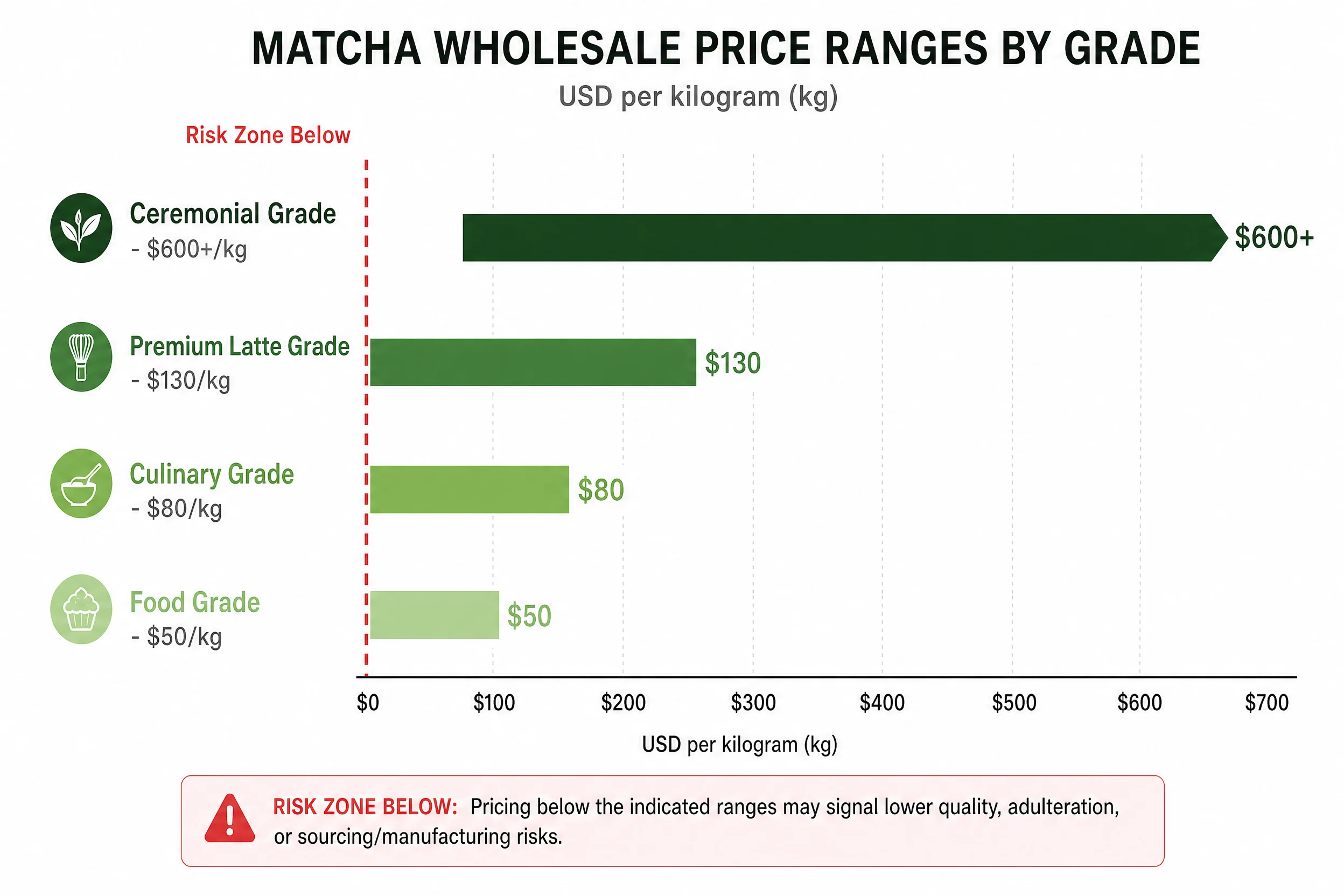
Climate-related harvest disruptions in Japan in 2025–2026 have tightened supply for premium grades — which means any offer of “premium Uji ceremonial matcha” priced significantly below market benchmarks should prompt immediate verification.
Here are the approximate wholesale ranges from current B2B market data (2025–2026, FOB Japan):
| Grade | Typical Application | Wholesale Price (USD/kg) | Typical MOQ |
|---|---|---|---|
| Ceremonial | Straight drinking, specialty shots | $120 – $600+ | 5–20 kg |
| Premium / Latte | Specialty café lattes, light desserts | $65 – $130 | 10–50 kg |
| Culinary | Baking, ice cream, smoothies, sauces | $45 – $80 | 20–100 kg |
| Food-grade / Ingredient | RTD manufacturing, supplements | $25 – $50 | 100+ kg |
Source: first-agri.jp B2B wholesale guide and current supplier market data, 2025–2026. Note: premium Uji ceremonial grade from specialist producers can exceed $600/kg. Chinese-origin matcha of comparable specification typically runs 30–50% lower across all grades.
The price trap that catches most first-time B2B buyers is optimizing for unit cost without accounting for total cost of ownership. The actual cost of a bad supplier includes: rejected shipments (re-testing fees, customs delays), off-specification product requiring reformulation, customer complaints from batch inconsistency, and emergency re-sourcing at premium rates when a cheap supplier fails. A supplier saving you $15/kg but delivering inconsistent product two batches out of three is more expensive than a reliable supplier at market rate.
Low-price red flags by threshold:
- Below $25/kg for any product claiming Japanese culinary-grade origin — ask for the customs export declaration
- Below $60/kg for claimed ceremonial or premium-latte grade from Japan — request batch-specific COA with origin documentation
- Pricing that never varies regardless of harvest year or seasonal supply conditions — indicates a supplier detached from real market dynamics
The Two-Stage Trial Order Protocol
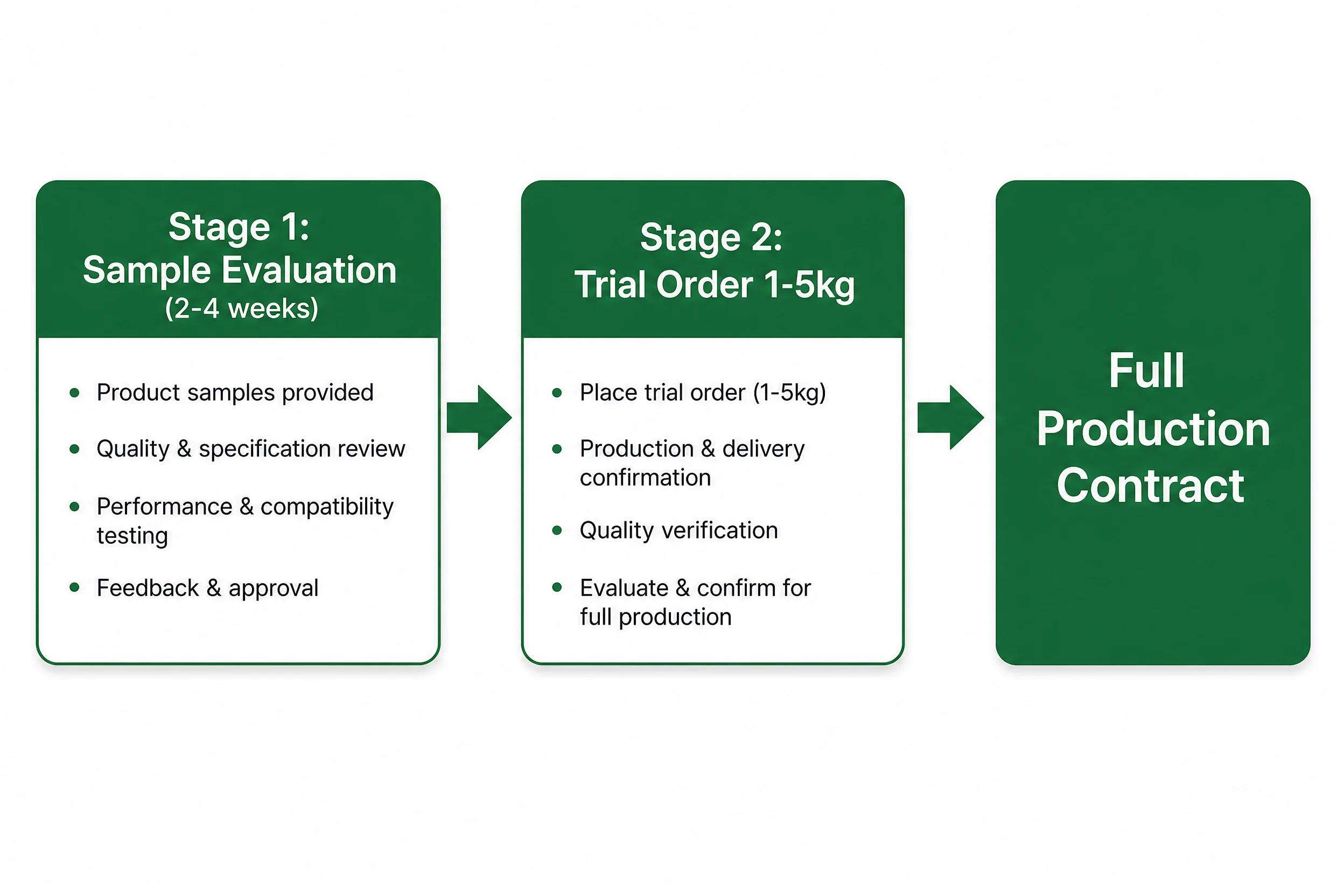
Never go from “first sample” to “full production order.” That gap is where most failed supplier relationships start.
A sample proves a supplier can produce one good batch. It proves nothing about consistency at scale, packaging quality during transit, lead times under production pressure, or documentation accuracy. The two-stage protocol closes that gap.
Stage 1: Sample Evaluation (2–4 weeks)
- Request a minimum of two grades that match your application — not their best ceremonial grade for a latte application
- Evaluate under your actual production conditions: brew it in the milk-based drink you’ll be serving, bake it at your actual oven temperature, mix it in your actual formulation
- Request the COA for each sample; verify the lot number matches the sample bag
- Note response time and communication quality during the sample process — this predicts the real relationship
Stage 2: Trial Order (scale to your smallest production run, typically 1–5 kg)
- Place a paid, documented order — not a free sample request
- Evaluate: Is the product identical to the approved sample? Does packaging protect freshness (opaque bag, nitrogen flushing, sealed seams)? What is the actual lead time versus quoted lead time?
- Check all shipping documentation: COA lot number matches, customs paperwork is complete, any required import documentation is provided correctly
- Attempt a return inquiry or change request — this stress-tests after-sales responsiveness
Only after Stage 2 should you negotiate full production volumes. A supplier who pushes you to skip Stage 2 and jump straight to 50 kg or more has an incentive structure misaligned with yours.
The 3 Questions I Ask Every New Supplier First
These aren’t the only questions, but they filter out roughly 80% of suppliers who aren’t ready for serious B2B relationships — in under 10 minutes of conversation.
Question 1: “Can you provide a batch-specific COA from a previous shipment — not the current one — and explain any parameters that changed between batches?”
Why it works: It tests whether the supplier actually understands their own testing data and can trace historical production. A capable supplier will walk you through normal batch variation and explain what causes it (harvest season, regional differences, processing line). A supplier who sends a template COA with no lot number and cannot explain variance has limited quality system visibility — and limited ability to help you when something goes wrong.
Question 2: “What is the MRL compliance status of your current stock against EU pesticide limits — specifically EU limits, not Japan limits?”
Why it works: EU Maximum Residue Limits are the world’s strictest benchmark for pesticides in tea. A supplier who tests specifically against EU MRL standards has made a deliberate investment in export quality. Many Japan-based suppliers test only against Japan’s domestic agricultural standards, which are less stringent. If you’re targeting the EU market, this question alone eliminates the majority of suppliers from your shortlist immediately — and it reveals how sophisticated their compliance operation actually is.
Question 3: “What was the issue on your last customs rejection or quality complaint, and how was it resolved?”
Why it works: Every supplier with meaningful export volume has had a problem. Suppliers who claim zero problems either have very limited track records or aren’t being honest. A supplier who can describe a specific incident — what caused it, how they addressed it with the customer, and what systemic change they made to prevent recurrence — is demonstrating exactly the kind of operational maturity that matters in a long-term partnership. Perfectionism in the answer is a red flag, not reassurance.
The B2B Matcha Supplier Scorecard
Use this weighted scoring framework when comparing two or three shortlisted suppliers. Score each category 1–5 (5 = fully meets criteria), then multiply by the weight.
| Category | Weight | What to Evaluate |
|---|---|---|
| Origin traceability | 15 pts | Prefecture confirmed, farm or cooperative name provided, harvest date documented, radiation test present |
| Certification portfolio | 20 pts | All certifications relevant to your target market are current, verifiable, scope-matched |
| COA quality | 20 pts | Batch-specific (lot-matched), ISO 17025 accredited lab, covers heavy metals + pesticides + color values |
| Product specification accuracy | 15 pts | Spec sheet with D50, Lab* values, caffeine/L-theanine, microbial limits, matches your application |
| Pricing transparency | 10 pts | Tiered pricing provided, cost drivers explained, within 2026 market benchmarks |
| Export compliance support | 10 pts | FDA registration confirmed, Prior Notice capability, customs documentation provided without prompting |
| Communication quality | 10 pts | Response time under 24 hours, clear English, proactive updates on supply or regulatory changes |
| Total | 100 pts |
Score interpretation:
- 85–100: Strong candidate — proceed to Stage 2 trial order
- 70–84: Conditional — address identified gaps before ordering; re-evaluate after responses
- Below 70: Significant risk profile — consider alternatives before committing further time
This scorecard is deliberately weighted toward documentation (origin + certifications + COA = 55 pts) because documentation failures are the ones that create regulatory and brand consequences. A supplier who communicates beautifully but can’t produce a lot-matched COA is still a liability.
Red Flags That Should Make You Walk Away
Vague origin claims. “Japanese matcha” with no prefecture, no region, no farm name. This can indicate repackaged imports, blended product of mixed origin, or a supplier who has not actually visited their supply chain.
No batch-specific COA. Any supplier who sends a generic, undated, or lot-number-free COA cannot prove the certificate relates to your specific shipment. This is a fundamental quality system failure.
Certifications that don’t match. Website shows “JAS Certified” but the certificate names a different company, a different product scope (e.g., “green tea leaves” rather than “matcha powder”), or has an expired validity date. Always read the certificate itself.
Prices well below the market floor. Authentic Japanese culinary-grade matcha rarely arrives at your dock under $25/kg FOB. Below that threshold for claimed Japanese origin, ask hard questions about what’s actually in the bag.
Resistance to the two-stage trial process. Legitimate suppliers welcome smaller initial orders. A supplier who won’t ship under 50 kg without allowing a proper trial order has different incentives than you do.
No nitrogen flushing or opaque packaging. Matcha oxidizes rapidly when exposed to light, air, and moisture. A supplier who ships in transparent bags or doesn’t specify packaging standards doesn’t understand — or doesn’t care about — product quality during transit.
“You handle the export documentation.” For international buyers, export compliance support is part of the service value. A supplier who doesn’t know what FDA facility registration is, or can’t explain what Prior Notice involves, will create customs and compliance headaches with every shipment.
No sample program, or only one sample option. A supplier who will only send their “best” single product and resists side-by-side grade comparison is limiting your evaluation deliberately.
FAQ: Vetting Matcha Suppliers
What certifications should a matcha supplier have for the US market?
At minimum: FDA food facility registration (mandatory for any food import) and HACCP or FSSC 22000 for food safety. For organic label claims: USDA NOP Organic certification or JAS Organic with a valid equivalency transaction certificate. If you’re supplying major retailers like Whole Foods or Costco, FSSC 22000 or BRC certification is effectively required by their procurement teams.
What is a COA and why does it matter for matcha procurement?
A Certificate of Analysis is a batch-level laboratory report confirming a product’s quality and safety parameters. For matcha, it should cover heavy metals (lead, arsenic, cadmium, mercury), pesticide residues against relevant MRLs, microbial safety (total plate count, E. coli, Salmonella), and physical parameters like particle size and Lab* color values. It matters because matcha is a whole-leaf powder that concentrates soil contaminants, and without batch-specific documentation you have no way to verify what you actually received.
How do I verify a matcha supplier’s origin claims?
Request: (1) prefecture of production and farm or cooperative name, (2) harvest date and season, (3) export inspection documentation, and (4) radiation test results if required by your destination market (some countries still require these for Japanese tea; confirm current requirements for your import region). For organic claims, verify the JAS certificate through the named certifying body. Ask what country of origin appears on the customs export declaration — that is a legal document and will reveal any discrepancy with marketing claims.
What is the difference between JAS and USDA Organic certification for matcha?
JAS (Japanese Agricultural Standard) is Japan’s official domestic organic certification program, administered by MAFF. USDA Organic is the US National Organic Program. Japan and the US maintain an equivalency agreement, meaning JAS-certified products can be imported and labeled organic in the US with appropriate NOP transaction certificates. A separate equivalency agreement covers EU imports. The practical implication: confirm your supplier can provide the export-specific paperwork for your target market — the base JAS certificate alone may not be sufficient.
What wholesale price should I expect for matcha in 2026?
Based on current market data (2025–2026), approximate wholesale prices for Japanese-origin matcha are: ceremonial grade $120–$600+/kg (premium Uji from specialist producers can significantly exceed $350/kg), premium/latte grade $65–$130/kg, culinary grade $45–$80/kg, and food-grade/ingredient $25–$50/kg. Chinese-origin matcha of comparable specification typically runs 30–50% lower. Prices have trended upward due to harvest pressures in Japan. Pricing significantly below these ranges for claimed Japanese-origin product warrants origin verification.
How many suppliers should I evaluate before choosing one?
Evaluate at least three suppliers simultaneously. Request samples from all three, apply the scorecard, then place trial orders with your top two. This protects supply continuity — if your primary supplier has a production issue, a qualified backup prevents a product outage — and gives you real comparative data rather than sequential evaluation with no baseline.
Summary
Choosing a matcha supplier is a higher-stakes decision than most buyers realize when they start, and a lower-stakes one than it looks once you have a repeatable framework.
The framework here reduces the risk to a manageable sequence: start with application fit rather than grade labels, verify certifications against your specific target market’s requirements, scrutinize the COA for heavy metals, EU pesticide compliance, and color/particle consistency, benchmark any pricing against current 2026 market data, and use the two-stage trial protocol before committing to production volume.
The suppliers who score well on this framework share a trait — they’re invested in your product’s success because they understand that if your product quality suffers, the relationship ends. That alignment of incentives is what a good supply chain partnership looks like. The framework just helps you find them faster.