
Private label matcha lets you sell premium green tea powder under your own brand without owning a production facility. This guide breaks down the difference between OEM (you own the formula) and ODM (the factory provides it), how to choose between Japanese and Chinese-grown matcha, what certifications to demand, realistic MOQ benchmarks, packaging requirements, and a practical checklist for vetting any supplier before you commit to a first order. Whether you’re launching a new wellness brand or scaling an existing tea line, the decisions you make at this stage determine your product’s quality ceiling and your margin structure for years.
Quick Reference: Private Label Matcha at a Glance
Private label matcha is not one thing — it’s a spectrum of manufacturing arrangements. Before you contact a single supplier, it helps to know exactly what model you’re shopping for.
| Model | Who Owns the Formula | Customization | Lead Time | Best For |
|---|---|---|---|---|
| OEM | You (the buyer) | Full — you spec the blend, grind fineness, additives | 6–12 months | Established brands with proprietary recipes |
| ODM | The manufacturer | Limited — choose grade, packaging, label | 2–4 months | Startups and first-time launchers |
| White Label | Manufacturer | Label/packaging only | 2–6 weeks | Testing market fit fast, low capital |
| Contract Mfg. | You (the buyer) | Full, including production process | 4–8 months | Scale-ready brands with proven demand |
The practical rule: if you don’t yet have a tested product and proven demand, start ODM or white label. Move to OEM once your volume justifies the tooling investment and longer timeline.
OEM vs ODM vs White Label: What These Terms Actually Mean for Matcha
Most B2B articles use OEM, ODM, private label, and white label interchangeably. In food and beverage manufacturing — particularly matcha — they describe meaningfully different commercial arrangements.
OEM (Original Equipment Manufacturer) means you bring the specification. You define the matcha grade, particle size (typically 10–20 microns for stone-ground/ceremonial, 15–25 microns for machine-ground/culinary), any blends (e.g., matcha + collagen + ashwagandha), packaging format, and quality checkpoints. The manufacturer executes your recipe and produces under your brand. You own the intellectual property. MOQs are typically higher because setup costs are real.
ODM (Original Design Manufacturer) means the supplier already has a validated product — a specific Japanese ceremonial grade, a culinary culinary blend, a matcha latte premix. You select from their existing catalog, apply your brand, and potentially adjust packaging and sizing. The manufacturer owns the underlying formula. MOQs are lower, timelines are shorter, and the quality/safety work has already been done. For most new entrants, this is the right starting point.
White label is a subset of ODM: a finished, unbranded product you simply relabel. No custom formulation, often no minimum blend customization. Think: a Japanese supplier’s house-grade matcha in a 100g tin with your logo on it. This is the fastest path to market.
Contract manufacturing is the OEM model taken further — you’re not just speccing the product, you’re potentially speccing the production line and own all output from that run. Relevant only once you’re placing orders large enough to justify factory capacity allocation.
In matcha specifically, the OEM/ODM distinction matters most when you want to blend in functional ingredients (collagen, adaptogens, sweeteners) or create a proprietary grind profile. If you’re selling straight matcha powder, ODM or white label almost always gets you to market faster and cheaper.
The Matcha Market Opportunity in 2026
The global matcha market was valued at approximately USD 5.1 billion in 2025 and is projected to reach USD 8.9 billion by 2033, growing at a CAGR of around 7.1% during that period, according to Grand View Research. Separate estimates from Emergen Research put 2025 value at USD 4.38 billion with a slightly higher CAGR of 9.6%, reflecting different scope definitions across research firms.
Either way, the trajectory is consistent: matcha is not a fad. It sits at the intersection of several durable consumer trends — functional wellness, clean-label ingredients, café culture, and the sustained TikTok-driven interest in matcha lattes. North America and Europe are the fastest-growing import markets; Japan remains the dominant origin by quality perception.
For a private-label brand, this creates a concrete opportunity. The category has enough consumer awareness that you don’t need to educate buyers on what matcha is — but it’s not yet so consolidated that new brands can’t build meaningful market share. The window to establish a differentiated matcha brand is narrowing, not closed.
A few data points relevant to private label positioning:
- Ceremonial grade commands a significant premium over culinary — but the word “ceremonial” is currently used by 70+ brands without a legally binding definition, creating positioning risk if your claim can’t be verified
- The US import market is heavily dependent on Japan (Uji, Kagoshima, Nishio, Shizuoka regions) for premium positioning, and on China for volume/cost efficiency
- Europe requires EU Organic certification for organic claims; US requires USDA NOP; Japan uses JAS — understanding which certification your target market requires is step one in supplier qualification
Japan vs China: Which Origin for Your Private Label?
This is the question almost every article in this space avoids answering directly. Here’s an honest breakdown.
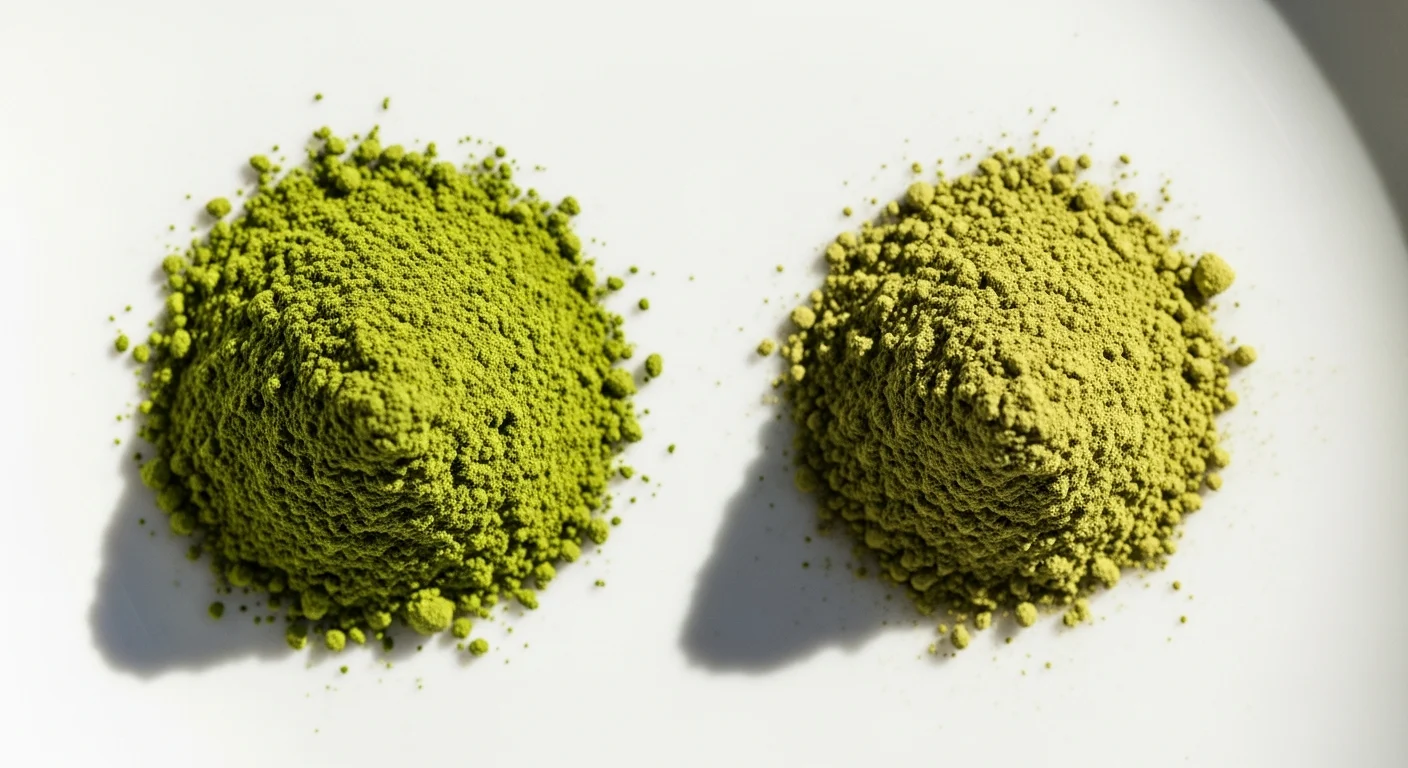
Japanese matcha is shade-grown for 3–4 weeks before harvest, stone-ground (or impact-milled for culinary), and benefits from centuries of cultivar refinement in regions like Uji (Kyoto), Nishio (Aichi), Kagoshima, Shizuoka, and Yame. The L-theanine content (typically 10–20mg per gram, reaching up to ~25mg/g in top ceremonial grades) is elevated due to the shading process, which diverts chlorophyll production and suppresses catechins in favor of amino acids. The resulting powder is vibrant green, umami-forward, and commands the price premium that supports a premium brand story.
Chinese matcha (primarily from Zhejiang, Fujian, and Yunnan provinces) uses different cultivars and often shorter or no shade periods. Color can be lighter or yellower, taste more bitter, and L-theanine content lower. Chinese bulk matcha from Alibaba runs roughly 30–60% cheaper than comparable Japanese grades — a figure corroborated by Alibaba’s own price comparison pages. For culinary applications — baking, smoothie mixes, matcha latte blends where the powder is one of several ingredients — Chinese origin is entirely defensible.
Where origin matters:
- Premium DTC brands targeting $30–$80 per 30g positioning: Japanese origin is nearly mandatory for credibility
- Foodservice and café chains: Japanese origin for ceremonial tin; Chinese acceptable for back-of-house culinary
- Food ingredient/supplement brands (capsules, protein blends): Chinese origin is the industry standard
The hybrid approach: Several private label brands I’ve seen use Japanese origin for their hero ceremonial SKU and Chinese origin for their culinary and food-use product lines. This maintains brand credibility while protecting margin on high-volume SKUs.
A word on “made in Japan” claims: Some Chinese-grown powder is ground or processed in Japan and labeled accordingly. If Japanese origin is a pillar of your brand story, request a “Certificate of Japanese Origin” explicitly, not just a JAS or Japanese address on the invoice. Reputable suppliers like Keicha Tea World and bulk.matcha.com provide batch-level radiation screenings and origin certificates as standard — not as add-ons.
Certifications That Actually Matter (And What They Unlock)
Certifications are not just compliance boxes. Each one unlocks specific retail channels or consumer trust segments. Here’s what matters for matcha specifically:
| Certification | What It Covers | What It Unlocks | Issuing Body |
|---|---|---|---|
| USDA Organic (NOP) | No synthetic fertilizers, GMOs, irradiation, sewage sludge | US organic labeling; Whole Foods, natural grocery placement | USDA National Organic Program |
| JAS (Japanese Agricultural Standard) | Japan’s organic standard; U.S.-Japan Organic Equivalence Arrangement with USDA NOP (effective 2014) | Japan + US organic claims from a single certification | Japanese Ministry of Agriculture |
| EU Organic | EU equivalent; stricter in some pesticide limits | EU retail organic labeling | EU certification bodies (e.g., ECOCERT) |
| FSSC 22000 | Full food safety management system, ISO-based, 3-year audit cycle | Mandatory for many retail buyers; covers raw materials through delivery | Foundation FSSC |
| HACCP | Hazard analysis and critical control points | Food safety baseline; required by most importers | NSF, SGS, or equivalent |
| ISO 22000 | International food safety management | Export compliance; often paired with FSSC | ISO |
| Non-GMO Project Verified | GMO-free verification | Natural channel positioning; Sprouts, co-ops | Non-GMO Project |
| Kosher / Halal | Religious dietary compliance | Specific retail channels and export markets | OU, MUI, etc. |
How to use this table: Start with your target retail channel and work backward. Whole Foods requires USDA Organic. EU natural grocery requires EU Organic. Most major US grocery buyers require FSSC 22000 or equivalent. Amazon doesn’t require certifications, but USDA Organic significantly improves conversion.
A supplier that holds only HACCP is not qualified for premium retail placement. A supplier with FSSC 22000 + USDA Organic + JAS is typically operating at a level of food safety rigor sufficient for any major retail channel.
Verification tip: Every legitimate certification can be verified through the issuing body’s public database. JAS certificates have a registration number; USDA Organic certificates are searchable at the USDA Organic Integrity Database (organic.ams.usda.gov/integrity). Ask any supplier for their certificate number and verify it yourself — not just a PDF that could be outdated or fabricated.
MOQ Reality Check: What to Expect at Each Business Stage
Minimum order quantities in the matcha private label market vary more than almost any other food ingredient category, because they’re driven by three independent variables: packaging type, supplier tier, and origin.
Here are the benchmarks I’ve been able to verify from publicly accessible supplier information:
| Supplier Type | MOQ Range | Notes |
|---|---|---|
| US/EU importer with private label program | 30–100 units of finished branded product | bulk.matcha.com publicly lists 30 units minimum; low capital risk |
| EU-based B2B suppliers (e.g., Wonnda network) | 100–300 kg of powder | Custom retail packs; packaging decisions drive MOQ |
| Japanese OEM suppliers (Uji, Kagoshima) | 10–50 kg bulk; custom packaging higher | Ceremonial grade OEM; long lead time from harvest calendar |
| Chinese ODM/white label (Alibaba) | 1–10 kg bulk powder; 50–1,000 units packaged | Highly variable; $1.20–$7/kg range |
| Premium contract manufacturer | 100–500 kg+ | Full production runs; verified certifications |
What this means in practice:
If you’re testing a concept, bulk.matcha.com’s 30-unit MOQ with no annual contract is the lowest-risk entry point I’ve seen from a verifiable public source. You’re paying a premium per unit, but you’re not committing $20,000 to find out your label design doesn’t resonate.
If you’re ready to scale (200–500 units/month), EU-based suppliers with FSSC 22000 and EU Organic become competitive on both unit cost and compliance coverage for European markets.
For high-volume culinary lines (1,000+ kg/year), Chinese origin suppliers on Alibaba with verified trade histories and HACCP/ISO 22000 certifications offer the best cost structure — provided you conduct independent quality testing on each shipment.
Packaging Your Private Label Matcha: Tins, Pouches, and Nitrogen Flush
Matcha is one of the most packaging-sensitive powders in the food category. Unlike coffee, which has some tolerance for oxygen exposure, matcha degrades quickly when exposed to light, oxygen, or moisture. A batch that ships perfectly green can arrive dull and yellow if packaging fails.
The three enemies of matcha quality:
- Light — accelerates chlorophyll degradation; the bright green becomes olive or yellow
- Oxygen — oxidizes catechins and L-theanine; flavor turns bitter and flat
- Moisture — clumping, microbial risk, and flavor loss
The solution that premium OEM suppliers use is straightforward: opaque, high-barrier packaging with nitrogen flush at the point of sealing. The tin or foil pouch is filled under inert gas (nitrogen), oxygen is displaced, and the seal is airtight. Shelf life goes from 3–6 months (unprotected) to 18–24 months (nitrogen-flushed, sealed tin or foil pouch in appropriate storage conditions).
Packaging options for private label:
| Format | Best For | Cost Signal | Shelf Life |
|---|---|---|---|
| Tin (aluminum, with inner foil layer) | Premium ceremonial, gift sets, DTC $40+ | Premium/high | 18–24 months sealed |
| Stand-up foil pouch (resealable, opaque) | Mid-range retail, subscription boxes | Mid | 18–24 months sealed |
| Paper/kraft pouch | NOT recommended for matcha | Budget | 6–12 months max |
| Glass jar with airtight lid | Specialty/artisan positioning | Premium | 12–18 months |
| Single-serve stick packs | Convenience, travel, café dispensing | Mid-premium | 12–18 months |
Paper packaging is not appropriate for matcha. Kraft pouches may look premium and eco-friendly, but they do not provide sufficient barrier against oxygen and moisture. Several brands have launched with kraft packaging and dealt with color degradation complaints within 90 days of shelf placement.
Ask your supplier specifically: “Do you nitrogen-flush at packaging?” and “What is your measured O₂ level post-seal?” A reputable OEM partner will have documented specs, not vague assurances.
How I Evaluate a Matcha OEM/ODM Supplier: My Vetting Checklist
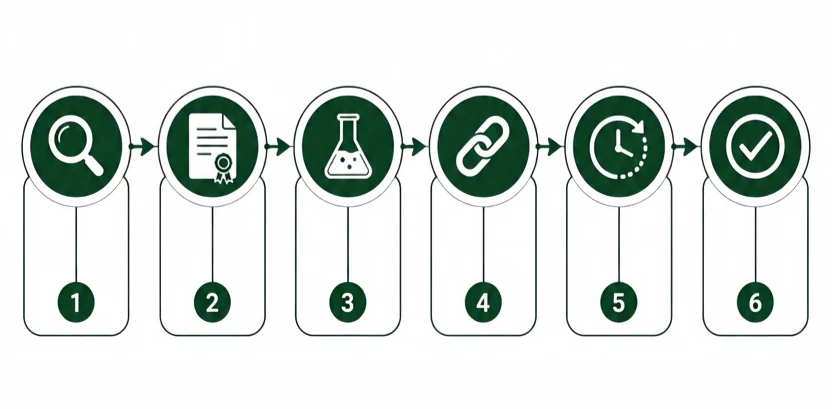
When evaluating a matcha supplier — whether discovered through Alibaba, a B2B directory, or a direct referral — I work through the same checklist. Most supplier fraud or quality failures are caught in steps 2–4.
Step 1: Verify certifications independently
- Request the certificate number for every claim (USDA Organic, JAS, FSSC 22000)
- Check the USDA Organic Integrity Database (organic.ams.usda.gov/integrity)
- For JAS, verify through Japan’s Ministry of Agriculture registration database
- For FSSC, check the FSSC 22000 public certificate database at fssc22000.com
Step 2: Request a Certificate of Analysis (CoA)
A legitimate CoA for matcha should include:
- Heavy metals panel: Lead, Cadmium, Arsenic, Mercury (EU and US limit thresholds differ)
- Pesticide residue: Specific to the origin country’s regulatory standards
- Microbiology: Total plate count, yeast/mold, E. coli, Salmonella
- Nutritional panel: Protein, caffeine, catechins (EGCG), L-theanine if claimed
- Radiation screening: Cesium-134, Cesium-137 (relevant for Japanese origin post-Fukushima)
If a supplier sends a generic, undated CoA or one that lacks heavy metals data, that’s a hard stop.
Step 3: Request a sample before any order
Premium suppliers provide samples with no fee or with a sample credit on first order. Chinese suppliers on Alibaba often charge $10–$30 for shipping. Always test:
- Color under natural light (bright green = quality; olive/yellow = degraded or low grade)
- Smell (fresh, grassy, slightly sweet; not musty or fishy)
- Taste dissolved in 60°C water (smooth, umami-forward, no bitterness until the finish)
- Clumping (fine powder should sift freely; clumps indicate moisture exposure)
Step 4: Check supply chain transparency
- Ask: “Where was this matcha grown, and in which prefecture/region?”
- Ask: “Can you provide a Certificate of Origin?”
- Ask: “Who performs your third-party testing, and can I see the lab name?”
Step 5: Evaluate MOQ and lead time honesty
Suppliers who say “any MOQ” for OEM custom work are almost always resellers, not manufacturers. Real manufacturers have production minimums tied to their equipment runs. If MOQ numbers don’t align with production logic, ask to see the facility.
Step 6: Reference check
Ask for 2–3 client brand names or case studies. For EU suppliers on Wonnda or Torg, you can often find existing clients through brand ingredient disclosures. For Chinese suppliers, check trade review history on Alibaba (years active, reorder rate, dispute rate).
Cost and Timeline Breakdown: OEM vs ODM Launch
The total cost of launching a private label matcha line depends heavily on the manufacturing model, origin, and packaging complexity. These are working ranges based on publicly available supplier data and industry benchmarks.
| Cost Component | ODM / White Label | OEM (Custom Formula) |
|---|---|---|
| Sample cost | $0–$30 (shipping) | $0–$100 (often credited) |
| Label/packaging design | $300–$1,500 (freelancer) | $500–$2,500 (more complex) |
| Initial order (MOQ) | $500–$5,000 | $3,000–$20,000 |
| 3rd-party lab testing | $200–$600 | $400–$1,200 |
| Import duties (US, matcha) | 0% base (HS 0902.20.90); Chinese-origin adds 35–55%+ in Section 301 + IEEPA tariffs | Same |
| Compliance/labeling review | $0–$500 | $500–$2,000 |
| Estimated launch total | $1,500–$8,000 | $5,000–$26,000 |
Timeline comparison:
| Phase | ODM / White Label | OEM |
|---|---|---|
| Supplier identification | 1–2 weeks | 2–4 weeks |
| Sampling and approval | 1–3 weeks | 3–6 weeks |
| Label design + packaging spec | 2–4 weeks | 3–6 weeks |
| Production | 2–6 weeks | 4–12 weeks |
| Shipping (sea, Japan/China → US) | 3–5 weeks | 3–5 weeks |
| Total to first inventory | 9–20 weeks | 15–33 weeks |
The honest trade-off: ODM gets you to market faster and cheaper, but you’re building on someone else’s foundation. If that supplier discontinues the grade or raises prices, your product spec changes. OEM is slower and more expensive but gives you a defensible, reproducible product that you fully control. For most new entrants, ODM for launch + OEM after proof-of-concept is the correct sequence.
Frequently Asked Questions
What is the difference between private label and white label matcha?
White label matcha is a pre-made, standardized product from a supplier that you rebrand without modification — you’re essentially putting your label on their product. Private label is broader: it can include formula customization, packaging specification, and blend development. All white label matcha is technically private label, but not all private label matcha is white label.
What certifications should a matcha OEM manufacturer have?
At minimum: HACCP and a current Certificate of Analysis covering heavy metals and pesticides. For premium retail, you need USDA Organic (or JAS + EU Organic for respective markets) and ideally FSSC 22000. The certifications you require should map to your target retail channels — not just what sounds impressive.
What is a realistic MOQ for private label matcha powder?
It ranges from 30 units of branded product (low-barrier importers like bulk.matcha.com) to 100–300 kg for EU-based custom packaging. Chinese ODM/white label on Alibaba can start at 1–10 kg bulk. The rule: the more custom the spec (formula, packaging, label), the higher the MOQ.
Is Chinese matcha good enough for a premium private label brand?
For culinary grades — baking, latte blends, supplements — yes, absolutely. Chinese culinary matcha priced at $1.20–$7/kg from verified suppliers delivers acceptable quality for food ingredient applications. For a premium ceremonial brand positioning ($40–$80+ per 30g), Japanese origin from named regions (Uji, Nishio, Kagoshima) is nearly essential for credibility in the current market.
How do I verify a matcha supplier’s certifications?
Never rely on a supplier-provided PDF alone. Cross-check USDA Organic certificates at organic.ams.usda.gov/integrity (search by company name). Verify FSSC 22000 at fssc22000.com/certified-organizations. For JAS, request the certificate registration number and verify through Japan’s Ministry of Agriculture. Any reluctance to provide certificate numbers is a red flag.
How long does it take to launch a private label matcha brand?
ODM or white label: 9–20 weeks from supplier selection to first inventory. Full OEM with custom formula: 15–33 weeks. Add 4–8 weeks if you’re working with a designer for custom packaging from scratch.
What packaging format should I use for private label matcha?
Opaque, high-barrier packaging with nitrogen flush is the standard. Tins are ideal for premium ceremonial positioning. Stand-up foil pouches work well for mid-range retail and subscription. Kraft or paper packaging is not appropriate for matcha due to poor oxygen and moisture barriers.
My Take
Launching a private label matcha line is one of the more execution-dependent moves in the beverage supplement space. The raw material exists across hundreds of suppliers; the variable is your ability to qualify the right partner and hold them to documentation standards most buyers never ask for.
Start with ODM if you’re new. The 2–4 month timeline and lower capital requirement let you test positioning, label design, and demand before committing to a formula you’ll defend for years. Once you have a channel that works, OEM gives you the differentiation and margin protection that white-label brands can’t match.
The three decisions that will define your product: origin (Japan or China, and which region), certification set (match to your retail channel, not your aspiration), and packaging format (nitrogen-flushed tin or high-barrier foil pouch — no exceptions). Everything else is details.