
Matcha wholesale prices have roughly doubled since 2023 across all grades. In 2026, expect to pay $100–$320/kg for Japanese ceremonial grade, $55–$140/kg for latte/barista grade, and $35–$80/kg for culinary grade (all FOB Japan). Chinese-origin matcha runs 60–80% cheaper at each tier but serves different use cases. The price surge traces to a structural supply shortage: Japan’s 2025 Uji tencha auction prices jumped 116% year-over-year while hand-picked harvest volume fell 40%. This guide breaks down current benchmarks by grade and origin, calculates your real landed cost including duties and freight, and flags the price thresholds that signal adulterated or mislabeled product.
2026 Matcha Wholesale Price Benchmarks by Grade
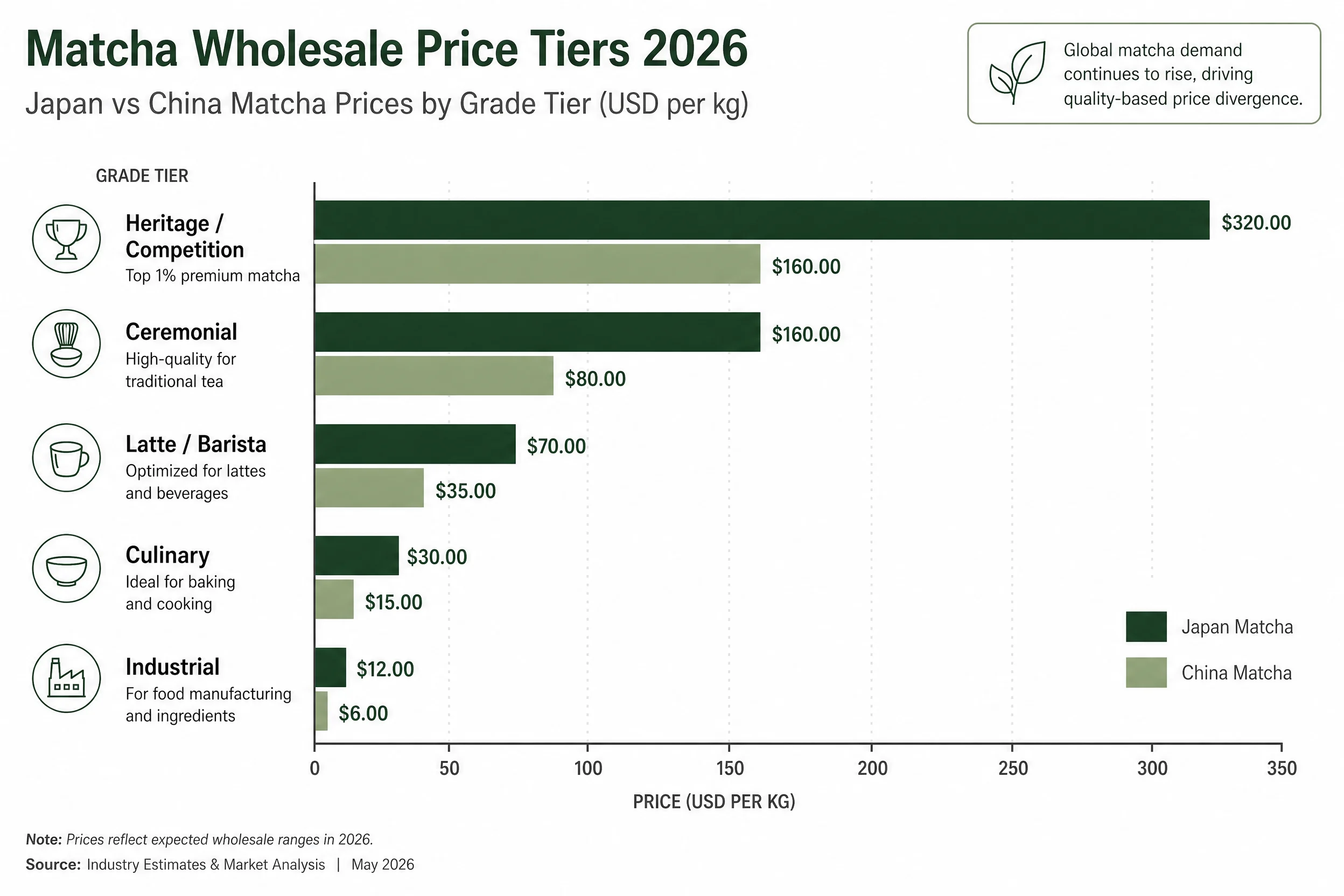
The single most useful thing you can do before contacting a supplier is know the current market range. Suppliers don’t publish retail price lists — you quote-request your way into a number. That puts you at a disadvantage unless you already know what’s normal.
The table below synthesizes data from 2026 Q1–Q2 across multiple Japanese exporters, direct-import operators, and B2B distributors. All prices are USD/kg, FOB Japan, unless noted.
| Grade | Typical Use | Japan FOB (USD/kg) | China FOB (USD/kg) |
|---|---|---|---|
| Heritage / Competition | Luxury retail, tea ceremony | $350–$650+ | N/A |
| Standard Ceremonial | Premium retail, matcha bars | $100–$320 | $30–$80 |
| Premium Latte / Barista | Café lattes, RTD beverages | $55–$140 | $15–$40 |
| Culinary (High-end) | Baking, confectionery, soft-serve | $35–$80 | $10–$25 |
| Industrial / Ingredient | Supplements, large-scale food mfg | $15–$30 (25kg+) | $3–$10 |
A few things to anchor: the premium latte/barista tier ($55–$140/kg) is where the largest share of café B2B volume actually trades. If you’re running a café program, this is the row your numbers should live in — ceremonial grade is a storytelling SKU for straight-bowl service, not a cost-effective latte base.
Also note that these are FOB prices. Your landed cost will be meaningfully higher. We cover the full math below.
Why Matcha Prices Have Roughly Doubled Since 2023

Tea fields in Minamiyamashiro, Kyoto Prefecture — the Uji growing region. Photo: vera46, CC BY 2.0, via Wikimedia Commons.
The price reset is structural, not cyclical. Understanding why matters because it changes how you plan supply contracts.
Three overlapping shocks converged in 2024–2025:
1. Kyoto yield collapse. Record spring heatwaves during the critical shading window hit Uji (Kyoto’s primary tencha-producing district) hard. Hand-picked tencha from Uji fell 40% year-over-year in 2025. A sixth-generation Uji farmer interviewed by Perfect Daily Grind reported a typical 2-tonne harvest dropping to 1.5 tonnes — a 25% loss on a single farm. Multiply that across a region and you have a severe supply shock at the premium end.
2. Auction price explosion. When supply drops and demand spikes simultaneously, auctions clear at extreme premiums. The Kyoto opening tencha auction averaged ¥8,235/kg in 2025 — roughly 1.7× the prior year and above the previous record set in 2016. At the highest lots, machine-harvested tea cleared at ¥50,000/kg. The wholesale side follows the auction; within months, import prices reflected these clearing levels.
3. Demand outrunning supply expansion. Japan’s total green tea exports crossed 10,000 metric tons for the first time since 1954 in 2025. Tencha production has nearly tripled since 2010 — but global demand grew faster. The average Japanese tea farmer is now 65–70 years old. Between 2000 and 2020, four out of five producers exited without successors. New tencha fields take five years to reach commercial harvest. Supply cannot respond quickly.
The result: ceremonial grade that cost $80–$120/kg FOB in 2023 now benchmarks at $120–$320/kg. Culinary grade moved from $20–$40 to $40–$80/kg. For anyone still running budgets against 2023 comps, those numbers are dangerously low.
What to expect going forward: Most analysts and trade sources project another 5–15% annual increase through 2027, with supply stabilization (not reduction) likely emerging from Kagoshima’s expansion by late 2026.
Japan vs China Matcha: What the Price Gap Actually Means
Chinese matcha is not fake Japanese matcha — it’s a different product at a different price point, and for some applications it’s the right call.
The pricing gap is substantial: Chinese culinary matcha runs $5–$20/kg FOB versus $35–$80/kg for the Japanese equivalent. Chinese “ceremonial equivalent” (their own marketing term) sits at $30–$80/kg versus $100–$320/kg for genuine Japanese ceremonial. That’s a 60–80% price difference depending on grade.
Where Chinese matcha makes sense for B2B buyers:
- High-volume blended beverages (boba shops, blended RTD formulations) where the matcha flavor is one of many ingredients
- Supplement encapsulation where L-theanine content matters more than flavor profile
- Initial product development when you need cost-effective testing batches before committing to a Japanese supply contract
- Price-sensitive food manufacturing (green tea noodles, confectionery coating, low-price matcha snacks)
Where it doesn’t substitute cleanly:
- Straight matcha preparation (tea ceremony, matcha shots) — flavor, color depth, and umami profile differ noticeably
- Premium café lattes where the color vibrancy is a visible quality signal to customers
- Any product marketed as “Japanese matcha” — mislabeling is both a brand risk and a regulatory issue under FDA import rules
One practical reality in this market: “ceremonial grade” is a marketing term, not a regulated designation. No governing body enforces it globally — and origin fraud is a documented pattern. The risk is not the origin per se; it’s unverified labeling claims.
If you source Chinese matcha, verify with a certificate of analysis (CoA) confirming country of origin, pesticide screening results, and heavy metal panel. Japanese certification standards (JAS) and direct-import documentation are harder to fake.
The Real Landed Cost: FOB Is Just the Beginning
FOB Japan at $120/kg doesn’t mean your cost is $120/kg. Most first-time importers underestimate landed cost by 25–45%, which blows up COGS models and menu pricing.
Here’s a realistic landed cost breakdown for a standard latte-grade matcha order (100 kg, FOB Japan):
| Cost Component | Per kg Estimate | Notes |
|---|---|---|
| FOB price (latte grade) | $65–$100 | Direct-import from Kagoshima/Nishio |
| Ocean freight (sea) | $1–$3 | Per kg, Japan to US West Coast |
| Air freight (premium) | $5–$10 | For short-lead orders or small volumes |
| US customs duty (Japanese origin) | ~15% of CIF value | Section 122 tariff as of mid-2026; MFN base for unflavored matcha is 0% |
| US customs duty (Chinese origin) | ~22.5% of CIF value | MFN 0% + Section 301 7.5% + Section 122 15%; confirm per HTS code |
| Cold-chain handling / storage | $0.50–$2 | Refrigerated warehouse, drayage |
| Broker/importer fees | $0.50–$1.50 | If using a customs broker |
| Landed total (sea, Japan) | ~$83–$133/kg | Mid-range latte grade at 100 kg |
The key insight: direct import from Japan saves 25–40% versus buying through a US distributor at equivalent grade, according to B2B operator data. Distributors add their margin on top of all the above costs. At high volume, the savings math on going direct is compelling — the trade-off is longer lead time and managing regulatory documentation yourself.
Also factor in lead time on your COGS planning. Japanese suppliers operating post-shortage run 8–16 weeks for new accounts on premium grades. Budget for buffer stock accordingly.
MOQ Tiers: How Order Volume Changes Your Price
Buying more costs less per kg, but the MOQ thresholds matter more than many buyers realize. Here’s how most 2026 Japanese suppliers structure their volume pricing:
| Order Volume | Typical Tier | Price Effect | Notes |
|---|---|---|---|
| 1–5 kg | Sample/validation | List price or higher | Qualification only — not a commercial price |
| 10–50 kg | Entry B2B | 5–10% below list | Suitable for small cafés, new accounts |
| 50–100 kg | Standard B2B | 10–20% below list | Most café chains operate here |
| 100–500 kg | Volume tier | 20–30% below list | Where per-kg economics get interesting |
| 500–1,000 kg+ | Allocation tier | Negotiated; requires contract | Post-shortage, allocation is priority |
| 5,000 kg+ | Manufacturing | Contract pricing; sea freight | RTD brands, supplement makers |
Heritage and Uji-origin producers have tightened allocation to protect existing customers since 2025. If you’re a new account requesting heritage-grade Uji matcha, expect 3–6 months onboarding and possible pre-payment requirements. Kagoshima-origin suppliers are meaningfully more accessible — onboarding in 2–4 weeks with digital documentation and phased volume scaling.
Price Red Flags: When “Cheap” Is Actually Expensive
The fastest way to waste your procurement budget in 2026 is to anchor on the cheapest quote. These pricing thresholds should trigger immediate skepticism:
- Ceremonial grade below $100/kg (Japan FOB): Almost certainly mislabeled. True Japanese ceremonial requires stone milling, 30+ day shade cultivation, and hand-sorting. The input cost alone doesn’t allow profitable production below this level.
- Ceremonial grade below $30/kg at any volume: This is Chinese-origin product relabeled, powdered sencha (not tencha), or aged inventory with oxidized chlorophyll and degraded flavor compounds.
- Culinary grade below $25/kg (Japan FOB): May indicate old stock, poor nitrogen-flush storage, or adulterated product.
- No price increase since 2023: Either the supplier locked in early supply contracts (which is actually good) or they are not buying at current market prices — which means they’re selling old product or substituting origin.
- “Japanese ceremonial” from China at $10–$15/kg: “Ceremonial grade” is a marketing term, not a regulated designation. No governing body enforces it. At this price point, you’re buying something that tastes nothing like Japanese ceremonial matcha.
A practical verification step before your first order: request a certificate of analysis (CoA) with lot number, origin declaration, harvest date, and pesticide residue testing. Legitimate suppliers provide this without friction. Pushback or delays on documentation is itself a red flag.
Cost Per Cup: Which Grade Actually Delivers the Best Café Margin?
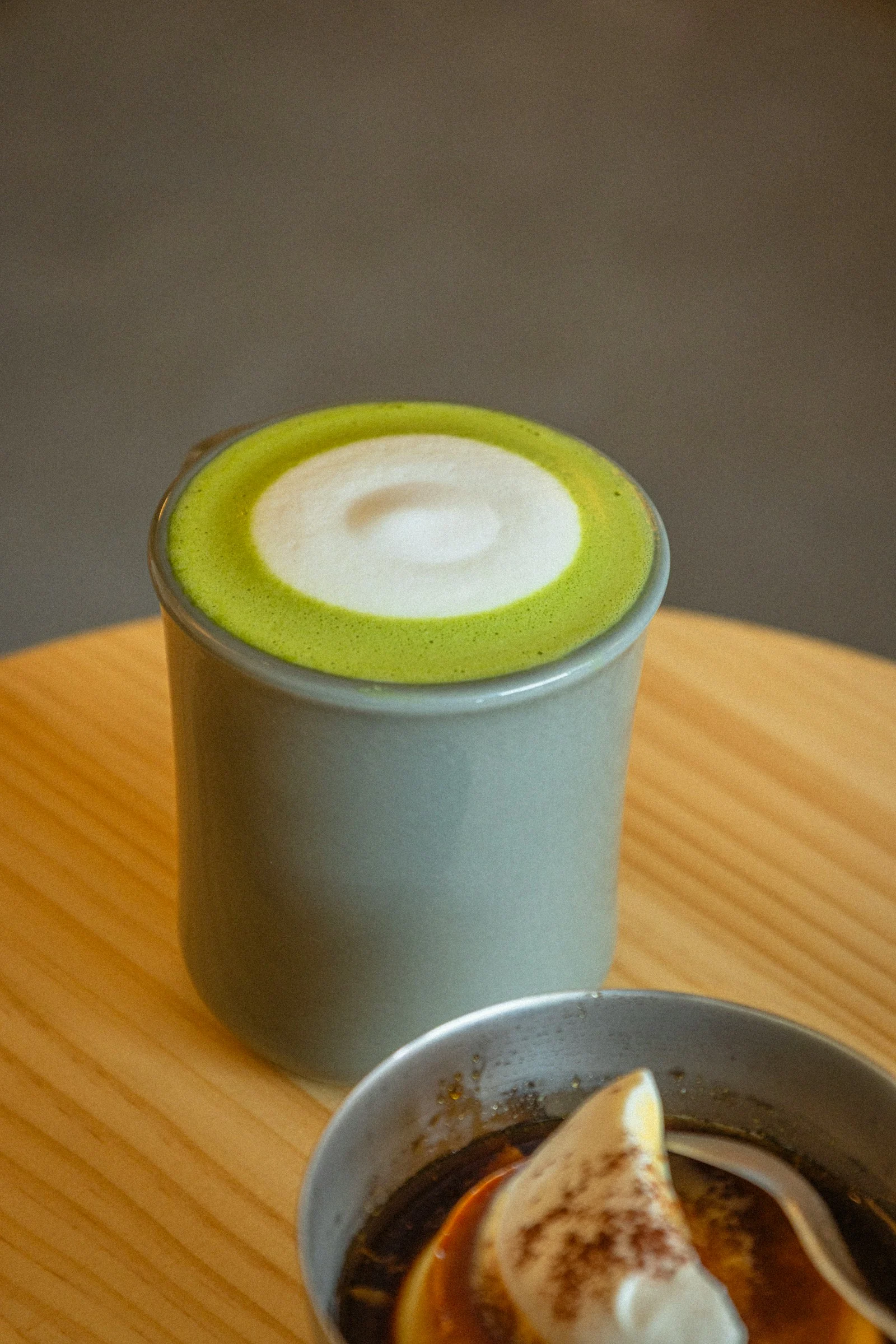
This is the calculation almost no wholesale guide shows you, and it changes which grade makes sense for your operation.
A standard matcha latte uses approximately 2–3 grams of powder. At 2.5g per drink, a 1 kg bag yields roughly 400 servings. Here’s how the math plays out across grades at the café level:
| Grade | Cost/kg (landed) | Cost/serving (2.5g) | Sell price (latte) | Matcha as % of COGS |
|---|---|---|---|---|
| Standard Ceremonial ($150/kg) | $150 | $0.38 | $6.50 | 5.8% |
| Latte/Barista ($80/kg) | $80 | $0.20 | $6.00 | 3.3% |
| Culinary ($45/kg) | $45 | $0.11 | $5.00 | 2.2% |
The counterintuitive finding from blind tests: in milk-based lattes with sweetener, customers consistently cannot distinguish $80/kg barista grade from $150/kg ceremonial grade. Dairy fat and sweetness mask the nuance. The quality difference only registers clearly in straight-bowl matcha preparations.
The verdict for most café operators: latte/barista grade at $60–$100/kg landed delivers the best margin per cup while maintaining the color vibrancy customers associate with quality. Save ceremonial grade for straight-drinking applications on your menu — price it as a premium offering that customers opt into, not as the base for lattes.
One caveat: this calculus assumes your customer base responds to price, not just to “ceremonial” marketing. Some premium-positioned cafés use ceremonial grade as a marketing anchor (“all our lattes use ceremonial grade matcha”) and price at $8–$10 accordingly. That’s a valid strategy if your positioning supports it — just understand that the quality signal is largely perceptual at the latte level.
What Smart B2B Buyers Are Doing in 2026
The buyers who locked in supply agreements in early 2025 are significantly better positioned than those entering the market now. But there are still actionable moves for 2026 procurement:
1. Move to Kagoshima-origin latte grade for volume purchasing. Kagoshima surpassed Shizuoka as Japan’s #1 first-flush producer in 2025. Large-scale flat-field mechanization delivers consistent quality at 20–30% below Uji pricing. For café and food manufacturing applications, this is the practical B2B volume standard of 2026.
2. Go direct-import on any volume above 25 kg. Direct Japan import costs 25–40% less than equivalent-grade distributor stock. The documentation overhead is manageable, and several exporters now offer onboarding in 2–4 weeks with full FDA/EU regulatory paperwork included.
3. Request an allocation contract, not just spot pricing. Post-shortage, the gap between “we can get you some” and “we can guarantee your volume” is material. An annual allocation contract secures supply priority — often worth more than a small per-kg discount.
4. Validate with a 1–5 kg sample order before committing. Test sensory profile (color, aroma, taste), request the CoA, verify lot traceability. Any supplier who won’t ship a small validated sample is not operating at B2B standard.
Frequently Asked Questions
How much does matcha cost per kg wholesale in 2026?
Japanese latte/barista grade: $55–$140/kg FOB. Japanese ceremonial grade: $100–$320/kg FOB. Chinese culinary grade: $5–$20/kg FOB. Landed cost in the US adds approximately 15–40% to FOB depending on freight method and duties.
Why is matcha so expensive right now?
Three overlapping factors: the 2024–2025 Kyoto heatwave cut hand-picked Uji tencha yields by 40%, Japan’s tencha auction prices jumped 116% in a single year, and global demand has been outpacing supply expansion for several years. Average Japanese tea farmer age is above 65, and new fields take five years to reach commercial harvest.
What is a fair wholesale price for ceremonial grade matcha?
Standard Japanese ceremonial grade (Uji or Kagoshima, stone-milled) should land between $100 and $250/kg FOB at 10–50 kg MOQ in 2026. Anything below $100/kg from a Japanese origin claim is a quality or origin concern. Heritage-grade Uji product runs $350–$650+/kg and supply is extremely limited.
Is Chinese matcha a viable B2B substitute for Japanese matcha?
For high-volume blended beverages, supplements, and budget food manufacturing: yes, with origin-transparent labeling. For premium café lattes, straight matcha, or any product marketed as Japanese matcha: no. The flavor, color depth, and regulatory/labeling compliance issues are material.
What is the minimum order quantity for bulk matcha?
Most Japanese B2B suppliers accept 5–10 kg for initial quality validation, 50–100 kg for first commercial orders. Volume pricing kicks in meaningfully at 100–500 kg. Post-shortage heritage producers may require 25–50 kg minimums even for new account validation.
How do I protect my supply in a constrained market?
Three actions: (1) sign an annual allocation contract with your primary supplier, (2) develop a secondary Chinese-origin supplier for non-premium applications to reduce Japanese supply dependency, and (3) build 60–90 days of buffer stock during Q3–Q4 when 2026 harvest inventory is most available.
Summary: What This Means for Your 2026 Procurement
The matcha pricing landscape has permanently reset from 2023 benchmarks, and it’s not coming back. If you’re building a product or menu program that depends on Japanese matcha, budget at 2026 rates, not the prices you last paid two years ago.
The clearest takeaways: use latte/barista grade for café volume programs (the ROI math doesn’t support ceremonial grade in lattes), go direct-import on any order above 25 kg, and treat allocation security as a priority metric alongside price. On the sourcing side, Kagoshima is the practical volume engine of 2026 — accessible, consistent, and meaningfully cheaper than Uji without a material quality penalty for most applications.
One thing I’ll flag honestly: the pricing ranges in this guide come from multiple B2B sourcing sources and 2026 Q1–Q2 trade data, but market conditions in this space move faster than published guides. Always confirm current pricing directly with 2–3 suppliers before finalizing your COGS model. The benchmarks here are a starting point for negotiation, not a substitute for real quotes.