
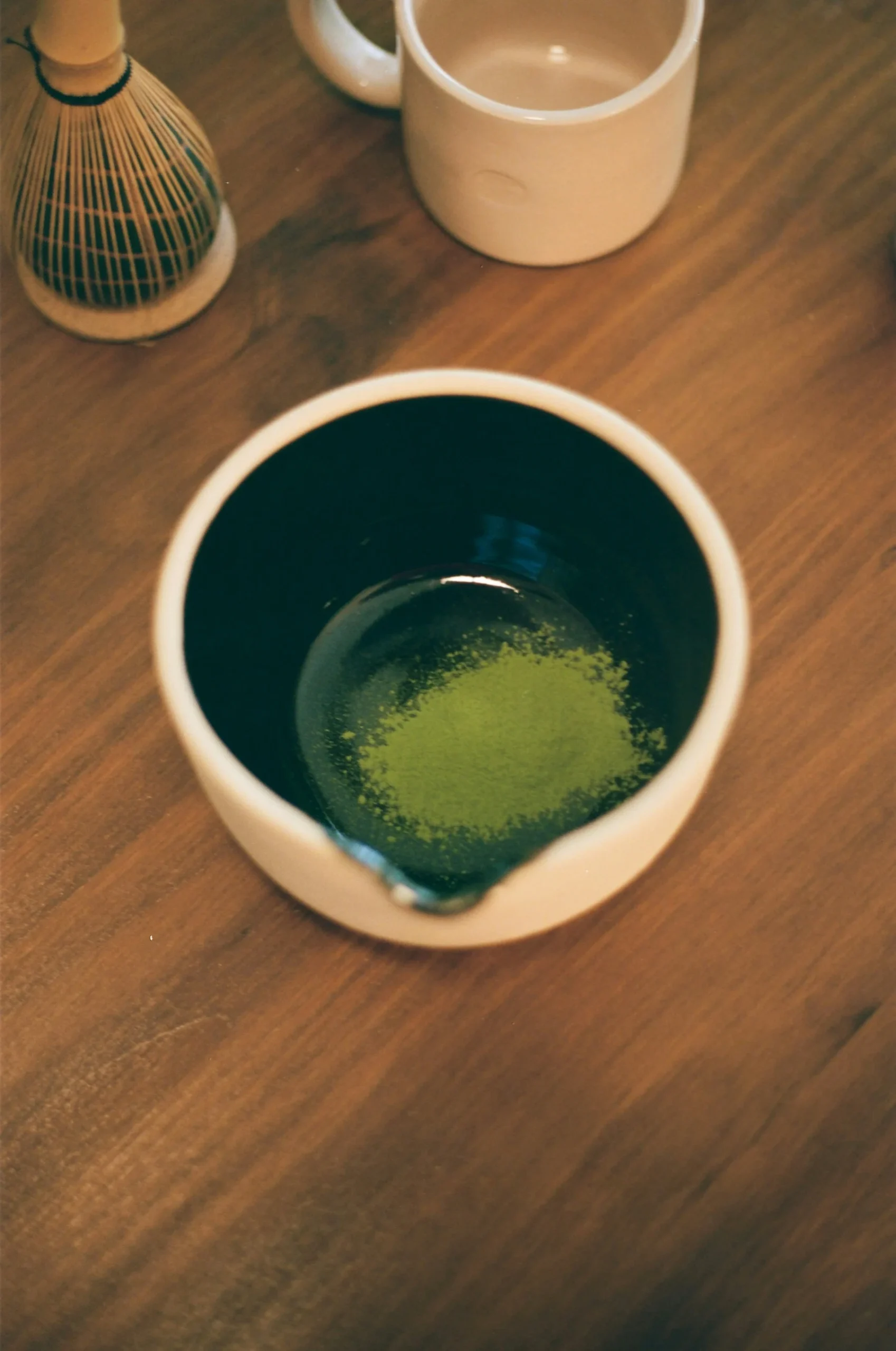
Japanese matcha — particularly from top-tier growing regions like Uji — delivers measurably higher L-theanine (up to 28.51 mg/g vs as low as 9.30 mg/g in some Chinese samples), lower bitterness, and more vibrant color due to longer shading periods (20–30 days vs 7–10 days) and stone-mill processing. Chinese matcha costs 30–50% less at wholesale and works well for culinary applications where flavor nuance is masked. For ceremonial use, specialty cafés, or premium retail, the quality difference is real and backed by peer-reviewed data. For high-volume baking or flavored products, Chinese matcha is a defensible cost choice — if you verify pesticide certifications.
The first time I sampled matcha side-by-side from both origins — a Nishio culinary grade from Aichi and a Guizhou export-grade — the difference wasn’t subtle. The Japanese powder dissolved into a matte, deep emerald foam. The Chinese sample clumped at the edges of the bowl, tasted sharper, and left a lingering bitterness that didn’t fade into the characteristic sweet finish.
That experience matches what a 2023 peer-reviewed study published in PMC found when they tested 11 matcha samples across Japanese and Chinese origins: Japanese premium grades scored the lowest ratio of bitter compounds to umami-producing amino acids — a metric called the RTA (ratio of tea polyphenols to amino acids). The best Japanese sample hit an RTA of 3.46. The worst Chinese sample reached 13.85. The gap isn’t marketing — it’s measurable chemistry.
This guide covers what actually separates Japanese and Chinese matcha at every level: cultivation, processing, flavor, nutrition, safety, pricing, and where to source each. It’s written for buyers making real procurement decisions — café operators, food manufacturers, and specialty retailers who need a clear framework, not vague praise for Japanese culture.
The global matcha market hit approximately $4–5 billion in 2025 and is growing at 7–11% annually (estimates vary by research firm). That growth is pulling more Chinese production online and pushing Japanese growers toward premium positioning. Understanding which origin actually serves your use case — and how to verify what you’re buying — is more commercially important than ever.
The Origin Story: Why These Two Matchas Took Such Different Paths
Matcha has an ironic history: the powdered tea technique was invented in China during the Song Dynasty (960–1279 CE), brought to Japan by Buddhist monks in the late 12th century, and then essentially abandoned in China for centuries as loose-leaf teas took over. Japan continued refining the process, developing the shading techniques, cultivars, and stone-milling methods that define ceremonial matcha today.
China’s re-entry into matcha production is largely a response to the past decade’s global boom. Large-scale commercial matcha farming in Chinese provinces like Guizhou and Zhejiang accelerated after 2015, driven by export demand rather than a domestic cultural tradition. In 2024, Tongren city in Guizhou Province produced over 1,200 tonnes of matcha, generating more than 300 million yuan (~$42 million) in output value — a figure that signals genuine industrial scale.
Japan, by contrast, has roughly 800 years of continuous matcha refinement behind it. Farming families in Uji (Kyoto), Nishio (Aichi), and Kagoshima have spent generations selecting cultivars, amending soil, and perfecting shade-growing protocols. That institutional knowledge doesn’t transfer quickly.
The practical implication: Japanese matcha production has deep process consistency baked in. Chinese matcha quality varies more widely producer-to-producer, because the industry is younger and standards are still being established.
How They’re Grown: Shading, Soil, and What It Does to the Leaf
Shading is the single biggest cultivation variable between Japanese and Chinese matcha — and it’s where the quality gap originates.
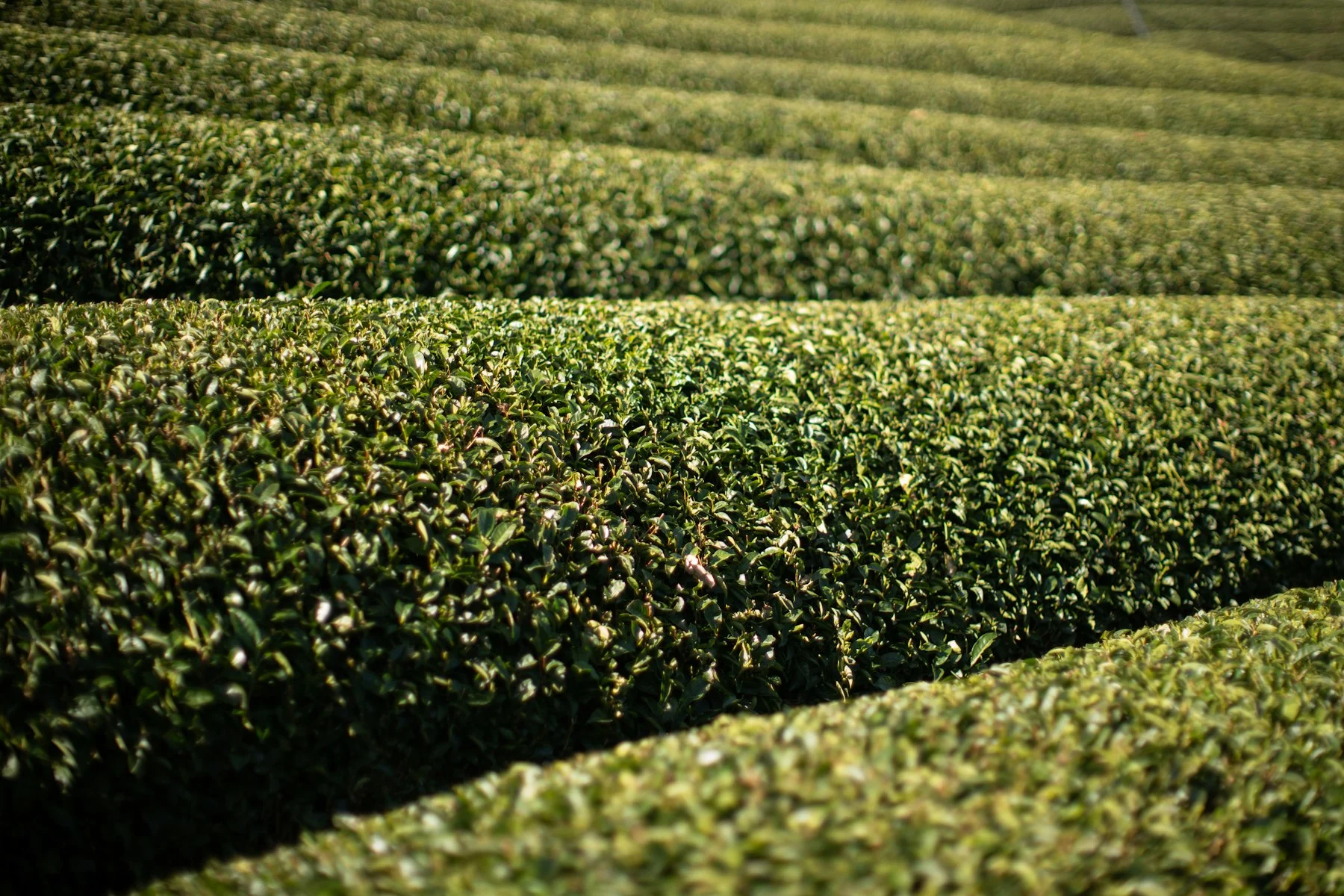
Japan: Tea plants destined for tencha (the leaf that becomes matcha) are shaded for 20–30 days before harvest, with structures blocking 80–90% of sunlight. This light deprivation triggers a stress response in the plant: chlorophyll production increases (giving matcha its vivid green), the plant converts stored catechins into L-theanine (reducing bitterness and increasing umami), and the leaf stays tender. This shading protocol is standard across Japan’s major growing regions, though the exact duration and method varies by farm and grade.
China: Commercial matcha operations in Guizhou and Zhejiang typically shade for 7–10 days, and some use minimal shading or none at all. Without adequate shading, L-theanine doesn’t accumulate to the same levels, catechins remain higher (more bitterness), and chlorophyll doesn’t reach the concentration that produces matcha’s characteristic bright green.
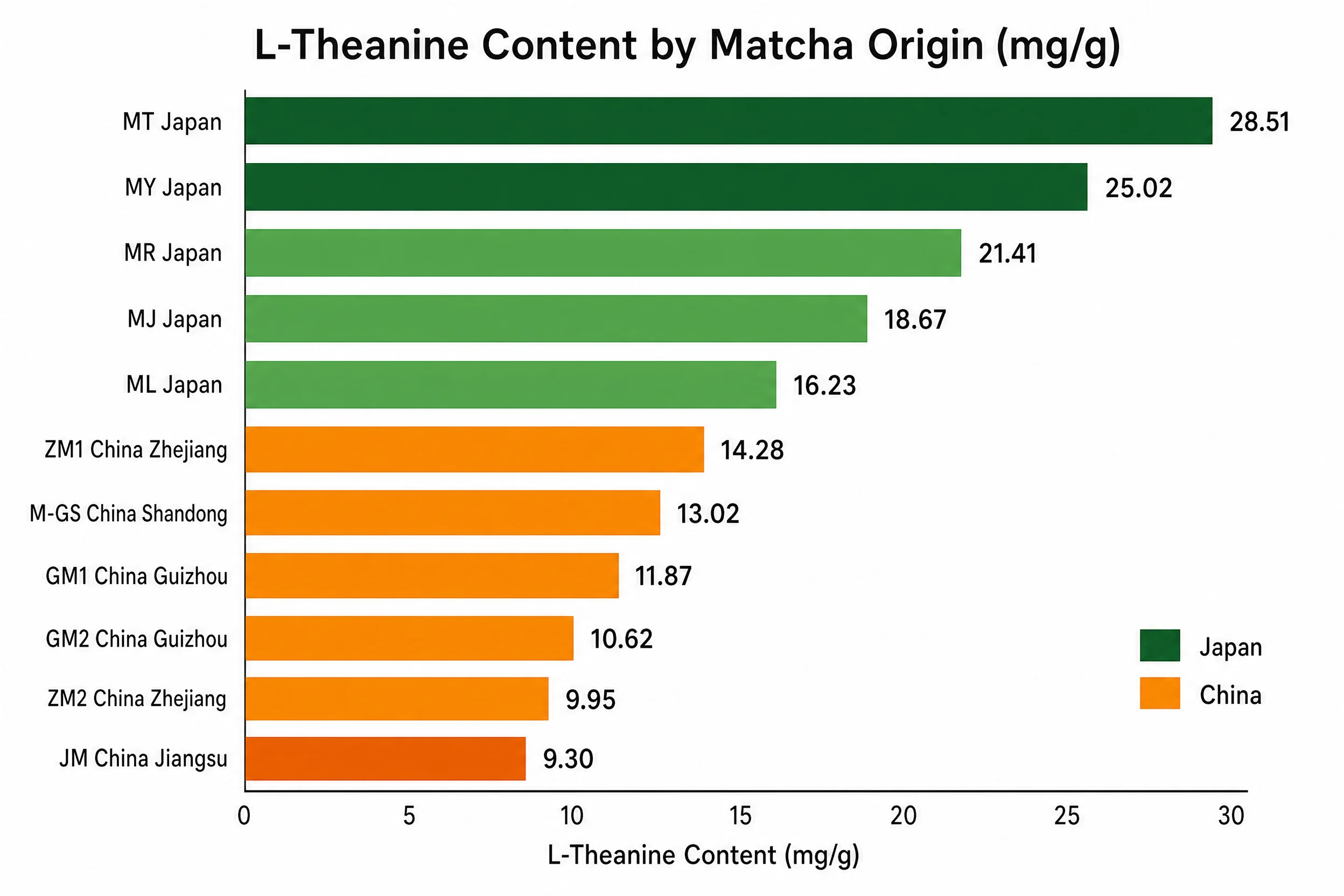
The 2023 PMC study confirmed this directly: the highest L-theanine readings (28.51 mg/g and 25.02 mg/g) came from Japanese samples; the lowest came from Chinese Jiangsu and Zhejiang samples (9.30 mg/g and 10.25 mg/g). L-theanine is the compound responsible for matcha’s calming focus effect and its sweet, savory taste. A threefold difference in L-theanine is a significant quality gap — not a marginal one.
Cultivar and soil also matter. Japan’s most prized cultivar for matcha is Okumidori (used in Uji ceremonial grades), followed by Yabukita (common in Nishio). Some Japanese plots use tea plants over 100 years old, where soil amendments over generations have created ideal mineral profiles. Chinese matcha operations often grow Longjing 43 or other cultivars originally selected for green tea, not matcha — which affects the base flavor chemistry.
| Factor | Japan | China |
|---|---|---|
| Shading duration | 20–30 days | 7–10 days (or less) |
| Sunlight blocked | 80–90% | Variable (often less) |
| Primary cultivars | Okumidori, Yabukita, Saemidori | Longjing 43, Zhejiang local cultivars |
| Farm history | Multi-generational (some 100+ year plots) | Largely post-2015 commercial operations |
| Soil management | Long-term amendment protocols | Variable by producer |
Processing: Steaming, Pan-Firing, Stone Mills, and Industrial Grinders
After harvest, matcha undergoes a multi-step process that shapes everything about the final powder. Japan and China diverge at every stage.
Step 1 — Killing the green (stopping oxidation)
Japan uses steam to halt oxidation immediately after harvest. Steaming preserves amino acids, maintains the leaf’s bright green color, and keeps catechins in their native form. This is the foundation of matcha’s characteristic flavor.
China traditionally uses pan-firing — a dry heat method inherited from green tea production. Pan-firing produces a toasty, nuttier flavor profile and causes some color dulling. Some Chinese matcha operations have adopted steaming to target the export market, but pan-firing remains common, particularly for domestic use and lower-grade exports.
Step 2 — Tencha preparation (Japan-specific)
Before grinding, Japanese matcha producers dry the steamed leaves into a form called tencha, then run the dried sheets through deveining and destemming machines. Removing the stems and veins before grinding produces a purer, smoother powder. Chinese producers typically skip this step, grinding the whole leaf including stems and veins. The result: coarser texture and a slightly more bitter, astringent finish.
Step 3 — Milling
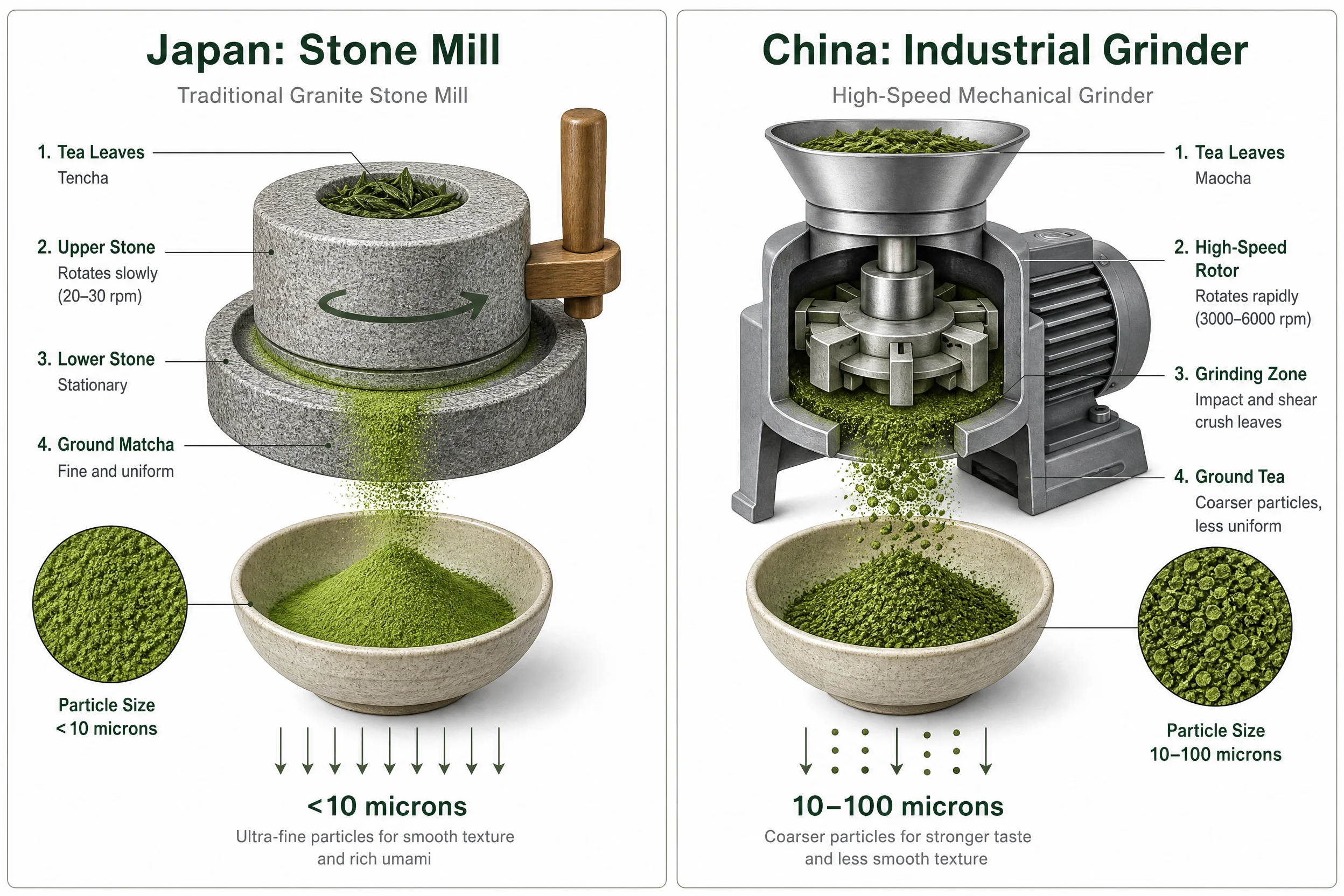
Japanese ceremonial and premium matcha is ground on granite stone mills, which produce particles under 10 microns without generating significant heat. The low-heat process preserves heat-sensitive compounds like EGCG and L-theanine. Stone mills are slow — a single mill produces roughly 30–40 grams per hour — which is partly why Japanese matcha costs more.
Chinese industrial operations use high-speed mechanical grinders. These are faster and cheaper but generate friction heat, which degrades sensitive compounds, and produce less consistent particle sizes. The result is a coarser, less uniform powder that doesn’t dissolve as cleanly in water.
| Processing Step | Japan | China |
|---|---|---|
| Oxidation stop | Steaming | Pan-firing (or steaming in premium lines) |
| Stem/vein removal | Yes — tencha process | Typically no |
| Milling method | Granite stone mill | Industrial mechanical grinder |
| Particle size | <10 microns | Coarser, variable |
| Heat during milling | Minimal | Higher (friction) |
The processing differences compound on each other. A Japanese premium matcha starts with longer-shaded, higher-L-theanine leaves, removes stems and veins, steam-halts oxidation, and grinds at low heat. Each step preserves quality. Chinese matcha at the budget end of the market skips or shortcuts several of these steps — that’s where the cost saving comes from.
What the Lab Data Actually Shows
Claims about Japanese matcha superiority are easy to find. Peer-reviewed data is rarer. A 2023 study published in PMC (Variations of Main Quality Components of Matcha from Different Origins, Luo et al.) tested 11 matcha samples — a mix of Japanese and Chinese origins — measuring the key biochemical markers that drive flavor quality. Here’s what they found.
L-Theanine (umami, sweetness, calming focus)
L-theanine is the amino acid responsible for matcha’s distinctive sweet savory flavor and its effect on focused calm. The range across all 11 samples was stark: 9.30 mg/g at the low end to 28.51 mg/g at the top. Japanese premium sample MT hit 28.51 mg/g; MY hit 25.02 mg/g. Chinese Jiangsu sample JM came in at 9.30 mg/g; Zhejiang ZM2 at 10.25 mg/g. The top Japanese samples had roughly three times the L-theanine of the lowest Chinese samples.
Some Chinese samples were more competitive: Guizhou GM1 reached 16.12 mg/g, and Shandong M-GS hit 15.14 mg/g — in the lower range of Japanese mid-grade matcha.
Tea Polyphenols (bitterness, astringency)
Lower polyphenol content generally means less bitterness. Japanese premium grades MT and MY showed the lowest polyphenol readings (~13.6–14.1%), while Guizhou GM1 scored highest at 20.56% and Jiangsu JM at 19.81%.
RTA Ratio (the overall quality indicator)
The RTA (ratio of tea polyphenols to free amino acids) captures the balance between bitterness and umami in a single number. Lower is better — it means more sweetness and umami relative to bitterness.
| Sample | Origin | RTA (lower = better) |
|---|---|---|
| MT | Japan (premium) | 3.46 |
| MY | Japan (premium) | 3.80 |
| MR | Japan (mid-grade) | 5.96 |
| MJ | Japan (mid-grade) | 5.90 |
| ML | Japan (mid-grade) | 6.96 |
| ZM1 | China (Zhejiang) | 6.95 |
| M-GS | China (Shandong) | 7.48 |
| GM1 | China (Guizhou) | 8.98 |
| GM2 | China (Guizhou) | 9.05 |
| ZM2 | China (Zhejiang) | 10.61 |
| JM | China (Jiangsu) | 13.85 |
Source: Luo et al. 2023, PMC10034323
The pattern is clear: Japanese premium grades occupy the top tier. But Zhejiang ZM1 (RTA 6.95) sits almost exactly at the level of Japanese mid-grade samples. Not all Chinese matcha is low quality — but the variance is much higher, and the bottom of the Chinese range is significantly worse than anything in the Japanese range tested.
This data has a direct sourcing implication: for cafés sourcing culinary-grade matcha for lattes or baked goods where the matcha is mixed with milk and sugar, the difference between an RTA of 7 and an RTA of 4 will be largely masked. For a ceremonial bowl of straight matcha where every note is exposed, it isn’t.
Color, Texture, and Taste: A Practical Side-by-Side
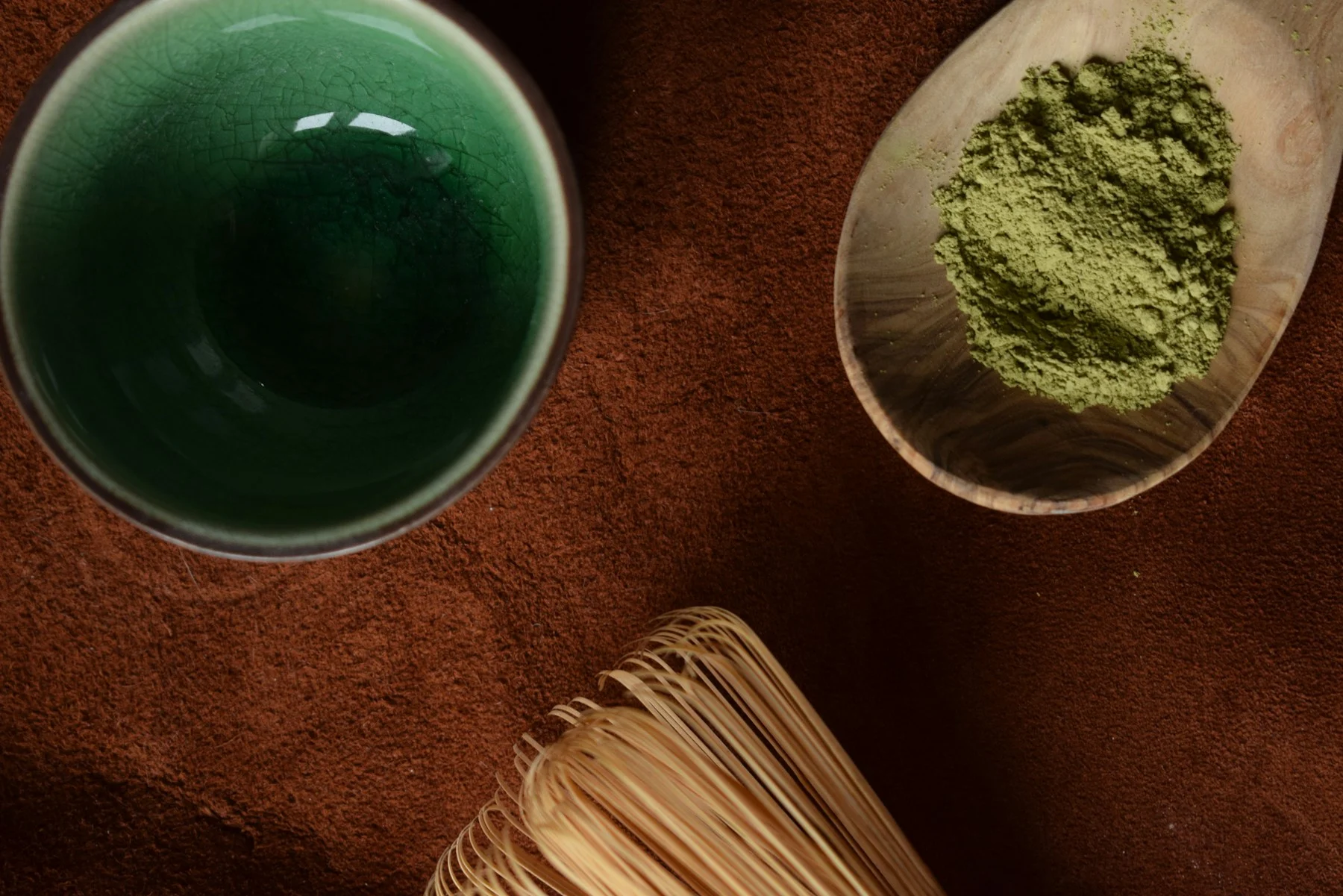
You don’t need a lab to tell the difference between high-quality Japanese matcha and low-grade Chinese matcha. The signals are visible and tangible before you taste anything.
Color
Premium Japanese matcha is a saturated, almost iridescent emerald green. When you open the tin, the color is vivid enough to notice. Chinese matcha at the budget end is noticeably duller — often with yellow or brown undertones that reveal lower chlorophyll and the color-dulling effects of pan-firing. Some premium Chinese producers are closing this gap, particularly those who’ve adopted steaming, but the population-wide color difference is real.
I’ve found the easiest field test is to put a small amount of each powder on a white ceramic plate in natural light. The color contrast between a Nishio culinary grade and a typical Guizhou export grade is immediately obvious.
Texture
Japanese ceremonial-grade matcha ground on stone mills feels silky when rubbed between fingers — no gritty sensation, no visible granules. It dissolves cleanly in water with a bamboo whisk, forming a smooth, stable foam.
Chinese matcha ground on industrial machines has coarser particles that you can feel. It doesn’t dissolve as cleanly, and the foam (if it forms) tends to be looser and collapses faster. In a latte, this difference is less important — the milk texture masks it. In a traditional bowl, it’s the difference between a smooth, cohesive drink and one with a slightly gritty finish.
Taste
Japanese premium matcha: sweet umami upfront, low bitterness, long clean finish. The sweetness comes from L-theanine interacting with taste receptors — this isn’t added sugar, it’s the amino acid chemistry.
Chinese mid-range matcha: more directly bitter, less complex. The vegetal/grassy notes are sharper and don’t soften into sweetness. A higher-quality Chinese sample (like the Guizhou GM1 in the study) is closer to mid-tier Japanese matcha in terms of bitterness, but still noticeably different from premium Japanese grades.
Foam quality (relevant for cafés)
Finely milled Japanese matcha produces a denser, more stable foam when whisked — important for both the ceremonial bowl presentation and latte art. The coarser particle size in industrial Chinese matcha produces less stable foam. For straight preparation, this matters. For matcha lattes where steamed milk dominates, less so.
Safety and Certifications: What the Labels Actually Tell You
The pesticide question about Chinese matcha comes up in almost every sourcing conversation. It deserves a calibrated answer rather than either dismissal or alarm.
The 2012 Greenpeace Study
A 2012 Greenpeace report tested 18 Chinese green teas and found that all 18 samples contained detectable pesticide residues; 12 of 18 (67%) exceeded EU Maximum Residue Levels for pesticides. A separate study on Chinese tea samples from 1999–2001 found 32% exceeded China’s national limits for lead contamination. These are real data points — but they’re also 13–25 years old, cover a broad category (not matcha specifically), and predate the current Chinese matcha export industry’s development.
What the data means now
China has updated its food safety standards significantly since 2012 (GB 2763 standard for pesticide residue limits in tea). The matcha producers targeting international B2B buyers typically test to much more stringent standards — often 500+ pesticide screens — because EU and US import requirements demand it. Reputable Chinese export-grade matcha suppliers submit to third-party laboratory testing to satisfy their buyers.
The risk is not zero, but it’s concentrated at the lower end of the market: unverified wholesale powder from trading companies with no lab documentation. A verified Chinese matcha supplier with EU Organic certification and current third-party pesticide test results is a meaningfully different proposition than a random bulk supplier.
What certifications actually verify
| Certification | What it verifies | Limitations |
|---|---|---|
| JAS Organic (Japan) | Japanese government inspection of growing/processing practices | Japanese regulatory standard; strong enforcement |
| USDA Organic | Third-party auditor verification of organic methods | Doesn’t independently verify specific pesticide absence — it verifies process |
| EU Organic | Strict multi-residue pesticide testing required for import | One of the strongest standards for actual residue verification |
| JAS + USDA Organic | Two independent verification systems | Strongest combination for verified Japanese matcha |
| ISO 22000 / HACCP | Food safety management system | Doesn’t address pesticides specifically |
The honest sourcing takeaway: For Japanese matcha, JAS certification combined with third-party pesticide screens covering 500+ compounds is the gold standard. For Chinese matcha, EU Organic certification (which requires actual residue testing) plus third-party lab results is the most reliable safety signal. Certifications alone aren’t enough — ask for the actual test reports.
Lead in matcha
One safety concern that applies to both origins: matcha is a whole-leaf powder, and Camellia sinensis can accumulate lead from soil. Studies have found that matcha can contain higher lead levels than steeped green tea (because you consume the whole leaf). This isn’t unique to Chinese matcha — it applies to any matcha, and reputable suppliers test for heavy metals including lead. Always ask for heavy metals testing documentation, regardless of origin.
Pricing Reality: What You Actually Pay Per Gram
Chinese matcha costs 30–50% less than comparable Japanese matcha at wholesale — but “comparable” is doing a lot of work in that sentence. The products being compared aren’t equivalent.
Here’s a realistic wholesale price landscape based on current market data:
Japan wholesale pricing (FOB Japan, approximate 2025–2026 ranges)
| Region | Grade | Price per kg (1–10 kg) | Price per kg (50–200 kg) |
|---|---|---|---|
| Uji (Kyoto) | Ceremonial | ¥60,000–¥120,000+ (~$400–800+) | ¥42,000–¥60,000 (~$280–400) |
| Nishio (Aichi) | Premium | ¥25,000–¥50,000 (~$165–330) | ¥18,000–¥30,000 (~$120–200) |
| Kagoshima | Culinary | ¥12,000–¥25,000 (~$80–165) | ¥10,000–¥18,000 (~$65–120) |
China wholesale pricing (approximate, export-grade)
| Region | Grade | Price per kg |
|---|---|---|
| Guizhou | Premium export | $30–70 |
| Zhejiang | Standard export | $15–40 |
| Jiangsu | Culinary/bulk | $10–25 |
The per-cup cost difference is smaller than the per-kg price suggests. A latte typically uses 2–3 grams of matcha powder. If you’re paying $150/kg for Japanese culinary-grade versus $30/kg for Chinese export-grade, the per-cup difference is roughly 24–36 cents. For a café selling matcha lattes at $6–8, that’s a margin consideration, not a business-ending one.
Where the price difference becomes significant is in high-volume applications — baked goods, packaged products, or food manufacturing where matcha is used by the hundreds of kilograms. There, the Chinese pricing advantage is substantial, and if the application masks flavor nuance, the quality tradeoff is more defensible.
One cost factor people overlook: Japanese matcha has higher potency due to its L-theanine and amino acid profile. You may achieve equivalent flavor impact at 2g of Japanese premium vs 3–4g of lower-grade Chinese matcha. The effective cost gap narrows when you account for this.
When to Source Japanese vs Chinese Matcha: A Decision Framework
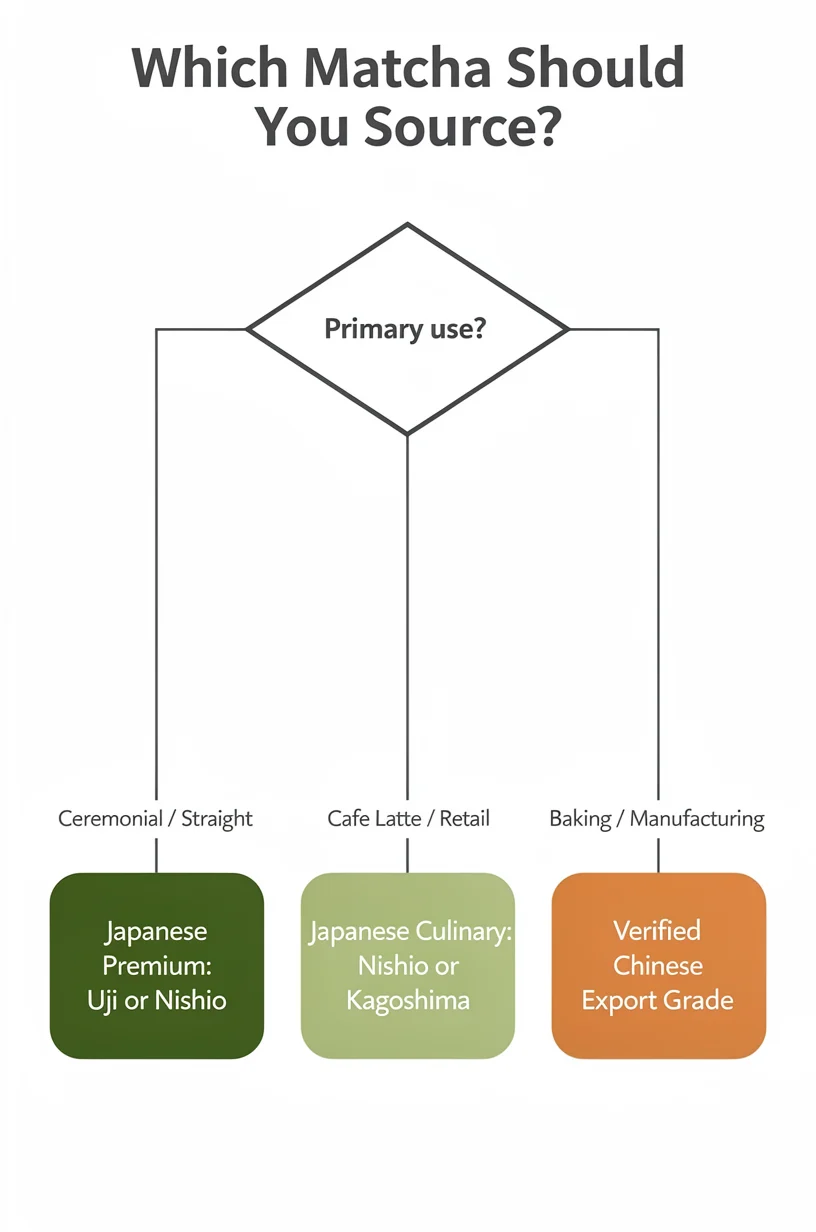
The right origin depends on your application, your customer’s expectations, and your quality verification capabilities.
Source Japanese matcha when:
- You’re serving straight matcha (ceremonial bowl, koicha, thinly whisked usucha) — flavor is fully exposed
- Your brand positioning is premium or specialty, and “Japanese matcha” is a marketing claim you need to own authentically
- Your customers are matcha-literate and will notice quality differences
- You’re building a specialty café menu where matcha is a hero ingredient, not a flavor additive
- You need consistent color for visual presentation (latte art, premium packaging, photography)
- You’re selling into markets with high E-E-A-T expectations (health food retail, functional beverage brands)
Chinese matcha can work when:
- Matcha is a flavor component in baked goods, ice cream, chocolate, or flavored confectionery — where it’s mixed with sugar, fat, and other ingredients that mask bitterness and texture
- You’re running a high-volume food manufacturing operation and cost per kilogram is a primary constraint
- You can verify pesticide safety with current third-party lab documentation and EU Organic or equivalent certification
- Your specific supplier has proven quality documentation and you’ve tested samples side-by-side against your specification
The honest middle ground:
Some Chinese producers — particularly in Guizhou using improved shading protocols — produce matcha that performs comparably to Japanese mid-grade culinary grades. The 2023 PMC study shows this. The issue isn’t “Chinese matcha is always bad” — it’s that the variance is much higher, and without proper verification, you don’t know which end of that range you’re getting.
Decision matrix:
| Application | Recommended Origin | Why |
|---|---|---|
| Ceremonial/straight matcha | Japanese (Uji or Nishio premium) | Flavor fully exposed; L-theanine and RTA matter |
| Specialty café matcha latte | Japanese (Nishio premium or Kagoshima culinary) | Brand positioning + visible color |
| Standard café volume latte | Japanese culinary or verified Chinese premium | Cost manageable; verify quality |
| Baked goods (muffins, cakes) | Chinese export-grade (verified) | Flavor masked; cost advantage relevant |
| Food manufacturing at scale | Chinese (high-volume) | Volume economics; rigorous QC documentation required |
| Premium retail/packaged matcha | Japanese | Consumer expectation and label claim |
| Private-label health supplement | Japanese (verified JAS Organic) | Consumer trust; clean label demand |
Where to Source: Regions, Supplier Types, and the Questions That Separate Good Vendors from Bad Ones
Japanese matcha: which region to target
Uji (Kyoto Prefecture) is Japan’s most prestigious matcha region and the origin of record for ceremonial-grade matcha. Uji matcha commands the highest prices — ¥40,000–¥120,000+/kg at volume — and the “Uji Matcha” designation carries genuine cachet. If you’re building a premium retail brand and “Uji” is part of your story, this is where to source. Expect higher MOQs and longer lead times.
Nishio (Aichi Prefecture) is Japan’s largest volume matcha producer, accounting for roughly 20–30% of Japan’s matcha output. Nishio’s matcha is more accessible at wholesale, offers consistent quality at mid-tier pricing (¥18,000–¥50,000/kg), and works well for specialty café applications. Most of the export-volume Japanese matcha brands that supply cafés globally source from Nishio.
Kagoshima Prefecture has Japan’s longest growing season (due to its southern climate) and offers competitive culinary-grade matcha at ¥12,000–¥35,000/kg. Good choice for high-volume café applications or food manufacturing where cost per kilogram matters but you still want verified Japanese origin.
Chinese matcha: which region to evaluate
Guizhou Province (particularly Tongren) is China’s most active matcha development zone. Some Guizhou producers have invested in proper shading infrastructure and steaming equipment — the Guizhou samples in the 2023 PMC study showed the most competitive quality among Chinese origins (RTA 8.98–9.05, L-theanine 16+ mg/g). Worth evaluating for culinary applications with a verified supplier.
Zhejiang Province has a longer tea history and some producers with more developed quality protocols. The PMC study showed mixed results — ZM1 was competitive (RTA 6.95), ZM2 was not (RTA 10.61). Requires careful sample evaluation.
Jiangsu Province showed the weakest quality profile in the study (RTA 13.85, L-theanine 9.30 mg/g). I’d avoid for anything except the most commodity-level bulk applications where flavor is entirely masked.
Supplier types and their tradeoffs
Direct from farm: Lowest cost, highest friction. Requires direct relationship, language capability (Japanese or Chinese), and willingness to navigate export logistics and certifications yourself. Best for buyers with significant volume (200+ kg/year) who have established relationships.
Specialized export partners / matcha importers: Handle certifications, documentation, quality verification, and shipping. Charge a margin for the service. Right choice for most specialty cafés and food brands — the MOQs are typically flexible (10–50 kg minimum), and they’ve already verified supplier quality.
Trading companies: High volume, low traceability. Often lack farm-level transparency. Best avoided unless you have direct access to their QC documentation.
5 questions to ask any matcha supplier before ordering
- “Can you provide your full pesticide test report?” — Ask for a multi-residue screen covering 500+ compounds, not just the certification summary. If they can’t provide it, move on.
- “What is the shading duration for this specific lot?” — Any supplier sourcing from Japan should be able to tell you whether this is 20-day or 30-day shade. Chinese suppliers should be able to answer this too; if they can’t, it’s likely minimal.
- “Is this a farm-direct product, and can you provide farm traceability documentation?” — Particularly important for Japanese matcha, where mislabeling (selling Chinese-grown powder as Japanese) is a documented problem.
- “What is the particle size?” — Ceremonial-grade should be under 10 microns. Ask for the specification sheet.
- “Can you provide a sample lot before we commit to volume?” — Any reputable supplier will provide samples. Test it against your application before placing a large order.
Frequently Asked Questions
Is matcha from China as good as from Japan?
It depends on the specific producer and grade. Peer-reviewed lab data (Luo et al. 2023) shows that Japanese premium grades have significantly higher L-theanine (up to 28.51 mg/g vs 9.30 mg/g in the lowest Chinese sample) and lower bitterness ratios. However, the best Chinese samples from Guizhou show quality comparable to mid-tier Japanese matcha. The average quality gap is real; the worst Chinese matcha is considerably weaker, but the best Chinese culinary-grade matcha is competitive for applications that don’t require ceremonial-level flavor.
Where does the highest quality matcha come from?
Uji in Kyoto Prefecture, Japan, produces the most consistently high-quality ceremonial matcha. Nishio in Aichi is the largest volume Japanese producer and offers excellent mid-grade consistency. Within Japan, quality is strongly correlated with shading duration, cultivar selection, and stone-mill processing — all of which are most consistently practiced in Uji and Nishio.
Why is Japanese matcha more expensive than Chinese matcha?
Three main factors: (1) longer shading (20–30 days vs 7–10 days) requires more labor and infrastructure; (2) tencha processing — de-stemming and de-veining before grinding — adds a step Chinese producers often skip; (3) stone-mill grinding is slow (30–40 grams per hour per mill) versus industrial grinding. These quality-producing steps are also cost-producing steps. Chinese matcha costs 30–50% less at wholesale because it shortcuts several of them.
Does Chinese matcha have pesticides?
Reputable Chinese export-grade matcha suppliers test to strict standards — many submit to EU Organic certification, which requires actual multi-residue pesticide testing (not just process auditing). The risk is concentrated at the low end of the market: unverified bulk powder from trading companies with no documentation. Always ask for a current third-party pesticide test report covering 500+ compounds before purchasing from any origin.
What is the best matcha for café lattes?
For specialty cafés where matcha is a premium offering, Japanese culinary-grade from Nishio or Kagoshima provides the best balance of quality and cost. The flavor is more complex than Chinese culinary grade, the color holds well in milk, and the Japanese origin supports premium menu positioning. For high-volume operations where cost per cup is the primary constraint, verified Chinese premium-grade matcha from a documented supplier can work for standard latte applications.
What does “ceremonial grade” actually mean?
There is no regulatory standard for “ceremonial grade” — any producer can use the term. In practice, it refers to first-harvest matcha ground to under 10 microns on stone mills, intended for straight preparation (water only). True ceremonial matcha from a reputable Japanese producer will have vibrant color, low bitterness, and high L-theanine. The term is frequently applied loosely, particularly by brands importing Chinese powder. Ask for lab data, not just the grade label.
How can I tell if “Japanese matcha” is actually from Japan?
Ask for farm traceability documentation and JAS certification papers that name the specific producing farm or co-op. A genuine Japanese supplier should be able to provide lot-specific documentation linking the powder to a named farm in a specific prefecture. Mislabeling — Chinese powder sold as Japanese — is documented in the specialty food trade. If the price seems unusually low for “Japanese ceremonial grade,” that’s a signal worth investigating.
What I’d Actually Recommend
After going through the lab data and testing samples from both origins, my practical recommendation for most specialty café and food brand buyers is this: Japanese culinary-grade from Nishio or Kagoshima is the right default position. It’s not ceremonial-grade pricing, it’s verified origin, the quality is consistent, and the color holds in milk applications. For most café use cases, you’re paying a reasonable premium for the quality gap it provides and the brand story it supports.
Chinese matcha earns a place in your sourcing strategy only when two conditions are met: the application genuinely masks the flavor difference (heavy baking, flavored confectionery, food manufacturing), and you’ve done the documentation work to verify pesticide safety and quality consistency. Without both conditions, the cost saving isn’t worth the quality and reputational risk.
The matcha market is maturing fast. Chinese producers are improving — some meaningfully — and the quality range is widening, both at the top and the bottom. The sourcing conversation in 2026 is more nuanced than “Japanese good, Chinese bad.” But nuance requires verification, not just trust. Do the quality checks, get the lab documents, and test samples before committing to volume.