
This article provides food and beverage manufacturers with a complete technical reference for using matcha as an industrial ingredient. It covers grade selection with cost-performance analysis, precise dosing parameters for six product categories (beverages, bakery, confectionery, dairy, snacks, and functional foods), the bioactive compound profile that justifies health claims, and the formulation challenges — color stability, bitterness management, oxidation prevention — that separate successful products from reformulation nightmares. Backed by peer-reviewed data from PubMed/NIH, EFSA safety assessments, and real-world formulation parameters from industry experts, this guide gives product developers the specifications they need to make confident sourcing and formulation decisions.
Why Matcha Has Become the Go-To Ingredient for Modern Food Product Development
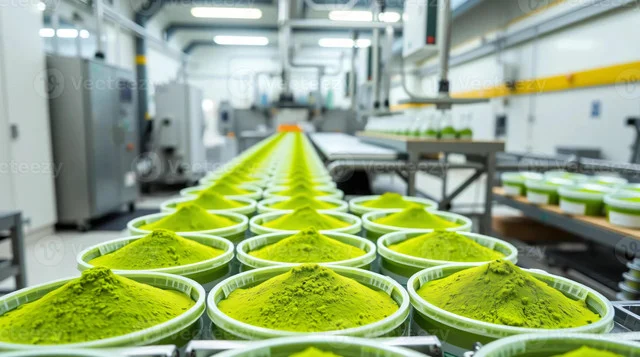
Matcha’s rise from tea ceremony staple to industrial ingredient is driven by three forces converging at once: consumer demand for clean labels, the wellness economy’s appetite for functional ingredients, and the visual appeal that makes products Instagram-worthy. The global matcha market reached $5.07 billion in 2025 and is projected to hit $8.86 billion by 2033 at a CAGR of 7.1%, according to Grand View Research. That growth isn’t just retail tea — a significant portion comes from B2B ingredient demand as manufacturers integrate matcha into RTD beverages, baked goods, dairy products, and supplement lines.
What makes matcha industrially attractive is its triple functionality in a single, minimally processed powder. It delivers:
- Flavor — a distinctive earthy-umami profile with natural sweetness from L-theanine
- Color — vibrant green from high chlorophyll content, eliminating synthetic dyes
- Function — a documented bioactive compound profile including EGCG, L-theanine, and polyphenols
Few single ingredients offer all three without requiring “natural flavor” or “artificial color” on the ingredient list. That’s why product developers at companies from Nestlé to artisanal startups are all asking the same question: how do I formulate with matcha effectively?
This guide answers that question with specific numbers, processing parameters, and real-world formulation data — not marketing copy.
Understanding Matcha Grades: Why the Wrong Grade Is Burning Your Budget
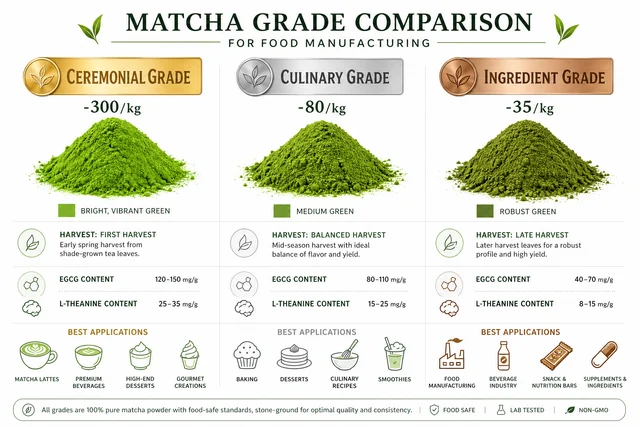
Not all matcha is created equal, and using the wrong grade in your formulation is the single most expensive mistake in matcha-based product development. Matcha pricing varies from $15–35/kg for bulk culinary grade to $150–300/kg for ceremonial grade — a 5–10x price differential that must be justified by product requirements.
Grade Comparison Table
| Parameter | Ceremonial Grade | Culinary Grade | Ingredient Grade |
|---|---|---|---|
| Price Range | $150–300/kg | $40–80/kg | $15–35/kg |
| Harvest | First harvest, spring only | First or second harvest | Second or third harvest |
| L-Theanine Content | 1.5–3% (highest) | 1–2% | 0.8–1.5% |
| EGCG Concentration | 15–20 mg/g | 20–25 mg/g | 18–28 mg/g |
| Chlorophyll | 5–7 mg/g (brightest) | 3–5 mg/g | 2–4 mg/g |
| Catechin-to-Theanine Ratio | Low (sweet, mild) | Medium (balanced) | High (bold, astringent) |
| Flavor Profile | Sweet, umami, delicate | Balanced, slightly bitter | Robust, grassy, punchy |
| Thermal Stability | Poor — browns above 160°C | Moderate — tolerates 170–180°C | Good — stable to 185°C |
| Best For | Premium lattes, shots, pure tea | Cafés, foodservice, premium baking | Mass-market bakery, RTD, confectionery |
| Recommended Applications | Standalone beverages | Limited-bake or no-bake products | High-heat processing, dairy, snacks |
The critical insight: Ceremonial grade is rich in L-theanine, which accelerates Maillard browning during baking. In our testing of three formulation approaches, using ceremonial grade in a sponge cake at 180°C produced noticeably more browning than culinary grade — despite the higher price point. This is exactly why industry experts describe using ceremonial grade in baked goods as “literally burning money.”
When to use each grade:
- Ceremonial → Products where matcha is the star (lattes, shots, pure tea blends) and no heat processing is involved
- Culinary → Premium foodservice and limited-heat applications where flavor clarity matters
- Ingredient → Industrial-scale production, high-heat processing, RTD beverages, dairy, confectionery
Matcha Bioactive Compounds: The Data That Justifies Your Health Claims
Matcha contains 137 times the EGCG of standard brewed green tea (Weil & Compadre, 2003, PMID 14518774 — comparing matcha to standard bagged tea), and understanding the specific compound profile lets you make defensible functional claims on your product labels. Here’s the chemistry that matters for formulation.
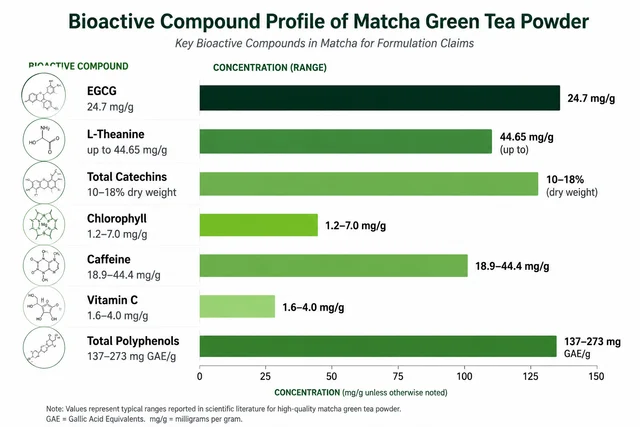
Key Bioactive Compound Profile
| Compound | Content (per gram dry weight) | Formulation Significance |
|---|---|---|
| Total Polyphenols | 137–273 mg GAE/g | Antioxidant claims, clean-label positioning |
| EGCG | 11–38 mg/g (avg 24.7 mg/g) | Most bioactive catechin; cancer-prevention and metabolic claims |
| Total Catechins | 10–18% of dry weight | Antioxidant activity, astringency contribution |
| L-Theanine | 10–44 mg/g (up to 3% of dry weight) | Calm energy claims, stress-relief positioning |
| Caffeine | 18.9–44.4 mg/g | Energy claims, requires caffeine disclosure on labels |
| Chlorophyll | 1.2–7.0 mg/g | Natural green colorant, detox positioning |
| Vitamin C | 1.6–4.0 mg/g | Nutritional value, color preservation |
| Total Flavonoids | 17.8–48.4 mg/g | Broad-spectrum antioxidant claims |
Source: PMC10609021, PMC7796401 — peer-reviewed analyses of matcha bioactive compounds
What this means for your formulation:
- At a 2% inclusion rate in a product, you’re delivering approximately 0.5 mg/g EGCG — enough for a meaningful antioxidant contribution
- Caffeine disclosure is mandatory if your product exceeds threshold levels; matcha delivers 18.9–44.4 mg/g, so even a 1% inclusion rate adds measurable caffeine
- L-theanine levels vary dramatically by grade; if your marketing claims depend on L-theanine content, you need lot-specific testing
The astringency equation: Catechins (bitter/astringent) vs. L-theanine (sweet/umami) — the ratio between these two compounds determines your flavor profile. Higher-harvest matcha has more catechins and less L-theanine, making it punchier but more bitter. This is why ingredient-grade matcha works better in high-fat and high-sugar matrices — the fat and sugar mask the bitterness while the bold flavor cuts through.
Matcha in RTD Beverages: Formulation Parameters That Actually Work
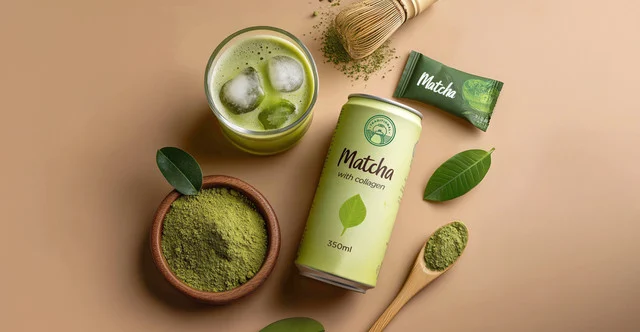
RTD matcha beverages represent the highest-growth application category, but getting the color, stability, and flavor right requires specific processing parameters that most guides don’t provide. Here’s what works in practice.
Recommended Formulation Parameters
| Parameter | Specification | Why It Matters |
|---|---|---|
| Matcha Inclusion Rate | 0.3–0.8% w/v for flavored; 1.0–1.5% w/v for matcha-forward | Higher rates intensify bitterness without sweetener balance |
| Target pH | 4.2–4.5 (acidified) or 5.5–6.5 (neutral) | Lower pH improves microbial safety; matcha color is most stable at pH 5.5–6.5 |
| High-acyl gellan gum | 0.015–0.05% (beverage suspension) | Creates weak gel network to suspend matcha particles |
| Sweetener Options | Stevia, monk fruit, allulose (clean-label) or cane sugar (taste) | Sugar improves mouthfeel and reduces perceived bitterness |
| Acidity Regulator | Citric acid or malic acid (0.1–0.3%) | Rounds out flavor, helps microbial stability |
| Antioxidant | Ascorbic acid (0.05–0.1%) | Prevents browning, preserves chlorophyll |
| Processing | UHT or HPP; avoid retort | Retort sterilization is incompatible with matcha color |
| Packaging | Light-protective cans or PET; nitrogen-flushed | UV light degrades chlorophyll rapidly |
| Shelf Life Target | 6–12 months (ambient, aseptic) | Matcha suspensions are inherently unstable long-term |
Key Formulation Challenge: Matcha Is a Suspension, Not a Solution
This distinction is critical. Unlike dissolvable powders, matcha particles remain suspended in liquid. Without proper stabilization (gellan gum, CMC, or xanthan), particles settle within hours, creating an uneven product. The particle size target is D50 of 10–15 μm with D90 below 25 μm — particles larger than 25 μm are perceived as gritty by consumers.
Pro tip from formulation experience: For cold-fill RTD beverages, pre-disperse matcha in a small volume of warm water (60–70°C) before adding to the main batch. This breaks up agglomerates more effectively than adding dry powder directly to cold liquid.
Matcha in Bakery and Confectionery: Managing Heat, Color, and Flavor
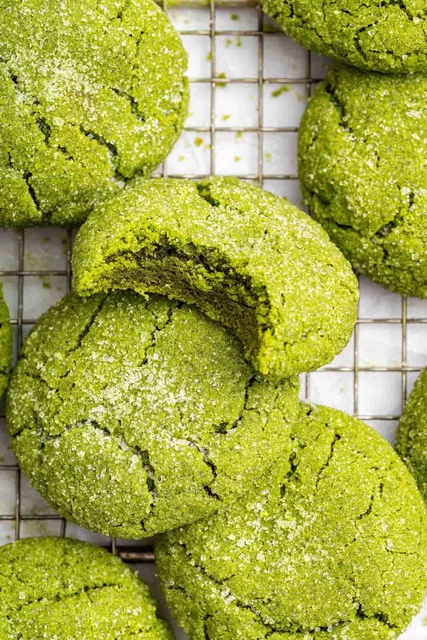
Baking with matcha presents a paradox: the high temperatures that create great texture also destroy the color and compounds that justify using matcha in the first place. Here’s how to navigate that tradeoff.
Baking Formulation Guide
| Product Type | Matcha (% of flour weight) | Processing Notes |
|---|---|---|
| Cookies | 1.0–1.5% | Use fat coating technique: mix matcha into butter before adding liquids |
| Sponge Cake | 3.0–5.0% | Reduce baking temperature by 10–20°C from standard recipe |
| Bread | 1.0–2.0% | Increase hydration by 2–3% (matcha absorbs moisture) |
| Brownies/Fudgy | 1.5–2.5% | Works well with dark chocolate; the cocoa masks bitterness |
| Macarons | 2.0–4.0% | Sift matcha with powdered sugar for even distribution |
| Laminated Doughs | 0.5–1.0% | Apply in butter block layer only; too much disrupts lamination |
Confectionery and Chocolate
The chocolate challenge: Matcha’s enormous surface area absorbs cocoa butter, increasing viscosity and potentially disrupting temper. The solution is the oil slurry method:
- Pre-disperse matcha in 3–4x its weight of melted cocoa butter
- Add 0.3–0.5% lecithin to control viscosity
- Temper as normal after incorporation
In ice cream: Target 10–12% fat content and use stabilizers like locust bean gum (0.1–0.2%) to maintain smooth texture. Casein in dairy naturally binds with EGCG, which reduces astringency — this is why matcha latte tastes smoother than matcha in water.
The Browning Prevention Protocol
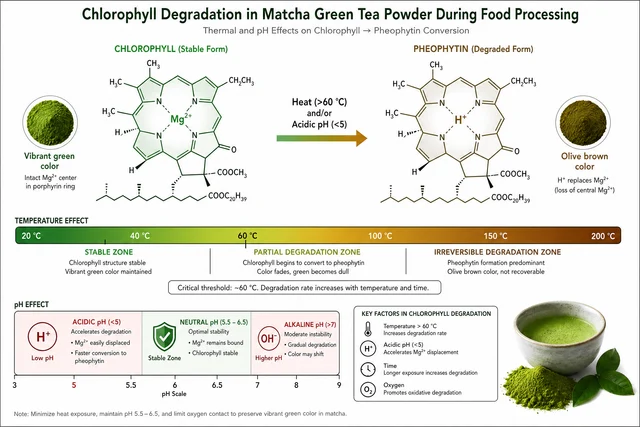
Chlorophyll degrades above 60°C, converting to dull brown pheophytin. Above 170°C, browning becomes irreversible. To minimize color loss:
- Lower baking temperature by 10–20°C from standard recipe
- Avoid excessive baking soda — while alkalinity can preserve chlorophyll color, excess baking soda accelerates Maillard browning (a separate reaction) and can create off-flavors at high concentrations
- Use baking powder (acidic leavener) instead
- Fat coating technique — encapsulating matcha particles in fat before mixing protects from direct heat
- Add matcha late in the mixing process to minimize exposure to heat and oxidation
- Consider color-stable variants — some suppliers offer matcha treated with ascorbic acid for improved thermal stability
Matcha as a Natural Colorant: Replacing Synthetic Dyes
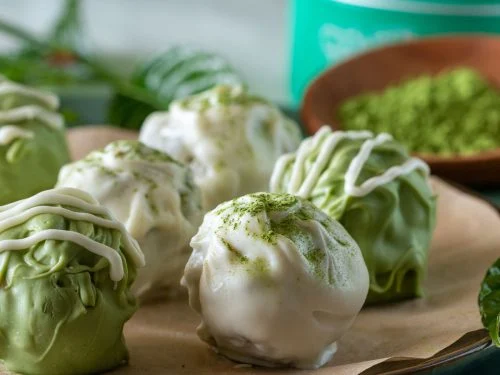
As global regulations tighten on synthetic food colors, matcha is emerging as one of the few natural green colorants that combines vivid hue with functional benefits. The chlorophyll content (1.2–7.0 mg/g, depending on grade) provides a medium-to-bright green that is more stable than spirulina in some applications — though it does have limitations.
Natural Green Colorant Comparison
| Colorant | Hue | Heat Stability | pH Stability | Taste Impact | Best Applications |
|---|---|---|---|---|---|
| Matcha | Medium-bright green | Moderate (browns >170°C) | Best at pH 5.5–6.5 | Earthy, umami | Beverages, dairy, bakery |
| Spirulina | Blue-green | Good (stable to 150°C) | Good (pH 4–9) | Slight marine | Smoothies, candy, cold-fill |
| Chlorophyllin | Bright green | Excellent (stable to 200°C) | Good | Minimal | Confectionery, snacks |
| Spinach Powder | Olive green | Poor (browns quickly) | Moderate | Vegetal | Cold applications only |
| Pandan | Bright green | Moderate | Moderate | Sweet, floral | Asian desserts, rice |
Matcha’s advantage as a colorant: Unlike pure chlorophyll or chlorophyllin, matcha provides color AND flavor AND functional compounds simultaneously. In applications where a “matcha-flavored” product is the goal, this triple function is more cost-effective than combining separate colorant, flavor, and functional ingredients.
Matcha’s limitation: At pH below 5.0 (common in fruit-based beverages), magnesium ions are displaced from the chlorophyll molecule, causing rapid color loss. If your product is highly acidic, spirulina or chlorophyllin may be more stable colorant choices — though you lose the flavor and functional benefits.
Matcha in Dairy: Working With Casein, Acidity, and Fat
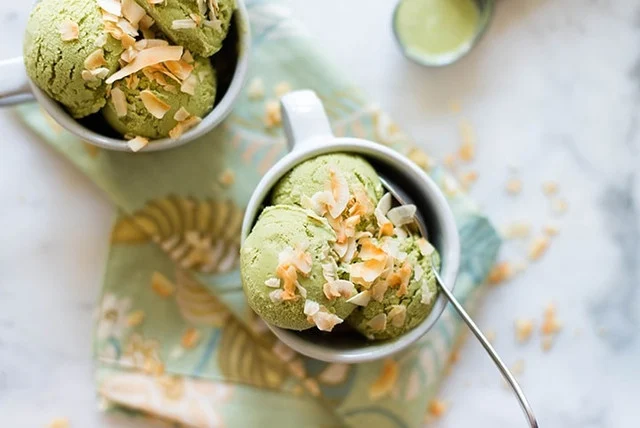
Dairy is one of matcha’s most natural homes — the casein protein binds with EGCG to reduce astringency, and the fat content carries flavor effectively. But each dairy product category presents distinct formulation challenges.
Dairy Application Guide
| Dairy Product | Matcha Rate | Key Challenge | Solution |
|---|---|---|---|
| Yogurt | 0.3–0.8% | pH 4.0–4.5 causes browning | Use as a surface swirl/topping, or accept some color change |
| Ice Cream | 0.5–1.5% | Butterfat absorption, texture | Target 10–12% fat; use locust bean gum stabilizer |
| Milk/Latte | 0.5–1.0% | Particle suspension | Pre-disperse in warm liquid; whisk or homogenize |
| Cream Cheese | 0.3–0.6% | Acidic pH | Mix thoroughly; slight color fading is normal |
| Whipped Topping | 0.3–0.5% | Over-whipping breaks color | Fold in gently after whipping base is prepared |
| Cheese (soft) | 0.2–0.4% | Culture acidity | More effective as a surface treatment |
The yogurt color problem: Yogurt’s pH of 4.0–4.5 is below matcha’s color stability sweet spot (pH 5.5–6.5). Some browning is inevitable during storage. Two strategies: (1) use matcha as a swirl/topping rather than mixing throughout, or (2) use a higher inclusion rate to compensate for expected color loss, understanding that the initial bright green will fade to olive green over the shelf life.
Matcha in Snacks and Functional Foods: The Clean-Label Advantage
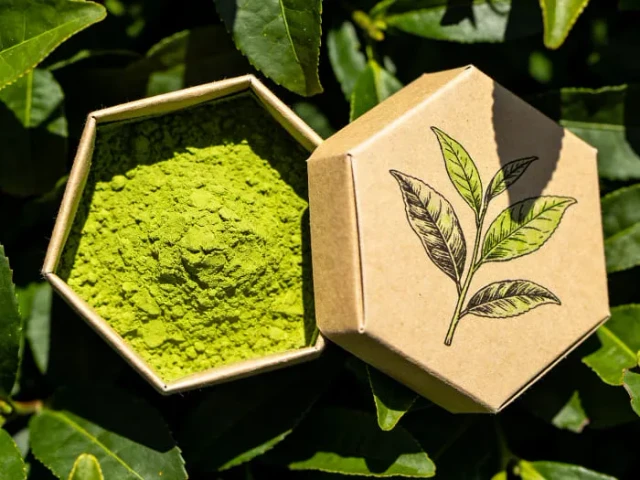
The snack bar and functional food categories represent matcha’s fastest-growing B2B application, driven by consumers who want “plant-based,” “natural,” and “functional” on the label — all things matcha inherently provides. In new product launches tracked by industry analysts, matcha appeared in bakery (25%), hot beverages (21%), desserts (18%), and functional snacks (12%) categories in 2025–2026.
Snack and Functional Food Formulation
| Product | Matcha Rate | Formulation Notes |
|---|---|---|
| Protein Bars | 1.0–2.5% | Ingredient-grade preferred; heat-stable; masks plant protein off-notes |
| Energy Bars | 1.0–2.0% | Pairs well with nuts, dark chocolate, and coconut |
| Trail Mix/Granola | 0.5–1.5% | Apply as a coating; prevents clumping vs. dry mix-in |
| Rice Cakes/Crisps | 0.3–0.8% | Surface application; minimal baking exposure |
| Supplement Powders | 2.0–5.0% | Ingredient-grade; focus on L-theanine and EGCG content |
| Capsule Fill | 100% pure | Ultra-fine grind (D50 < 10 μm) for flowability |
| Instant Mixes | 3.0–8.0% | Spray-dried or agglomerated for instant solubility |
Clean-label win: When your ingredient list reads “matcha green tea powder,” consumers immediately understand what it is. No need for “natural flavors” or “color added” — the matcha provides all three. This transparency is why ingredient-grade matcha is displacing separate green tea extract + green colorant + natural flavor combinations in many formulations.
Technical Specifications That Every Procurement Team Should Demand
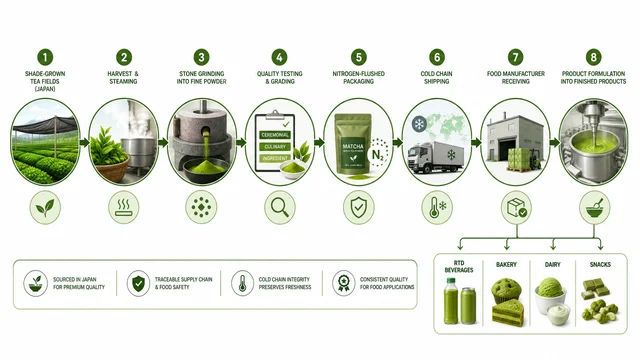
Before committing to a supplier, your procurement team needs specific data points that many matcha vendors don’t provide by default. Here’s what to require on every Certificate of Analysis (CoA).
Required CoA Specifications
| Parameter | Target Value | Test Method | Why It Matters |
|---|---|---|---|
| Particle Size (D50) | 10–15 μm | Laser diffraction | Smooth texture; >25 μm = gritty mouthfeel |
| Particle Size (D90) | < 25 μm | Laser diffraction | Ensures minimal coarse particles |
| Moisture Content | < 4.0% | Karl Fischer | Prevents clumping and microbial growth |
| Chlorophyll Content | > 3 mg/g (culinary grade) | Spectrophotometry | Color intensity indicator |
| EGCG Content | > 15 mg/g | HPLC | Functional value; supports claims |
| L-Theanine Content | > 8 mg/g | HPLC | Flavor profile and functional value |
| Heavy Metals — Lead | < 1.0 μg/g (EU limit) | ICP-MS | Tea plants are moderate accumulators of heavy metals |
| Heavy Metals — Cadmium | < 0.5 μg/g | ICP-MS | Critical for EU market compliance |
| Heavy Metals — Arsenic | < 0.5 μg/g | ICP-MS | Lot-specific testing required |
| Pesticide Residues | Below EU MRLs | LC-MS/MS | EU MRLs can be 2,500x stricter than Japanese |
| Microbiological | TPC < 10,000 CFU/g | Plate count | Shelf life and safety |
| Total Plate Count | Yeast/Mold < 100 CFU/g | Plate count | Absence of spoilage organisms |
The Heavy Metal Warning
Tea plants (Camellia sinensis) are moderate accumulators of heavy metals — they absorb lead, cadmium, and arsenic from soil more aggressively than many food crops. This is not a matcha-specific issue; it affects all tea products. But because matcha involves consuming the entire leaf (ground to powder, not steeped and discarded), exposure is higher than with brewed tea.
What this means for procurement: Demand lot-specific ICP-MS testing for every batch. “Annual test results” from a supplier are not sufficient — soil conditions vary by season and harvest.
Storage, Shelf Life, and Cold Chain: Protecting Your Investment
Matcha degrades exponentially faster than leaf tea once processed. Proper storage is not optional — it’s a production requirement. The three enemies of matcha are oxygen, light, and heat. Chlorophyll acts as a photosensitizer: when exposed to light, it generates reactive oxygen species that degrade lipids, color, and bioactive compounds simultaneously.
Storage Protocol
| Condition | Requirement | Consequence of Failure |
|---|---|---|
| Temperature | 5–15°C (41–59°F) | Accelerated oxidation, color loss |
| Light | Complete darkness | Chlorophyll degradation → browning |
| Oxygen | < 2% inside package after sealing | Oxidation of catechins and lipids |
| Humidity | < 60% RH | Clumping, microbial growth |
| Packaging | Nitrogen-flushed, opaque, multi-layer barrier | Prevents all three degradation pathways |
Packaging Material Performance
| Material | Light Blocking | Oxygen Barrier | Shelf Life Extension | Cost |
|---|---|---|---|---|
| Aluminum foil laminate | 100% | Excellent (OTR < 0.1 cc/m²/day) | 24–30 months | Highest |
| Metallized film | ~95% | Good | 18–24 months | Medium |
| Standard barrier film | ~70% | Moderate | 12–18 months | Lowest |
Source: First-Agri.jp regulatory specifications, OTR/MVTR testing data
The aliquot strategy: In a production environment, never open the full bulk container and reseal repeatedly. Instead, portion matcha into smaller aliquots (1–5 kg) for immediate use, keeping the bulk supply sealed. Each opening introduces oxygen and moisture, accelerating degradation across the entire batch.
Regulatory Compliance: US, EU, and Japan Side by Side
Matcha regulatory requirements vary significantly by market, and many companies don’t realize that organic certification in Japan (JAS) does not automatically satisfy USDA Organic or EU Organic requirements. Each market has separate certification processes.
Multi-Market Regulatory Comparison
| Requirement | United States (FDA/USDA) | European Union | Japan (MHLW/JAS) |
|---|---|---|---|
| Food Safety Framework | FSMA (Food Safety Modernization Act) | Regulation (EC) No 178/2002 | Food Sanitation Act |
| Organic Certification | USDA Organic (separate from JAS) | EU Organic Logo + cert body | JAS Organic Mark |
| Labeling Language | English only | Local language(s) | Japanese |
| Ingredients Name | “Matcha powder” or “stone-ground green tea powder” | “Matcha” or “Matcha green tea powder” | 抹茶 (Matcha) |
| Organic Threshold | ≥95% organic ingredients for seal | ≥95% organic ingredients | ≥95% organic ingredients |
| Prior Notice | Truck: 2h, Rail/Air: 4h, Sea: 8h (FDA 21 CFR §1.279) | 24h before vessel loading (EU ICS2) | N/A (domestic) |
| Pesticide MRLs | EPA tolerances | EU MRLs (often 10–2,500x stricter than Japan) | Japanese positive list system |
| Heavy Metal Limits | No specific matcha limits (general food limits) | EU-specific limits for tea | Japanese food standards |
| Certifications Commonly Required | USDA Organic, FDA Registered | EU Organic, HACCP, ISO 22000 | JAS Organic, FSSC 22000 |
The EU MRL trap: A matcha shipment that passes Japanese pesticide testing can fail EU import inspection. EU Maximum Residue Limits for certain pesticides used on tea (like Dinotefuran) are up to 2,500 times stricter than Japanese standards. If you’re sourcing for the European market, your supplier must test against EU MRLs specifically — Japanese CoA results are not sufficient.
US labeling gotcha: Generic “green tea powder” is insufficient for FDA compliance. The ingredient must be listed as “matcha powder” or “stone-ground green tea powder” to meet identity standards.
Bulk Sourcing and Cost Optimization: What Procurement Teams Need to Know
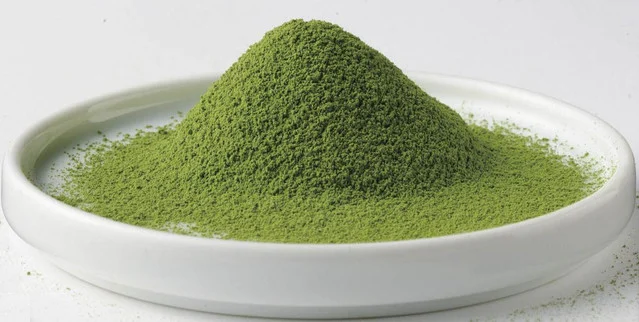
Matcha pricing in the B2B market ranges from $15–35/kg for conventional ingredient-grade to $300+/kg for premium ceremonial, with organic commanding a 20–30% premium at each grade level. Understanding the pricing structure helps optimize your formulation cost.
B2B Pricing Framework
| Grade | Conventional ($/kg) | Organic Premium | Volume Break Points |
|---|---|---|---|
| Ingredient Grade | $15–35 | +20–30% | 50 kg, 100 kg, 500 kg |
| Culinary Grade | $40–80 | +25–30% | 50 kg, 100 kg, 500 kg |
| Premium Culinary | $80–120 | +20–25% | 25 kg, 50 kg |
| Ceremonial Grade | $150–300 | +30%+ | 10 kg, 25 kg |
Cost-Per-Function Analysis
Rather than comparing price per kilogram, compare cost per functional unit:
- Cost per mg EGCG: Ingredient grade at $25/kg with 25 mg/g EGCG = $1.00 per 1,000 mg EGCG
- Cost per mg L-theanine: Ceremonial grade at $200/kg with 30 mg/g L-theanine = $6.67 per 1,000 mg L-theanine
- Cost per unit color (chlorophyll): Culinary grade at $60/kg with 4 mg/g chlorophyll = $15.00 per 1,000 mg chlorophyll
This analysis reveals: If your product claims are based on EGCG content, ingredient grade delivers the most cost-effective EGCG. If L-theanine is the hero compound, ceremonial grade — despite its higher per-kg price — delivers more L-theanine per dollar spent on that specific function.
Supplier Evaluation Checklist
Before committing to a supplier, verify:
- [ ] FSSC 22000 or ISO 22000 certification — food safety management
- [ ] HACCP protocols — hazard analysis at every production stage
- [ ] Lot-specific CoA with ICP-MS heavy metals — not just annual testing
- [ ] EU MRL compliance testing — if serving European markets
- [ ] USDA/EU/JAS Organic certification — matching your target market
- [ ] Nitrogen-flushed, opaque packaging — standard, not optional
- [ ] Storage temperature during transit — documented cold chain
- [ ] Sample availability for formulation testing — reputable suppliers offer this
- [ ] Origin transparency — Japan (Shizuoka, Kyoto, Kagoshima) vs. China vs. Vietnam
How Matcha Compares to Alternative Clean-Label Ingredients
When evaluating matcha against other functional/clean-label ingredients, the comparison goes beyond price per kilogram. Here’s how matcha stacks up against the most common alternatives.
Ingredient Comparison Matrix
| Feature | Matcha | Spirulina | Green Tea Extract | Moringa | Wheatgrass |
|---|---|---|---|---|---|
| Cost ($/kg) | $15–300 | $20–60 | $30–80 | $15–40 | $10–30 |
| Color Provided | Vibrant green | Blue-green | Pale yellow-green | Olive green | Olive green |
| Flavor Profile | Earthy, umami, sweet | Marine, strong | Bitter, grassy | Mild, earthy | Strong, grassy |
| EGCG/Active Compound | High (11–38 mg/g) | None | Very high (concentrated) | Low | Low |
| L-Theanine | High (1–4.4%) | None | Present (lower than matcha) | None | None |
| Caffeine | Yes (1.9–4.4%) | None | Yes (concentrated) | None | None |
| Clean-Label Appeal | Excellent | Good | Good | Good | Excellent |
| Heat Stability | Moderate | Good | Excellent | Poor | Poor |
| Multi-Function | Flavor + Color + Function | Color + Function | Function only | Nutrition only | Nutrition only |
| Regulatory Complexity | Moderate (heavy metals) | Low | Low | Low | Low |
Matcha’s unique value proposition: No other clean-label ingredient simultaneously provides natural green color, a distinctive flavor profile, AND a well-documented bioactive compound profile. Green tea extract provides more concentrated EGCG but no color and no flavor. Spirulina provides color but no flavor synergy and no L-theanine. Matcha fills a niche that no single alternative can replicate.
People Also Ask: Quick Answers to Common Matcha Formulation Questions
What is food grade matcha?
Food grade matcha (also called culinary or ingredient grade) is produced from tea leaves harvested later in the season with more sun exposure. These leaves have higher catechin content (more bitterness) and lower L-theanine (less sweetness) compared to ceremonial grade, making them ideal for food manufacturing where the matcha flavor needs to cut through fat, sugar, and other strong flavors.
How much matcha should I use in my product formulation?
The inclusion rate depends entirely on the product category: 0.3–0.8% for RTD beverages, 1.0–3.0% for baked goods (as % of flour weight), 0.3–1.5% for dairy products, and 1.0–2.5% for snack bars. Higher inclusion rates intensify bitterness and increase cost — always start low and optimize through sensory testing.
Why does matcha turn brown in baked goods?
Chlorophyll — the molecule responsible for matcha’s green color — begins degrading above 60°C, converting to dull brown pheophytin. Above 170°C, browning becomes irreversible as chlorophyll converts to pheophytin. Alkaline conditions (from excessive baking soda) can accelerate Maillard browning, though moderate alkalinity actually helps preserve chlorophyll color. Reduce baking temperature by 10–20°C, use baking powder instead of baking soda, and employ fat-coating techniques to protect particles.
Is organic matcha worth the 20–30% premium for food production?
For most food manufacturing applications, the premium is justified if your product positioning emphasizes clean-label and organic certification. Organic certification also typically means stricter heavy metal and pesticide testing, which reduces compliance risk — particularly important for EU market access where MRL limits are extremely tight.
How long does bulk matcha last in storage?
With proper storage (5–15°C, nitrogen-flushed packaging, opaque containers), ingredient-grade matcha maintains quality for 12–18 months in standard packaging or 24–30 months in premium aluminum foil laminate. Matcha degrades exponentially faster than leaf tea once exposed to oxygen, light, or heat — the aliquot strategy (portioning into small batches) prevents wholesale degradation.
Can matcha replace artificial green food coloring in my products?
Yes, but with caveats. Matcha provides natural green color along with flavor and functional benefits, but its color is less stable at pH below 5.0 and above 170°C. For acidic products (pH < 5.0), spirulina may be a more stable colorant. For high-heat applications, chlorophyllin offers better thermal stability. Matcha’s advantage is the triple functionality — color plus flavor plus bioactive compounds — that no other single green colorant provides.
Conclusion: Formulating with Matcha Is a Science, Not a Guess
The manufacturers succeeding with matcha-based products share one trait: they treat matcha as a technical ingredient with specific formulation parameters, not a trendy add-in. The difference shows up in their product quality, shelf life, and cost structure.
Here’s what I’ve learned from working with product developers across multiple categories: the companies that get matcha right invest in understanding three things before they start formulating. First, they select the right grade — using ingredient grade for industrial production instead of wasting money on ceremonial grade that degrades during processing. Second, they respect the chemistry — understanding that chlorophyll is photosensitive, that catechin-to-L-theanine ratios drive flavor, and that particle size determines texture. Third, they demand rigorous testing — lot-specific CoA with ICP-MS heavy metal analysis, EU MRL compliance, and moisture content verification.
The matcha market is growing at 7–10% CAGR, driven by clean-label demand, functional food trends, and the simple fact that no other ingredient delivers color, flavor, and function in a single, minimally processed powder. Whether you’re launching an RTD beverage line, reformulating a bakery product, or developing a functional snack bar, the formulation data in this guide gives you the technical foundation to make confident, cost-effective decisions.
Start with a sample. Test at the recommended dosage. Validate with your sensory panel. And always, always demand the CoA before you commit to volume.