
El abastecimiento de matcha está plagado de afirmaciones que no resisten un análisis riguroso. El “grado ceremonial” carece de definición legal. Se imprimen logotipos de productos ecológicos sin certificados válidos. Y las normativas de importación son cada vez más estrictas: EE. UU. añadió un arancel 10%, sección 122, en febrero de 2026, y la UE redujo los límites de residuos de plaguicidas hasta el umbral de detección en marzo de 2026. Tras auditar docenas de cadenas de suministro de matcha y revisar los certificados de análisis (COA) de más de 40 proveedores de Japón, China y Vietnam, he aprendido que la diferencia entre un socio B2B fiable y un quebradero de cabeza en materia de cumplimiento normativo suele reducirse a seis pasos de verificación. Esta guía desglosa todas las normas de calidad, certificaciones, requisitos de seguridad alimentaria y puntos de control de cumplimiento que necesitas, con cifras concretas, referencias normativas y las señales de alerta que he observado de primera mano.
“Calidad ceremonial” es una estrategia de marketing, no una norma: esto es lo que hay que preguntar en su lugar
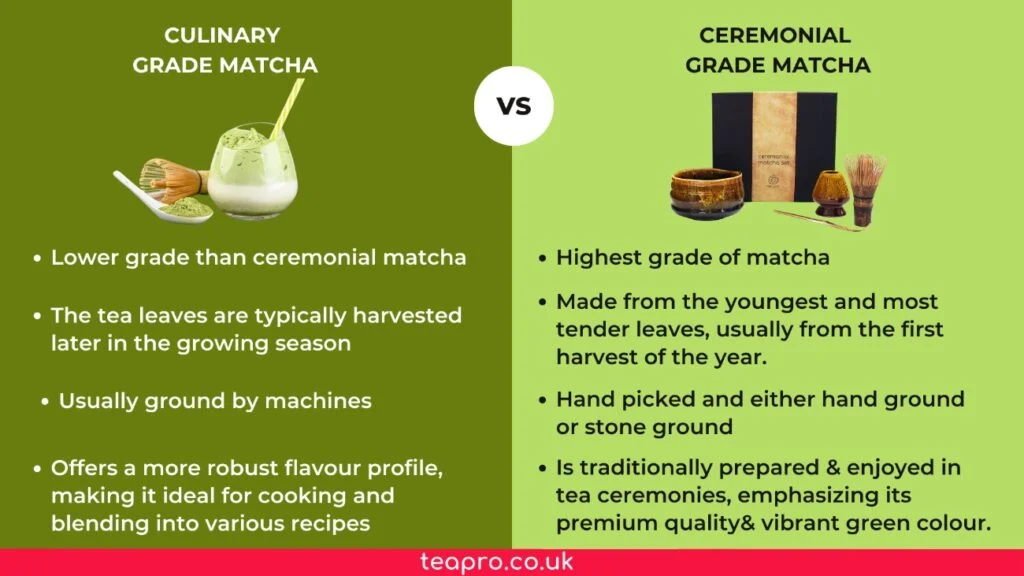
Lo primero que debe saber cualquier comprador de matcha en el sector B2B: No existe ninguna definición normativa de “calidad ceremonial” en ninguna parte del mundo. Ni de la JAS, ni del USDA, ni de ningún organismo gubernamental japonés. Se trata de un término de marketing occidental que los proveedores utilizan con total libertad, a menudo para referirse a un té en polvo que un maestro del té japonés clasificaría como «culinario».
He visto a proveedores cobrar $180/kg por matcha “ceremonial” que, según los análisis, presentaba un tamaño de partícula superior a 25 micrómetros y un contenido de L-teanina inferior a 0,8%. A modo de referencia, el auténtico matcha de grado ceremonial molido en un molino de piedra japonés suele tener un D50 de entre 5 y 10 μm y un contenido de L-teanina superior a 2%.
Qué exigir en lugar del nombre de una calificación:
| Parámetro | Punto de referencia ceremonial | Referencia «Latte/Premium» | Referencia culinaria | Método de ensayo |
|---|---|---|---|---|
| Tamaño de las partículas (D50) | 5-10 μm | 10-15 μm | 15-30 μm | Difracción láser (ISO 13320) |
| L-teanina | >2,0% | >0,6% | <0,6% | HPLC (analizador de aminoácidos) |
| Color a* (CIELAB) | de -14 a -18 | de -10 a -14 | de -4 a -10 | Espectrofotómetro |
| Clorofila | >0,3% | 0.1-0.3% | <0,1% | Espectrofotometría UV-Vis |
| Humedad | <5,0% | <5,51 TP3T | <6,0% | Método de secado en horno (según la norma ISO 3720) |
| EGCG | 13-19 mg/g | 8-13 mg/g | 5-8 mg/g | HPLC (tiempo de retención ~4,5 min) |
La norma de referencia ISO/TR 21380:2022 Es lo más parecido a una norma internacional sobre el matcha. Define el matcha como hojas de té cultivadas a la sombra que se cuecen al vapor, se secan (como tencha) y se muelen con molino de piedra hasta alcanzar un tamaño medio de partícula de 10-30 μm, sin aditivos. Pero se trata de un informe técnico, no de una normativa vinculante: te indica qué es el matcha debería ser, y no lo que vaya a comprobar cualquier organismo encargado de hacer cumplir la ley.
Mi recomendación: Elabora tu propia ficha técnica interna utilizando la tabla anterior y exige a los proveedores que te faciliten un certificado de análisis (COA) que se ajuste a tus especificaciones, y no solo una etiqueta en la que ponga “ceremonial”.”
Control de calidad del matcha: los métodos y las normas que importan
Si adquieres matcha en grandes cantidades, es importante que conozcas cómo funciona el sistema de análisis. A continuación te explicamos cómo se miden realmente los parámetros clave en un laboratorio alimentario competente:
Distribución del tamaño de las partículas es el indicador de calidad más fiable. La difracción láser (ISO 13320) proporciona una distribución D10/D50/D90. El matcha ceremonial molido en molinos tradicionales de granito suele presentar un valor D50 de entre 5 y 10 μm. Un tamaño de partícula mayor indica que se ha utilizado molienda por chorro (más barata, pero que genera calor que degrada la clorofila) o que el tiempo de molienda ha sido insuficiente. Cuando revisé los certificados de análisis (COA) de tres proveedores chinos que afirmaban ofrecer un grado “ceremonial”, los tres presentaban valores de D50 de entre 18 y 28 μm, más cercanos al grado culinario según cualquier criterio objetivo.
Medición del color (CIELAB Lab)* es rápido y no destructivo. El valor a* (eje verde-rojo) es el dato clave: el matcha ceremonial debe dar un valor inferior a -14, lo que indica un color verde intenso. Un valor a* superior a -8 indica bien un sombreado insuficiente (menos de 20 días), bien oxidación debida a un almacenamiento inadecuado. He utilizado un espectrofotómetro portátil en las instalaciones de los proveedores para verificarlo in situ: tarda 10 segundos y te dice más que cualquier afirmación de la etiqueta.
Perfil de la L-teanina y de los aminoácidos Requiere HPLC con una columna específica para aminoácidos. La L-teanina es el compuesto responsable del sabor umami y del efecto calmante del matcha. El té cultivado a la sombra (más de 20 días bajo el dosel de tana) acumula entre 2 y 41 TP3T de L-teanina en peso seco; el té cultivado al sol o con poca sombra se reduce a entre 0,3 y 0,61 TP3T. Esta es la huella química que distingue el té ceremonial del culinario, y es caro falsificarla porque no se puede añadir L-teanina sintética al polvo de matcha sin que quede reflejada en el perfil de aminoácidos.
EGCG (galato de epigalocatequina) Se analiza mediante HPLC con una columna C18, con un tiempo de retención de aproximadamente 4,5 minutos. Las calidades premium presentan un promedio de 13-19 mg/g. El contenido de EGCG está relacionado con el momento de la cosecha: la primera cosecha (ichibancha, cosecha de mayo) presenta los niveles más altos de catequinas.
Normas ISO clave a las que se hace referencia para los ensayos del matcha:
| Estándar | Qué cubre |
|---|---|
| ISO/TR 21380:2022 | Características específicas del matcha: tamaño de las partículas, sombreado, molienda, pureza |
| ISO 3720:2011 | Especificaciones del té negro (cenizas insolubles en ácido: máximo 1%; extracto acuoso: mínimo 32%) — de referencia para el té verde según la norma ISO 11287 |
| ISO 1839 | Protocolo de cata de té |
| ISO 1572 | Preparación de la muestra (trituración) |
| ISO 14502-1 | Contenido total de polifenoles |
| ISO 10727:2002 | Contenido de cafeína determinado mediante HPLC |
| ISO 13320 | Tamaño de las partículas mediante difracción láser |
Comparativa de certificaciones ecológicas: JAS, USDA, UE — La tabla completa
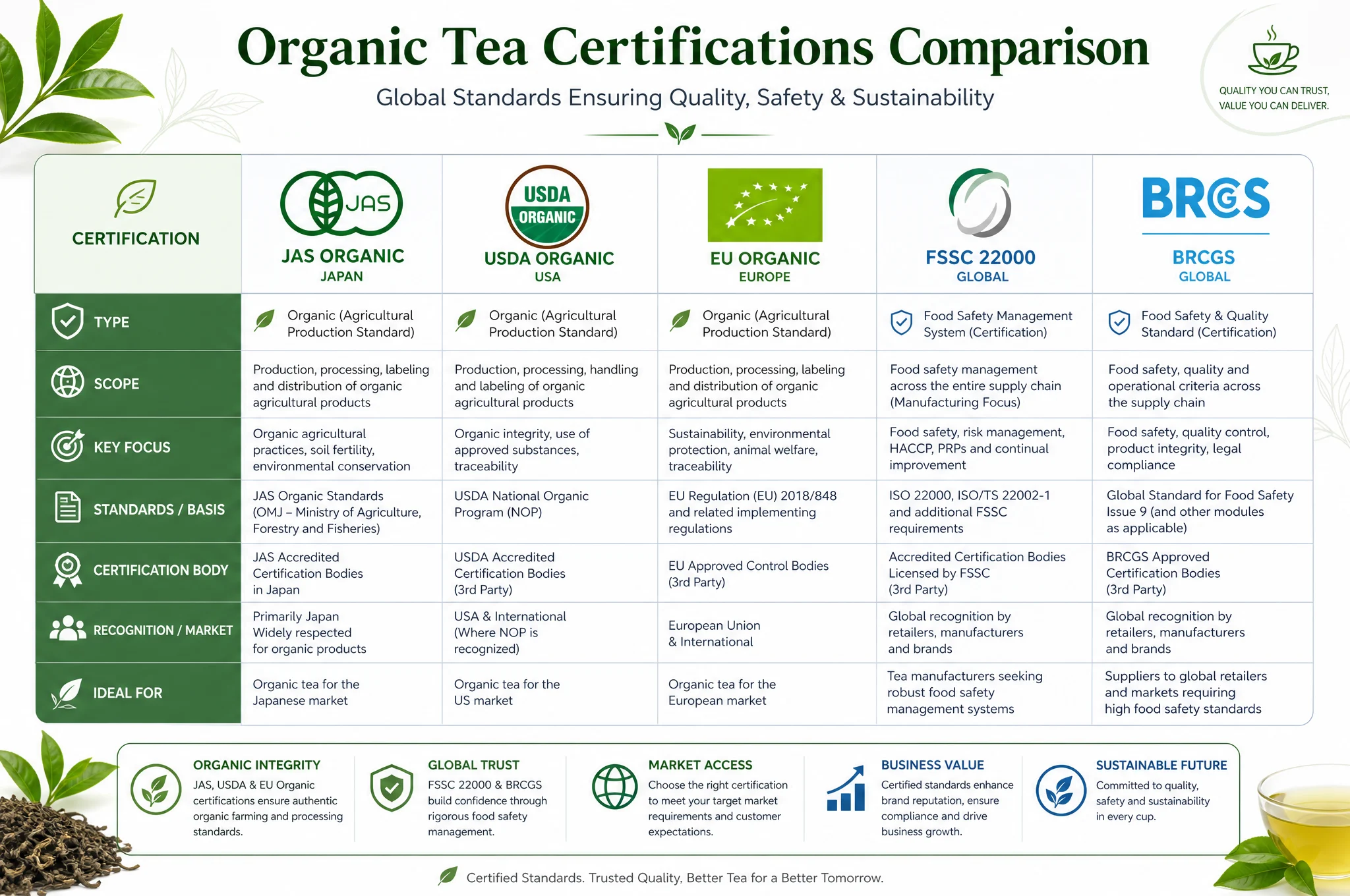
Esta es la sección que más tiempo me ha llevado perfeccionar, porque la certificación ecológica del matcha es realmente complicada. Japón, Estados Unidos y la UE cuentan con marcos normativos distintos, y los acuerdos de equivalencia añaden una complejidad adicional. A continuación se ofrece un desglose:
| Certificación | Órgano de gobierno | Período de conversión | Frecuencia de las auditorías | Coste (explotación agrícola/año) | TC por envío | Requisito clave |
|---|---|---|---|---|---|---|
| JAS Orgánico | MAFF (Japón) | 2-3 años sin productos químicos | Anual | $2,500-8,000 | $50-150 | 95%+ contenido orgánico, responsables de producción certificados |
| Certificado ecológico por el NOP del USDA | USDA/AMS | 3 años sin sustancias prohibidas | Anual | Varía ($500-5.000+) | Incluido en el certificado | Cumplimiento de la normativa sobre suelos, plagas y aditivos; posibilidad de subvención 75% |
| Ecológico de la UE (CE 2018/848) | CE + organismos de certificación (ECOCERT, etc.) | 2 años de conversión | Anual | Varía | Obligatorio | Aceptado mediante la equivalencia JAS para exportadores japoneses |
| FSSC 22000 | Fundación FSSC | N/A (seguridad alimentaria, no ecológico) | Anual + seguimiento | $5,000-15,000 | N/A | ISO 22000 + PRP del sector; reconocidas por la GFSI |
| Seguridad alimentaria de BRCGS | BRCGS | N/A (seguridad alimentaria) | Anual | $8,000-20,000 | N/A | Análisis de riesgos, programas de requisitos previos |
Datos fundamentales sobre la equivalencia:
- Equivalencia entre JAS y la UE sigue vigente, con un plazo de renegociación que vence el 31 de diciembre de 2026, de conformidad con el Reglamento (UE) n.º 2018/848. El matcha ecológico japonés con certificación JAS puede comercializarse como ecológico en la UE sin necesidad de una certificación específica de la UE, pero el exportador debe disponer tanto de la certificación JAS como de un certificado de transacción reconocido por la UE.
- Equivalencia entre JAS y USDA está en vigor desde el 1 de enero de 2014. El matcha ecológico JAS puede llevar el sello «USDA Organic» siempre que vaya acompañado de un certificado de equivalencia válido entre JAS y NOP.
- Programa de financiación compartida del USDA reembolsa hasta 75% de los gastos de certificación, pero los fondos de 2025 se retrasaron; la FSA tiene previsto realizar una emisión conjunta de 2025 y 2026 a finales de la primavera de 2026.
La trampa del certificado de transacción (TC): Es aquí donde he observado la mayoría de los incumplimientos normativos. Es posible que un proveedor muestre un certificado ecológico JAS válido en su página web, pero Cada envío requiere su propio TC para comprobar que ese lote concreto se había producido siguiendo los protocolos ecológicos. En una ocasión revisé la documentación de un proveedor en la que el certificado JAS estaba vigente, pero los certificados de seguimiento (TC) databan de 14 meses antes, lo que significaba que los envíos realizados entre medias carecían de trazabilidad ecológica.
Recargo por productos ecológicos: Se prevé un sobrecoste de entre 20 y 40% respecto al precio convencional. Esto refleja una reducción del rendimiento de aproximadamente 30% derivada de la agricultura ecológica, los costes del control manual de malas hierbas y los gastos en fertilizantes ecológicos ($0,80-1,40/kg frente a $0,30-0,50/kg en el caso de la agricultura convencional).
Normas de seguridad alimentaria: la FDA, la UE y Japón — Por regiones
Los requisitos de seguridad alimentaria para el matcha varían considerablemente en función del mercado de destino. A continuación se detallan los requisitos concretos de cada organismo regulador:
Estados Unidos: FSMA y FSVP
Desde la entrada en vigor de la Ley de Modernización de la Seguridad Alimentaria (FSMA), la FDA exige a los importadores —y no solo a los proveedores extranjeros— que verifiquen el cumplimiento de las normas de seguridad alimentaria. El Programa de Verificación de Proveedores Extranjeros (FSVP) es el mecanismo de aplicación, y la FDA ha estado intensificar considerablemente la aplicación de la ley desde 2024, con un aumento de las cartas de advertencia dirigidas a las importaciones de té y productos botánicos.
Requisitos que el FSVP exige a los importadores de matcha:
- Análisis de riesgos — Identificar los riesgos conocidos o razonablemente previsibles para el matcha: metales pesados (plomo, cadmio, arsénico), residuos de plaguicidas, contaminación microbiológica (Salmonella, E. coli, recuento total de gérmenes) y radiación (en el caso del matcha de origen japonés)
- Evaluación de proveedores — Evaluar las prácticas de seguridad alimentaria del proveedor extranjero, su historial de cumplimiento y el entorno de seguridad alimentaria del país productor
- Actividades de verificación — Auditorías anuales, presenciales o a distancia, de las instalaciones del proveedor; revisión de los certificados de análisis (COA); pruebas periódicas
- Persona cualificada — Designar a una persona que haya recibido formación sobre el FSVP para que supervise el programa
- Conservación de documentos — Conservar todos los registros del FSVP durante un mínimo de 2 años
Novedades en 2026: Estados Unidos impuso una Recargo de la sección 122 de la norma 10% sobre las importaciones, con efecto a partir del 24 de febrero de 2026 — se trata de un destino temporal de 150 días (que expira el 24 de julio de 2026) se aplica además de los aranceles vigentes. Si se suma al arancel base vigente del 6,41 TP3T sobre el té, el arancel total en destino asciende aproximadamente a 16,41 TP3T sobre el valor CIF durante este periodo. Esto modifica significativamente la rentabilidad de las importaciones ceremoniales de lotes pequeños mientras esté en vigor.
Unión Europea: Reglamento (UE) 2023/915 y LMR
La UE mantiene algunos de los límites de contaminantes más estrictos del mundo para las importaciones de alimentos. La normativa vigente es Reglamento (UE) 2023/915, que sustituyó a la Directiva (CE) n.º 1881/2006 con efecto a partir del 25 de mayo de 2023:
Metales pesados: El Reglamento (UE) n.º 2023/915 no establece niveles máximos específicos para el plomo ni el cadmio en el té (Camellia sinensis). Cuando no existe un límite armonizado, se aplica el principio ALARA (As Low As Reasonably Achievable, «tan bajo como sea razonablemente posible»), y cada Estado miembro puede fijar sus propios límites nacionales. Los compradores deberían fijarse como referencia interna conservadora para el matcha un nivel de plomo inferior a 1,0 mg/kg y de cadmio inferior a 0,1 mg/kg.
Límites máximos de residuos de plaguicidas (LMR):
- Incumplimiento de la UE: 0,01 mg/kg para cualquier sustancia no autorizada (límite de detección según el Reglamento (CE) n.º 396/2005)
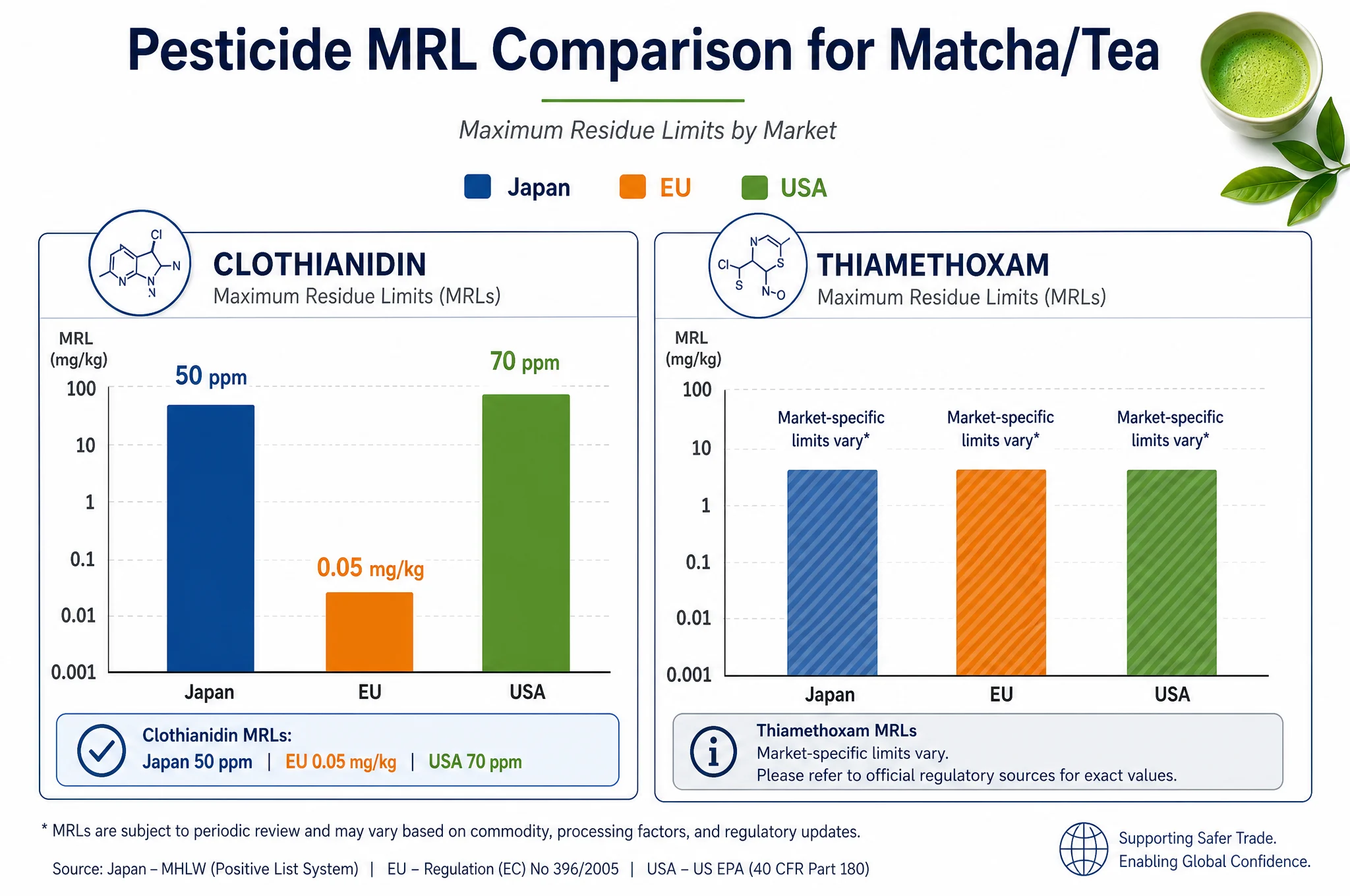
- Con efecto a partir del 7 de marzo de 2026: En virtud del Reglamento (UE) 2023/334, los LMR de la clotianidina y el tiametoxam se redujeron a 0,05 mg/kg para el té y los granos de café (no 0,01 mg/kg —el té tiene un LMR transitorio específico—). El resto de categorías de alimentos se reducen a 0,01 mg/kg.
Japón: Ley de Higiene Alimentaria
Las normas nacionales de Japón, reguladas por el Ministerio de Salud, Trabajo y Bienestar (MHLW), suelen ser más estrictas que los requisitos de exportación. Japón utiliza un Sistema de lista positiva En el caso de los productos químicos agrícolas, cualquier sustancia que no figure en la lista aprobada tiene, por defecto, un límite de tolerancia de 0,01 ppm. El matcha japonés producido para el consumo interno suele dar resultados más limpios en los análisis que los lotes destinados a la exportación, lo cual conviene tener en cuenta si se está evaluando la consistencia de los proveedores.
Referencia del Codex Alimentarius: La norma CAC/GL 92-2017 establece la Norma General sobre Contaminantes y Toxinas en los Alimentos y los Piensos, con LMR específicos para el té en la base de datos del CCPR (Comité del Codex sobre Residuos de Plaguicidas).
Metales pesados, pesticidas y límites microbiológicos: las cifras
Esta es la sección en la que las afirmaciones vagas no te servirán de nada. A continuación te presentamos los límites concretos y los resultados típicos de las pruebas que necesitas para tomar decisiones de adquisición en el ámbito B2B.
Metales pesados: valores habituales frente a límites
| Metal | Límite de la UE (mg/kg) | Directrices de la FDA de EE. UU. | Matcha japonés típico (datos de laboratorio de 2026) | Nivel de riesgo |
|---|---|---|---|---|
| Plomo | No existe un límite armonizado (se aplica el principio ALARA) | No hay ningún límite específico (nivel de intervención: 0,5 ppm para los dulces) | 0,03-0,12 mg/kg | Bajo |
| Cadmio | No existe un límite armonizado (se aplica el principio ALARA) | Sin límite específico | 0,01-0,035 mg/kg | Bajo |
| Arsénico | No existe un límite armonizado | Sin límite específico | <0,01 mg/kg (total) | Bajo |
Por qué el matcha requiere más análisis que el té infusionado: Cuando bebes té verde infusionado, estás consumiendo compuestos solubles en agua procedentes de una bolsita de té que luego tiras. Con el matcha, estás consumiendo el hoja entera molida — incluidos los metales pesados, los residuos de plaguicidas o los contaminantes microbianos adheridos a la matriz foliar. Esto hace que el análisis de la hoja entera sea obligatorio, no opcional.
ICP-MS (Espectrometría de masas con plasma acoplado inductivamente) Es el método de referencia para el análisis de metales pesados en el matcha. Permite detectar simultáneamente plomo, cadmio, arsénico, mercurio y aluminio en concentraciones de partes por mil millones. Al revisar un certificado de análisis (COA), comprueba que el laboratorio de análisis haya utilizado ICP-MS o ICP-OES; los métodos más antiguos, como la AAS (espectroscopia de absorción atómica), pueden pasar por alto la contaminación a niveles traza.
Límites de residuos de plaguicidas por mercado
| Pesticida | Japón (lista positiva) | UE (Reglamento n.º 396/2005) | Tolerancia de la EPA de EE. UU. |
|---|---|---|---|
| Clotianidina | 50 ppm (té) | 0,05 mg/kg (Marzo de 2026, Reg. 2023/334) | 70 ppm (té, seco) |
| Tiametoxam | 0,01 ppm (por defecto) | 0,05 mg/kg (Marzo de 2026, Reg. 2023/334) | 20 ppm (té, seco) |
| Imidacloprid | 50 ppm (té) | 0,01 mg/kg (LOD por defecto) | 0,50 ppm (té seco) |
| Glifosato | 25 ppm (té) | 0,01 mg/kg (LOD por defecto) | 1,0 ppm (té) |
La diferencia entre los LMR de la UE, EE. UU. y Japón es real y tiene importancia. Un lote de matcha que cumpla holgadamente con las normas japonesas puede no superar los análisis de la UE en cuanto a neonicotinoides. Si exportas a la UE, es imprescindible realizar análisis previos al envío comparando los resultados con los LMR de la UE —y no con las normas japonesas—. Japón permite 50 ppm de clotianidina en el té, mientras que el LMR específico de la UE para el té es de 0,05 mg/kg (1.000 veces inferior). He visto casos en los que los proveedores realizaron pruebas según los límites japoneses, enviaron el lote a Europa y este fue rechazado en la aduana.
Requisitos microbiológicos
| Parámetro | Límite aceptable | Umbral de preocupación | Método de ensayo |
|---|---|---|---|
| Recuento total de gérmenes | <3.000 UFC/g | >10 000 UFC/g | ISO 4833 |
| Coliformes | <100 UFC/g | >100 UFC/g | ISO 4832 |
| E. coli | No presente en 25 g | Cualquier detección | ISO 16649-2 |
| Salmonella | No presente en 25 g | Cualquier detección | ISO 6579-1 |
| Levaduras y mohos | <100 UFC/g | >500 UFC/g | ISO 21527 |
El matcha es un polvo con bajo contenido en humedad (actividad del agua <5%), por lo que es poco probable que se produzca crecimiento microbiano durante su almacenamiento. La contaminación suele producirse durante el procesamiento o el envasado, de ahí la importancia de contar con instalaciones con certificación GMP.
Cómo leer un certificado de análisis (COA) del matcha y detectar las señales de alerta
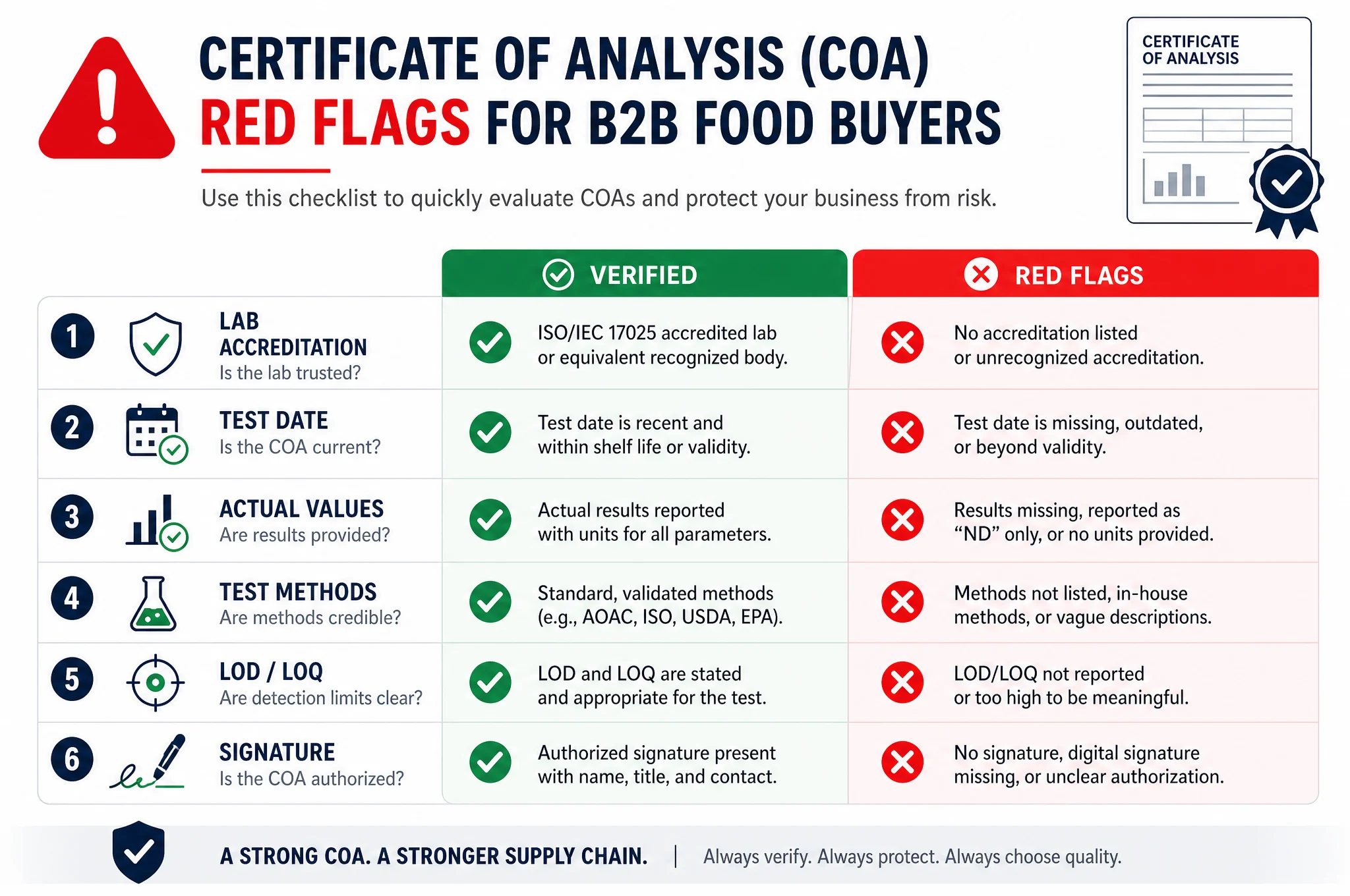
Un certificado de análisis (COA) es el documento más importante en la adquisición de matcha entre empresas (B2B). Pero no todos los COA son iguales. Esto es lo que compruebo y lo que suele suponer un escollo para los compradores:
Lo que debe incluir un certificado de origen válido:
- Nombre del laboratorio y acreditación — La acreditación ISO/IEC 17025 es imprescindible. Laboratorios como Eurofins, SGS, Bureau Veritas e Intertek son fiables. Un certificado de análisis (COA) expedido por el laboratorio interno de un proveedor no es verificable de forma independiente.
- Fecha de ensayo y número de lote — Debe coincidir con el envío que vas a recibir
- Resultados concretos de las pruebas con unidades — No “aprobado” ni “dentro de los límites”, sino cifras concretas (p. ej., “Plomo: 0,04 mg/kg”)
- Métodos de ensayo a los que se hace referencia — ICP-MS para metales, HPLC para plaguicidas y aminoácidos, métodos ISO para micro
- Límite de detección (LOD) y límite de cuantificación (LOQ) — Si el laboratorio indica “ND” (no detectado) sin especificar el LOD, el resultado carece de sentido.
- Firma y sello — De un representante autorizado del laboratorio
Señales de alerta con las que me he topado:
- Fechas del COA anteriores a 6 meses en el caso del lote que se va a enviar: es posible que el polvo proceda de una tanda de producción diferente
- Expresión genérica “cumple con la norma” en lugar de valores reales de las pruebas: se trata de una plantilla, no de un resultado de prueba
- Falta por completo la sección sobre metales pesados — algo habitual en los certificados de análisis (COA) de proveedores que no han invertido en análisis mediante ICP-MS
- Panel de plaguicidas que incluye solo entre 3 y 5 compuestos — Un comité adecuado debería analizar más de 100 plaguicidas para comprobar el cumplimiento de la normativa de la UE
- Humedad superior a 6% — indica un almacenamiento inadecuado o un producto caducado; el matcha se degrada rápidamente por encima de un 5% de humedad
- No hay datos sobre el tamaño de las partículas — Los proveedores de artículos ceremoniales de confianza siempre lo incluyen, ya que es su garantía de calidad.
Cumplimiento de la normativa FSVP para importadores estadounidenses: el proceso paso a paso
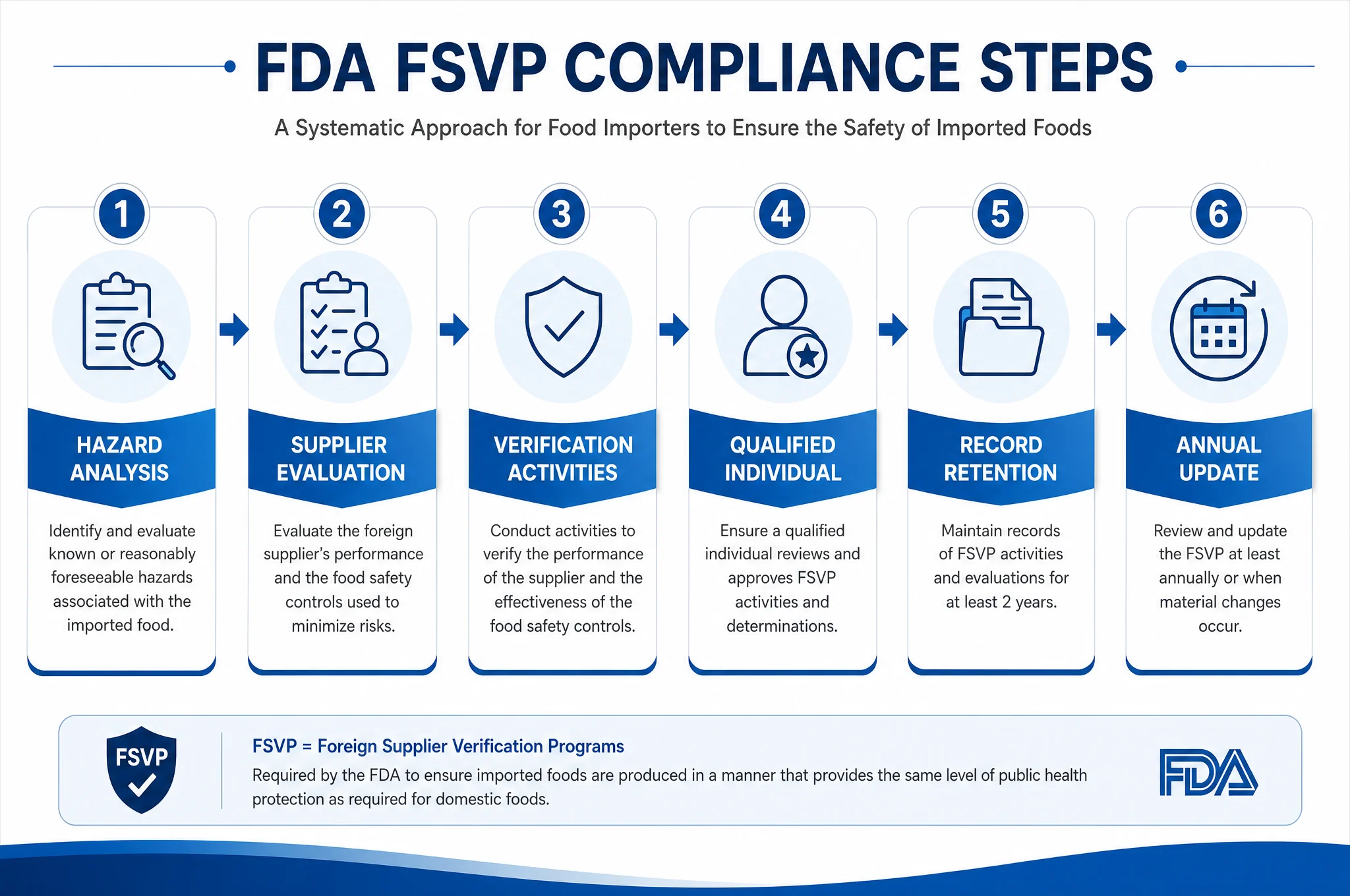
Si importas matcha a Estados Unidos, el cumplimiento del FSVP no es opcional, y es más complejo de lo que la mayoría de los importadores creen. Este es el procedimiento que recomiendo:
Paso 1: Realizar un análisis de riesgos Documenta todos los riesgos conocidos o razonablemente previsibles relacionados con el matcha: metales pesados, residuos de plaguicidas, contaminación microbiana, radiación (cesio-134/137 en el caso del matcha de origen japonés) y contaminantes físicos.
Paso 2: Evalúa a tu proveedor extranjero Revisa las certificaciones de seguridad alimentaria del proveedor (FSSC 22000, BRCGS, HACCP), su historial de cumplimiento (cartas de advertencia de la FDA, alertas de importación) y el entorno de seguridad alimentaria en Japón (en general, excelente: Japón se encuentra entre los orígenes de té más seguros).
Paso 3: Elige las actividades de verificación
- Auditoría in situ (preferible): Visitar las instalaciones una vez al año o cada dos años; comprobar el cumplimiento de las buenas prácticas de fabricación (GMP), el plan de HACCP, el control de plagas, las condiciones de higiene y las capacidades del laboratorio.
- Revisión del COA: Obtener y revisar los certificados de análisis (COA) de cada envío; comprobar la acreditación del laboratorio y que el panel de análisis esté completo
- Pruebas periódicas: Envía tus propias muestras a un laboratorio independiente con sede en EE. UU. entre una y dos veces al año para realizar una verificación cruzada
Paso 4: Designar a una persona cualificada Esta persona debe haber completado la formación sobre el FSVP (los cursos reconocidos por la FDA están disponibles a través de la AFDO y otros proveedores) y debe figurar en sus registros del FSVP.
Paso 5: Llevar un registro Conserve todos los análisis de riesgos, evaluaciones de proveedores, informes de auditoría, certificados de análisis (COA) y registros de medidas correctivas durante un mínimo de dos años. La FDA puede solicitar estos registros en cualquier momento durante una inspección.
Paso 6: Actualizar anualmente Reevaluar los riesgos y el rendimiento de los proveedores al menos una vez al año. Documentar cualquier cambio en los procesos de los proveedores, los nuevos resultados de las pruebas o los cambios normativos (como la obligación prevista en la sección 122 de 2026).
La Propuesta 65, las pruebas de radiación y otros escollos en materia de cumplimiento normativo
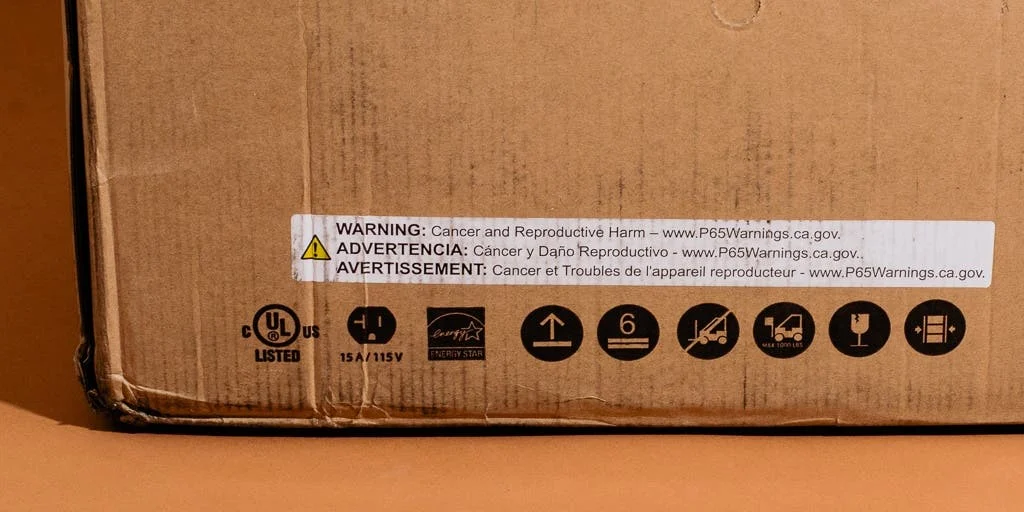
Propuesta 65 de California
Esto afecta a más marcas de matcha que cualquier otro problema de cumplimiento normativo. La Propuesta 65 de California exige que los productos que contengan sustancias químicas que se sabe que causan cáncer o toxicidad reproductiva lleven etiquetas de advertencia, y el plomo figura en dicha lista.
El nivel de seguridad para el plomo según la Propuesta 65 es de 0,5 μg/día (como dosis máxima permitida, o MADL). Una ración típica de matcha es de 1 a 2 gramos. Si el matcha contiene 0,1 mg/kg (100 ppb) de plomo, una ración de 2 gramos aporta 0,2 μg, lo que se encuentra claramente dentro del umbral de seguridad. Sin embargo, si el plomo se encuentra a 0,3 mg/kg, una ración de 2 gramos aporta 0,6 μg, lo que supera el umbral y requiere una advertencia conforme a la Propuesta 65.
Mi estrategia de pruebas para el cumplimiento de la Propuesta 65: Exigir a los proveedores que realicen análisis de plomo con un nivel igual o inferior a 0,1 mg/kg. A esa concentración, incluso una ración generosa de 3 gramos se mantiene dentro del límite de seguridad de 0,5 μg/día. Varias marcas conocidas de matcha incluyen actualmente advertencias de la Propuesta 65, lo que indica que sus niveles de plomo superan los 0,25 mg/kg.
Pruebas de radiación tras el accidente de Fukushima
Japón exige controles de radiación para las exportaciones de té, concretamente análisis para detectar cesio-134 y cesio-137. El límite establecido por el Gobierno japonés es de 100 Bq/kg para los alimentos en general. Estos análisis se realizan de forma rutinaria desde 2011 y los resultados de los principales productores de Uji y Nishio muestran sistemáticamente niveles muy por debajo de los límites de detección.
Qué hay que comprobar: Pide a tu proveedor su certificado de análisis de radiación más reciente. Debe proceder de un laboratorio reconocido por el Gobierno japonés y debe incluir tanto el Cs-134 como el Cs-137, con los resultados expresados en Bq/kg. Si el proveedor dice “no realizamos pruebas de radiación porque han pasado 15 años”, eso es una señal de alarma, no un motivo de tranquilidad. El requisito de realizar estas pruebas existe por una razón, y algunos compradores (especialmente en la UE y EE. UU.) lo solicitan expresamente.
Emiratos Árabes Unidos/Arabia Saudí — Nueva normativa sobre la indicación de alérgenos
A partir del 31 de diciembre de 2026, los nuevos productos que entren en los Emiratos Árabes Unidos y Arabia Saudí deberán incluir información obligatoria sobre alérgenos. Aunque el matcha en sí mismo no es un alérgeno, si tu matcha está mezclado con otros ingredientes (leche en polvo, azúcar, aromatizantes), el etiquetado de alérgenos deberá cumplir con los requisitos de la Organización de Normalización del CCG.
Realidad regional en materia de producción, precios y cadena de suministro
Saber de dónde procede el matcha es importante para la calidad, el precio y la fiabilidad del suministro. A continuación se presenta la situación actual de la producción de matcha en Japón para el periodo 2025-2026:
Principales regiones productoras
| Región | Característica | Posición de precio | Situación en 2025 | Lo mejor para |
|---|---|---|---|---|
| Uji (Kioto) | Origen histórico, molinos de piedra tradicionales | Premium (+30-60% por encima de la media) | Restricciones en el suministro debido a los daños climáticos previstos para 2025 | Marcas de lujo y de gala |
| Nishio (Aichi) | A escala industrial, con una calidad constante | Media del mercado | Suministro estable | Volumen B2B, café con leche/gastronomía |
| Kagoshima | Líder en volumen, mecanizado | Por debajo de la media (-20-30%) | Superó a Shizuoka como primer productor de té de primera cosecha #1 (8.440 frente a 8.120 toneladas) | Compradores B2B de gran volumen y sensibles al precio |
| Shizuoka | Región del sencha tradicional | Media | Transición de la producción de sencha a la de tencha | Suministro transitorio |
Precios de referencia (FOB Japón, 2026):
| Grado | Rango de precios (USD/kg) | Señal de alerta de falsificación |
|---|---|---|
| Tradicional/seleccionado a mano | $300-600+ | Por debajo de $250 |
| Ceremonia estándar | $100-250 | Por debajo de $120 |
| Ceremonia de bienvenida | $60-100 | Por debajo de $50 |
| Latte/premium | $40-70 | Por debajo de $35 |
| Culinaria | $25-45 | Por debajo de $20 |
Contexto del mercado mundial: El mercado del matcha se valoró en $4,55-4,95 mil millones en 2025 y se prevé que alcance los $7,5-9,1 mil millones para 2032-2034, con una tasa de crecimiento anual compuesto (CAGR) del 6-10%. La región de Asia-Pacífico representa entre el 50 % y el 60 % de la cuota mundial. Las exportaciones de té de Japón alcanzaron un récord de 29.2 mil millones de yenes en 2023, y las exportaciones reales de 2024-2025 han superado con creces las previsiones iniciales, alcanzando aproximadamente entre 36 y 72 mil millones de yenes debido al aumento de la demanda mundial. La superficie dedicada al cultivo de tencha a la sombra se ha ampliado considerablemente desde 2010, con un crecimiento anual de la producción del 7-8%.
Tu lista de comprobación de cumplimiento normativo para el matcha en el sector B2B
Antes de firmar cualquier contrato con un proveedor, comprueba los siguientes puntos:
Documentación (imprescindible para cada envío):
- [ ] Certificado de análisis (COA) expedido por un laboratorio acreditado según la norma ISO 17025
- [ ] Certificado de transacción ecológica (TC) correspondiente al lote específico
- [ ] Certificado GMP/HACCP/FSSC 22000 (del año en curso)
- [ ] Registros de trazabilidad que vinculan el lote con la explotación agrícola o la empresa transformadora
- [ ] Certificado de prueba de radiación (de origen japonés)
- [ ] Ficha de datos de seguridad (FDS) / Ficha técnica
Verificación de la calidad (prueba a la llegada):
- [ ] Distribución del tamaño de las partículas (difracción láser)
- [ ] Medición del color según el sistema CIELAB (valor a* inferior a -14 para uso ceremonial)
- [ ] Contenido de L-teanina (HPLC)
- [ ] Análisis de metales pesados (ICP-MS: plomo, cadmio, arsénico)
- [ ] Panel de residuos de plaguicidas (más de 100 compuestos para el mercado de la UE)
- [ ] Análisis microbiológico (TPC, E. coli, Salmonella, levaduras y mohos)
Cumplimiento normativo (específico de cada mercado):
- [ ] EE. UU.: Documentación del FSVP completa; obligación prevista en el artículo 122 calculada
- [ ] UE: LMR verificados con respecto a los umbrales de 2026 (clotianidina/tiametoxam a 0,05 mg/kg para el té, Reglamento 2023/334)
- [ ] California: Nivel de plomo inferior a 0,1 mg/kg para acogerse a la exención de la Propuesta 65
- [ ] Japón: Se confirma el cumplimiento del sistema de lista positiva
- [ ] Oriente Medio: Obligación de indicar los alérgenos (a más tardar el 31 de diciembre de 2026)
Preguntas frecuentes
¿Qué certificaciones se necesitan para el comercio internacional del matcha?
Las exportaciones de matcha requieren una combinación de certificaciones de calidad (JAS Organic, USDA Organic o EU Organic para las declaraciones de producto ecológico) y certificaciones de seguridad alimentaria (FSSC 22000, BRCGS o HACCP). Cada envío debe incluir un certificado de análisis expedido por un laboratorio acreditado según la norma ISO 17025 y un certificado de transacción (TC) de productos ecológicos. Los importadores estadounidenses también deben disponer de la documentación que acredite el cumplimiento del FSVP.
¿El matcha de “calidad ceremonial” es una norma regulada?
No. “Clasificación ceremonial” es un término de marketing sin definición regulatoria en Japón, EE. UU. o la UE. La referencia más cercana es ISO/TR 21380:2022, que define el tamaño de partícula y el método de producción de matcha pero no establece clasificaciones de grado. Los compradores deben verificar la calidad a través de parámetros objetivos: tamaño de partícula (D50 de 5-10 µm para ceremonial), contenido de L-teanina (>2%) y valores de color CIELAB (a* por debajo de -14).
¿Cómo se analiza el matcha para detectar metales pesados?
El método estándar es el ICP-MS (espectrometría de masas con plasma acoplado inductivamente), que detecta plomo, cadmio, arsénico, mercurio y aluminio a niveles de partes por mil millones. El matcha japonés suele presentar niveles de plomo de entre 0,03 y 0,12 mg/kg y de cadmio de entre 0,01 y 0,035 mg/kg. Dado que el matcha implica el consumo de toda la hoja molida (y no solo de una infusión), los análisis de metales pesados son obligatorios para cumplir con la normativa de seguridad alimentaria.
¿Cuál es el requisito del FSVP para los importadores de matcha?
El Programa de Verificación de Proveedores Extranjeros (FSVP), en el marco de la FSMA, exige a los importadores estadounidenses que: (1) realicen un análisis de peligros específico para el matcha, (2) evalúen las prácticas de seguridad alimentaria del proveedor extranjero, (3) lleven a cabo actividades de verificación anuales (auditorías, revisión de los certificados de análisis o análisis), (4) designar a una persona cualificada con formación en el FSVP, y (5) conservar los registros durante dos años. La FDA ha intensificado la aplicación del FSVP desde 2024.
¿Cuáles son los límites de residuos de plaguicidas de la UE para el matcha en 2026?
La UE aplica un límite máximo de residuos (LMR) por defecto de 0,01 mg/kg para las sustancias no autorizadas, de conformidad con el Reglamento (CE) n.º 396/2005. A partir del 7 de marzo de 2026, los LMR de la clotianidina y el tiametoxam se redujeron a 0,05 mg/kg específicamente para el té y los granos de café (Reglamento (UE) 2023/334), mientras que para el resto de categorías de alimentos se redujeron a 0,01 mg/kg. Los análisis previos al envío, realizados con arreglo a los LMR de la UE —y no a las normas nacionales japonesas—, son esenciales para el matcha destinado a la UE.
¿Por qué algunas marcas de matcha incluyen advertencias relacionadas con la Propuesta 65 de California?
Las advertencias de la Prop 65 aparecen en los productos de matcha que contienen más de 0,5 μg de plomo por ración diaria. Dado que una ración habitual es de 1 a 2 gramos, esto significa que el contenido de plomo del matcha supera aproximadamente los 0,25 mg/kg. Los compradores pueden evitar las advertencias de la Propuesta 65 exigiendo a los proveedores que realicen análisis que demuestren un contenido de plomo igual o inferior a 0,1 mg/kg, lo que mantiene incluso una ración generosa de 3 gramos dentro del nivel de seguridad.
Resumen
El abastecimiento de matcha para el sector B2B es tanto una cuestión de cumplimiento normativo como de calidad. Las normas existen —la norma ISO/TR 21380:2022 para la identidad del matcha, los laboratorios acreditados según la norma ISO 17025 para los análisis, las certificaciones JAS, USDA y UE para las declaraciones de producto ecológico, y el FSVP para las importaciones a EE. UU.—, pero nadie las hace cumplir en tu nombre. Cada declaración de “calidad ceremonial” debe verificarse mediante datos sobre el tamaño de las partículas y el contenido de L-teanina. Cada logotipo ecológico requiere un certificado de transacción válido. Y cada envío necesita un certificado de análisis (COA) de un laboratorio de confianza.
Según mi experiencia, los compradores que evitan problemas son aquellos que elaboran sus propias fichas técnicas, exigen métodos de ensayo específicos (ICP-MS para metales, HPLC para aminoácidos) y auditan a los proveedores en persona al menos cada dos años. El marco normativo es cada vez más estricto: los cambios en los LMR de la UE para 2026 (0,05 mg/kg para los neonicotinoides en el té), el arancel temporal de la Sección 122 de EE. UU. y el aumento de las medidas de control de la FDA apuntan todos en la misma dirección. Si tu documentación de cumplimiento normativo es sólida hoy en día, ya vas por delante de la mayor parte del mercado.