
Japan’s matcha supply chain is under structural — not cyclical — stress. Tea farm numbers have collapsed 77% since 2000, over 70% of remaining farmers are aged 65+, and new plantings won’t yield usable tencha until 2029–2030. First-flush 2025 tencha prices rose 160% in Kyoto, and 2026 auctions show no relief. Global demand continues to outpace premium-grade supply — industry estimates place the gap at several thousand tonnes annually, though the total is partly offset by China’s rapidly expanding output. For procurement teams, the critical questions are: how long will this last, where else can you source, and what does it cost to hedge now versus wait.

The Scale of the Problem: Three Numbers That Define 2026
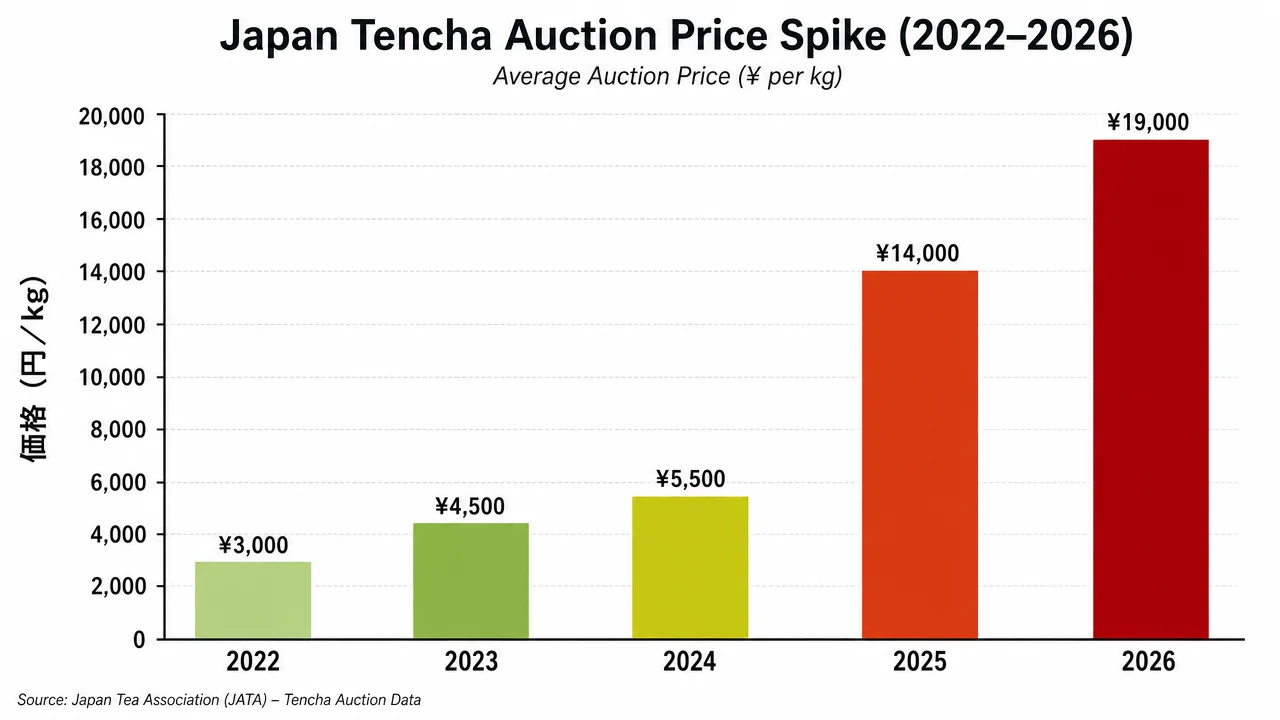
Japan produced 5,336 tonnes of tencha in 2024 — nearly triple the 2010 volume — yet premium-grade supply still falls far short of what the world wants. China now produces over 12,000 tonnes of matcha annually (~70% of global supply), but the vast majority is food-service and culinary grade. The premium Japanese ceremonial-grade market remains severely constrained, and that is where prices have exploded. This is not a blip from a bad harvest. It is a multi-year structural divergence between a product the world increasingly wants and an agricultural system in Japan that is contracting faster than it can expand.
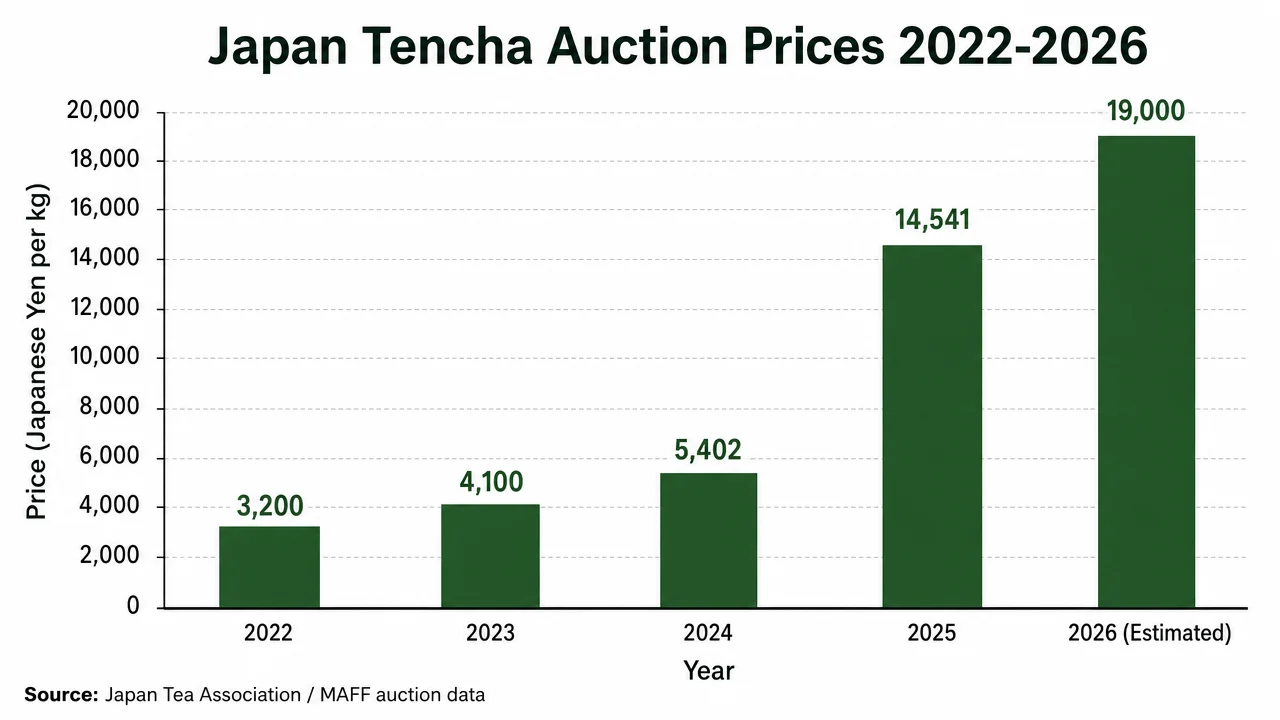
The price signal confirms this: Kyoto first-flush machine-harvested tencha moved from ¥5,500/kg in 2024 to ¥14,333/kg in 2025 — a 160% increase in twelve months. Uji hand-picked tencha went from ¥20,024/kg to ¥43,330/kg, up 116%. In Kagoshima, first-flush 2026 auction prices opened near ¥19,000/kg. These are not rounding errors. They reflect a market where buyers are competing for allocation, not just price.
For B2B buyers — whether you’re sourcing ceremonial grade for a premium brand, culinary grade for a supplement line, or food-service grade for a café chain — the underlying dynamic is the same: the supply you relied on in 2022 and 2023 no longer exists in the same form, at the same price, or on the same lead time.
Why Japan Can’t Just Grow More Tencha
The phrase “structural shortage” gets used loosely. In the case of Japanese tencha, it is precise.
The demographic collapse is irreversible on any near-term horizon. Japan had 53,687 tea farms in 2000. By 2015, that number had fallen to 19,603. By 2024, it had reached approximately 12,000 — a 77% decline over two decades. More than 70% of remaining farmers are aged 65 or older. Fewer than 1,500 active tea farmers in Japan are under 49. The industry has not modernized its labor model; high-quality matcha remains predominantly hand-picked and stone-ground. There is no mechanization path that replicates the quality characteristics of hand-harvested Uji tencha at scale.
Tea acreage has shrunk 29% in the past decade. Land not in production doesn’t just sit idle waiting to come back. Abandoned tea fields require years of rehabilitation. New plantings from 2024–2025 will not reach production-ready maturity until 2029–2030 under best-case conditions.
Climate stress has compounded the labor problem. The 2023–2025 period brought record-breaking heatwaves across Japan’s main tea-growing prefectures. The 2025 first-flush fell 10–20% nationally. In Kyoto, hand-picked tencha — the highest grade — declined approximately 40% year-on-year. These are not isolated weather events layered on top of a healthy system; they are shocks hitting an already weakened production base.
The inventory buffer is gone. For years, the industry maintained a strategic reserve of aged tencha that smoothed year-to-year variability. That buffer was exhausted during the 2024 shortage. There is no cushion left.
The result: supply cannot respond to price signals the way commodity markets typically expect. A 160% price increase hasn’t triggered a meaningful supply response because the constraints — farmer age, land attrition, bush maturation timelines — are not price-elastic on a 1–3 year horizon.
The Hidden Bottleneck: Processing Capacity
Most coverage of the matcha shortage focuses on raw tencha leaf — and that scarcity is real. But there is a second constraint that procurement teams need to understand: milling infrastructure.
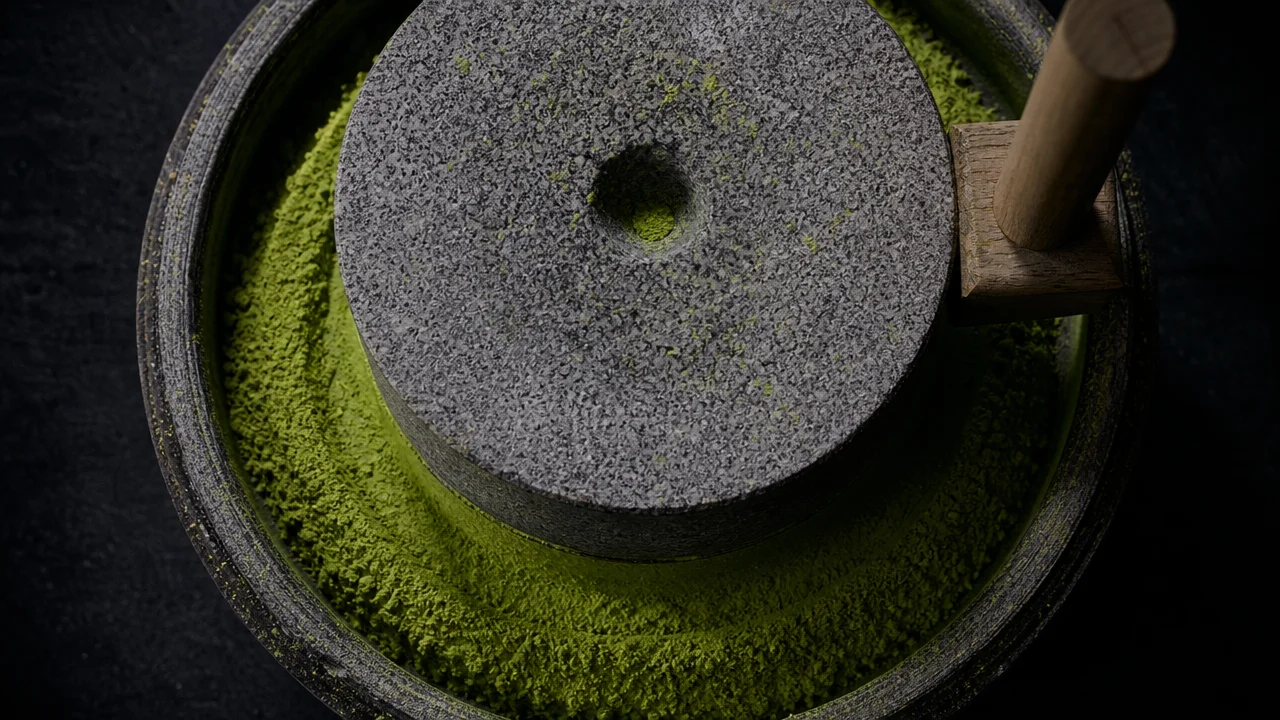
Even when tencha leaves exist, converting them into matcha requires stone mills that run slowly by design. Authentic stone-milled matcha produces roughly 40 grams per mill per hour. Facilities cannot simply add throughput overnight. Capital investment cycles for new milling equipment run 2–4 years. This means that even as Japanese producers attempt to expand tencha acreage, finished matcha output will lag behind raw leaf availability by a further cycle.
For buyers, this has a practical implication: a supplier telling you “the harvest was fine this year” does not automatically mean your allocation is secure. The milling step is its own allocation bottleneck.
Region-by-Region Supply Risk
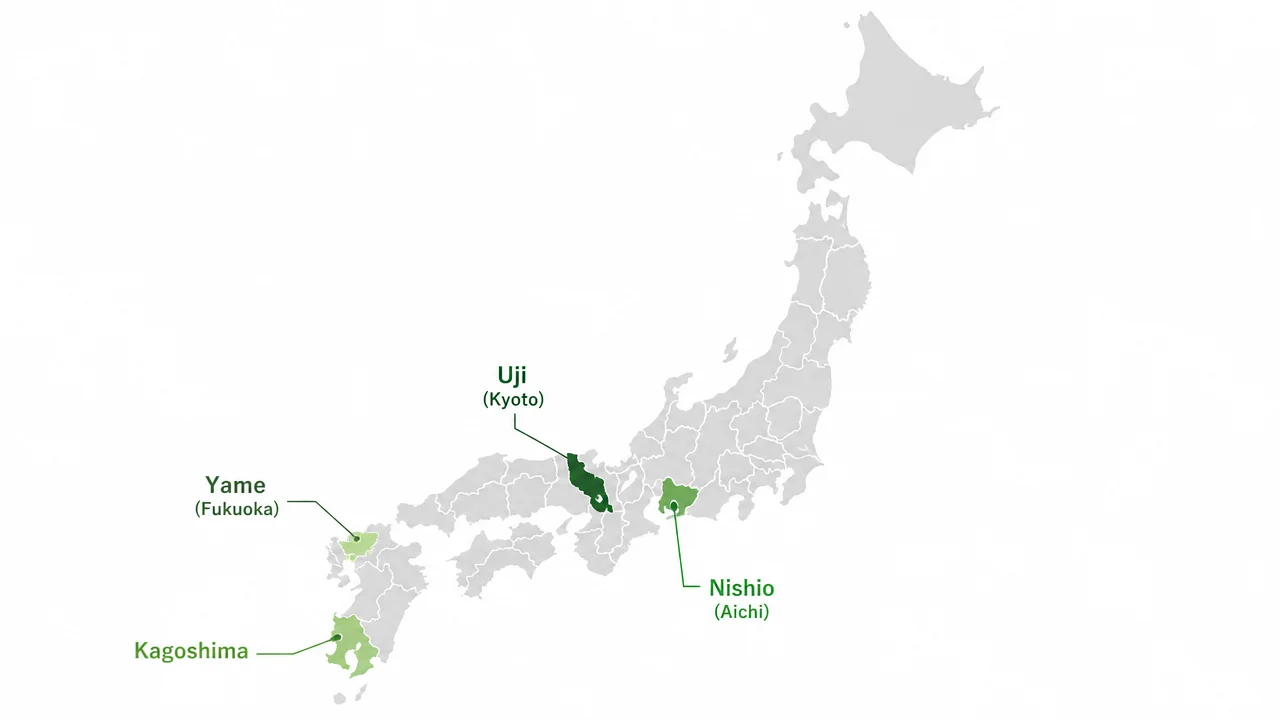
Not all Japanese matcha is equally constrained. Understanding the regional landscape helps procurement teams target their sourcing conversations.
| Région | Primary Grade | 2025 Price Trend | Key Risk Factor |
|---|---|---|---|
| Uji (Kyoto) | Ceremonial, premium | +116% (hand-picked) | Labor scarcity most acute; 40% first-flush decline |
| Nishio (Aichi) | Ceremonial to mid-grade | Elevated, data less public | Strong domestic buyer competition |
| Kagoshima | Culinary to food-service | ~¥19,000/kg (2026 auction) | Machine-harvested, higher volume but also surging |
| Yame (Fukuoka) | Prime | Elevated | Smaller volume, niche premium market |
| Shizuoka | Mostly sencha; limited tencha | Indirect pressure | Labor demographic same as national |
The key implication: Uji ceremonial grade is effectively a constrained luxury market. Procurement teams sourcing for food-service or culinary-grade applications have more flexibility to look at Kagoshima or non-Japanese origins without significant product degradation for their end use case.
The China Question: When It’s an Option and When It Isn’t
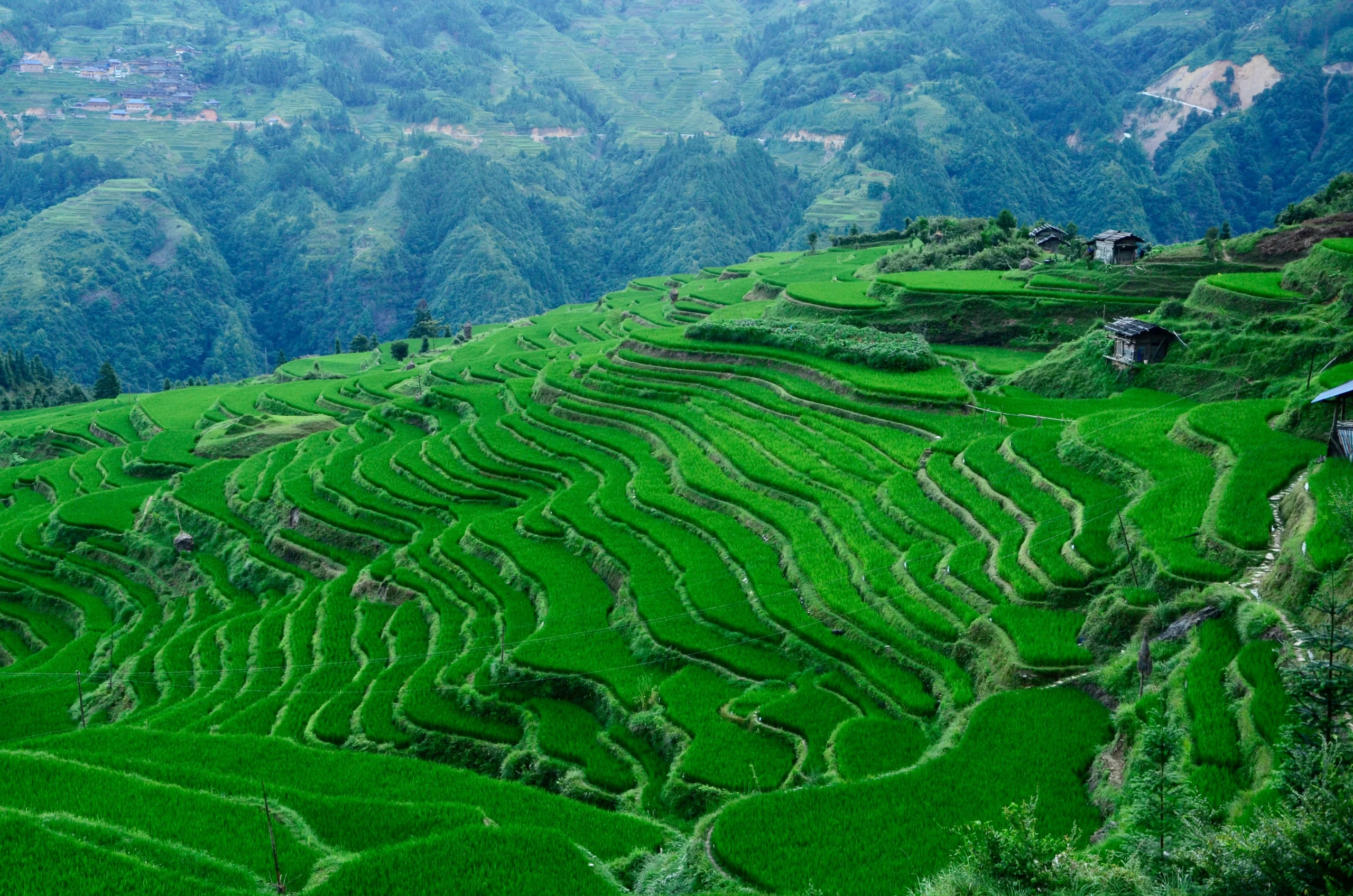
China is now the world’s largest matcha producer by volume. Output exceeded 12,000 tonnes in 2025 — roughly 70% of global matcha production, according to the China Tea Marketing Association. Guizhou and Hubei provinces are the primary production centers, and producers such as Guitea Group (贵茶集团) have begun exporting tencha to Japan directly.
The price differential is real: Chinese industrial-grade matcha runs $15-35/kg versus Japanese equivalent at $40–70/kg — a 30–50% cost advantage.
When Chinese-origin matcha is a viable option:
- Food-service applications (lattes, bakery, confectionery, RTD beverages) where end consumers don’t differentiate origin
- Supplement and nutraceutical products where active compound levels (EGCG, L-theanine) are controlled through specification
- Culinary applications where matcha is a flavoring ingredient, not a centerpiece
When it is not a direct substitute:
- Premium ceremonial-grade products where origin is part of the brand proposition
- Products that explicitly market Japanese origin as a differentiator
- Any application where shading duration, cultivar, and stone-milling method are part of your quality spec
The compliance barrier is non-trivial. Japan’s Positive List system subjects imported tea to over 800 pesticide residue tests at a 0.01ppm MRL (maximum residue limit) — one of the strictest food safety regimes globally. Any buyer importing Chinese-origin tencha into Japan, or any brand sourcing from China that sells into Japan-sensitive markets, needs pre-shipment verification through an accredited third party such as SGS or Bureau Veritas. This is not optional compliance theater; it is a real operational requirement that adds cost and lead time.
Vietnam, South Korea, and Myanmar are viable for lower-grade culinary applications. Sri Lanka, India, and Kenya currently lack the infrastructure, cultivars, and shading protocols for commercial matcha volumes.
What Buyers Are Actually Experiencing in 2026
From conversations across the procurement landscape, the pattern is consistent:
Lead times have extended from 2–3 weeks to 4–6 weeks for standard wholesale orders. For first-flush ceremonial grade, allocation windows are now set in January–February, not at time of order. Suppliers who haven’t been asked to hold allocation are being reallocated to existing accounts. New buyers entering the market are told to expect 3–6 month onboarding delays before meaningful volume is available.
Ito En, Japan’s largest tea company, raised prices on 51 matcha and green tea products in September 2025 — matcha lines up 48.8–100%, green tea leaves up 3.3–50%. Coca-Cola Japan raised prices on its Ayataka green tea brand in October 2025. When the domestic majors move this sharply, the price signal has moved well past the volatility phase and into structural repricing.
Some Tokyo specialty retailers implemented purchase limits — one canister per customer on premium ceremonial grades — a development almost unthinkable in normal years. Japan’s Minister of Agriculture made a public visit to a matcha café on April 9, 2026, explicitly endorsing government support for export destination diversification. When a cabinet minister is visiting matcha shops, the supply situation has reached national policy salience.
Three Scenarios for Tencha Prices Through 2027
No forecast here is certain — but having a scenario framework is more useful than assuming either a return to 2022 prices or permanent ¥40,000/kg tencha.
Base case (most likely): Prices remain elevated 30–60% above 2023 levels through end-2026 and into the 2027 first-flush. New plantings from 2024–2025 begin to add marginal supply by 2028. China-origin sourcing absorbs food-service demand, taking some pressure off Japanese supply. Japanese prices plateau but don’t collapse until labor/land constraints loosen — which requires demographic change that isn’t coming quickly.
Bull case for prices (worse for buyers): Another heat-event summer in Japan in 2026 further reduces the 2026 second-flush and the 2027 first-flush. Export demand continues accelerating into new markets (Middle East, Southeast Asia, Africa). Prices extend gains above 2025 peaks. Chinese supply absorbs volume demand but not premium-grade demand, which sees further price divergence.
Bear case for prices (better for buyers): Chinese tencha quality improves faster than expected; major global brands publicly adopt Chinese-origin culinary matcha, normalizing the supply narrative; global consumer spending on premium beverages softens; Japanese farmers receive meaningful government subsidy support that brings new acreage into production faster. Prices correct toward 2024 levels by late 2027.
The base case implies buyers should be negotiating annual supply contracts now, not waiting for prices to fall. The bull case makes the same argument more urgently. Only the bear case rewards waiting — and the structural fundamentals (77% farm decline, 70%+ farmers over 65) make the bear case the lowest-probability outcome.
A Procurement Decision Framework for 2026
Given the above, here is how to structure your sourcing decisions:
If you are sourcing ceremonial or premium grade:
- Lock annual contracts before the 2026 second-flush window closes. Waiting for 2027 first-flush pricing is a high-risk bet.
- Establish relationships with at least two Japanese regional suppliers across different prefectures (e.g., one Uji source, one Nishio or Kagoshima source).
- Build 90–120 days of inventory buffer. The previous 30-day buffer is inadequate at current lead times.
If you are sourcing culinary or food-service grade:
- Conduct a serious China-origin evaluation now. The $15–35/kg vs $40–70/kg differential is too large to ignore if your application doesn’t require Japanese origin.
- Factor in Japan Positive List compliance costs when modeling China-origin landed cost. The gap narrows but does not close.
- Pilot a China-origin batch with your product formulation team before committing volume — L-theanine and EGCG profiles vary.
If you are a brand with mixed grade needs:
- Consider a split strategy: Japanese-origin ceremonial for your flagship SKUs, Chinese or mixed-origin culinary for your volume products.
- Document your origin specification clearly so your procurement team has a written quality standard, not an informal preference. This matters when your primary supplier requests a substitution.
In all cases: single-source procurement carries elevated risk in 2026. The industry consensus has shifted to multi-origin diversification, and that shift reflects operational reality, not supply chain fashion.
FAQ
What is tencha and why does it matter for matcha supply?
Tencha is the shaded tea leaf that is dried, destemmed, and stone-ground to produce matcha. It is the raw material upstream of every bag of matcha powder. A shortage of tencha is a shortage of matcha — there is no other input. Unlike sencha or gyokuro, tencha is not a commodity traded across multiple product categories; it exists almost entirely to become matcha.
Is the matcha shortage getting worse in 2026?
By most measures, yes. First-flush 2026 auction prices in Kagoshima opened near ¥19,000/kg; Kyoto auctions confirmed continued price elevation. The structural causes — farm decline, aging farmers, climate stress — have not reversed. Supply is expected to remain constrained through at least mid-2026 before any marginal improvement from new plantings becomes visible.
Will matcha prices drop in 2027?
Unlikely to return to 2022–2023 levels. New plantings from 2024–2025 won’t reach full yield until 2029–2030. The most realistic outlook is prices plateauing at 30–60% above pre-2025 levels, with modest downward pressure from Chinese supply absorbing culinary-grade demand. A meaningful correction requires either a demand slowdown or a China-origin quality upgrade that shifts premium buyer behavior — neither is imminent.
Can Chinese matcha replace Japanese matcha?
For culinary and food-service applications, yes — it already is, at scale. China produced approximately 5,000 tonnes of tencha in 2025. For ceremonial grade and brands where Japanese origin is a marketing differentiator, no. Chinese-origin tencha currently lacks the cultivar diversity, shading protocols, and stone-milling tradition that define the flavor and quality ceiling of top Japanese matcha. The gap is narrowing, not closing.
How do I verify Chinese-origin matcha meets food safety standards?
Pre-shipment testing against Japan’s Positive List is the standard for Japan-market compliance. SGS and Bureau Veritas both offer accredited matcha residue testing programs. For non-Japan markets, EU MRL thresholds and US FDA import requirements apply. Insist on certificates of analysis (COA) per lot, not per supplier — batch variability in Chinese agricultural supply is real.
Conclusion: This Is a Structural Shift, Not a Spike
The matcha supply chain is not experiencing a bad year. It is completing a structural transition that has been building for two decades. Japan’s tea farm base has contracted by 77%. The workforce is aging out faster than it is being replaced. Climate events are hitting a system with no remaining buffer. And global demand is accelerating into markets that didn’t exist five years ago.
The buyers who navigate this well in 2026 and 2027 will be the ones who treat matcha procurement the way they’d treat any constrained specialty agricultural commodity: with diversified sourcing, forward contracts, origin-specific quality specifications, and enough inventory buffer to absorb a delayed shipment without a production shutdown.
The buyers who wait for prices to “normalize” to 2022 levels are likely to be waiting until at least 2029 — and paying a premium for the privilege of staying flexible.